What is your glass worth, and why?
Researched valuation of antique and art glass: cameo, cut crystal, iridescent, pressed, mid-century and Chinese. Makers' marks, condition, and cited comparable sales.
Glass is worth what comparable pieces by the same maker, or of the same kind, have recently sold for, and in glass the maker's name, the technique and an unchipped rim are most of the argument. The written report names the maker or the attribution with a confidence level and the reasons, says how the piece was made and what condition the photographs allow it to judge, cites comparable sales with lot, price and venue, and compares the routes to a sale.
In February 1845 a young man who had been drinking for several days walked into the British Museum, picked up a piece of sculpture and threw it at the case holding the Portland Vase, a Roman cameo-glass vessel made within a generation of the emperor Augustus. It broke into about two hundred pieces. It has been put back together three times since, most recently in 1989, and it remains the most important piece of glass in Britain. That is the first thing to understand about glass: it is the one major material that a child, a cat or a careless duster can destroy in a second, and that nobody can afterwards put right. Condition is not one factor in a glass valuation. It is the gate every other factor has to pass through.
The second thing is that glass is chemistry, and the chemistry dates it. In 1674 George Ravenscroft, a London merchant, patented a new crystal glass and within two years had perfected it with lead oxide: heavier, softer, slower to cool, and with a brilliance that a cut edge turned into fire. English lead crystal became the glass of the Georgian table, and Parliament taxed it by weight from 1745, which made it thinner; the tax did not reach Ireland until 1825, which is why Waterford and the Cork glasshouses were founded in 1783 and why the heavy cut glass of the Regency is called Irish whether it is or not. When the duty came off in 1845 the cutters went to town, and the Great Exhibition of 1851 had a crystal fountain twenty-seven feet high. Half a century later the fashion turned entirely: Émile Gallé at Nancy made layered glass carved and etched down to the picture, signed in the glass itself, and after he died in 1904 the factory added a star to that signature for a decade, so that the signature on a Gallé vase is a date as much as a name. A great deal of the 'Gallé' in the world today was made in Romania in the 1990s and marked 'Tip', the Romanian for 'type', in letters small enough to grind off.
The humbler truth is that the glass in most families is a cut-glass decanter with a stopper from a different decanter, a pressed bowl from the 1930s, a Murano fish from a 1960s holiday, and the wedding crystal, and each of these has a market, if a modest one. The sleepers are real but specific: an iridescent vase bought as 'carnival glass' that turns out to be Loetz, a Lalique car mascot in a drawer, a paperweight from the classic French factories of the 1850s, a Whitefriars vase in the one colour collectors fight over. This page tells you what we look at, what moves the figure, and what the written report covers when you upload photographs. Comparable prices come from the auction record and the specialist trade.
A piece of glass is worth what comparable pieces of the same maker, technique, colour and condition have recently sold for, and each of those words hides a question. Can the maker be named, and does the piece say so, in a signature cut or etched into the glass, a moulded mark, a label, or only in its style? Was it blown and cut by hand, carved through layers of colour, or pressed in a mould by the thousand? Is it a colour or a pattern that collectors want? And is it whole?
The answers spread the glass people actually own across four orders of magnitude. A pressed bowl from between the wars is worth tens of pounds or dollars, whatever its colour. A Georgian decanter, a good piece of Victorian cut glass or a signed 1930s pressed figure runs from a hundred into the low hundreds. Signed art glass from the great factories, Daum, Gallé, Lalique, Loetz, Tiffany, Orrefors, runs from the high hundreds into the thousands and tens of thousands depending on the piece. The rarest techniques and the named designers' masterpieces go from there into six figures.
The maker is the lever. Condition is the brake, and it is a hard one.
What changes the price
Six things matter, in roughly this order.
The maker comes first, and with it the question of how the piece says who made it. The great art-glass houses signed in the glass: Gallé and Daum in cameo or engraving, Lalique moulded or wheel-cut, Orrefors engraved with the designer's initials and a model number. Loetz, by contrast, left most of its glass unsigned, as did the English and Bohemian houses before 1900, Whitefriars used only paper labels, and Murano has always sold on a foil sticker that falls off in the first wash. So most glass is attributed on its form, its colour and its technique, and the report says 'attributed to' and gives a confidence level when that is the honest position. A mark on a silver mount is a date for the mount, not the glass. A signature that is right for the maker but wrong for the date, or that sits where that maker never signed, is a warning.
Condition comes second and in glass it is unforgiving. A chip to a rim cannot be filled; it can only be ground away, which shortens the piece and shows to anyone who measures it. A crack is permanent and usually halves the figure or worse. 'Bruises', the small internal clouds left by a knock, count as damage. Decanters go cloudy from years of wine and water, the trade calls it sick, and the cloud is etching in the glass that only a polisher can remove. Worn gilding and tarnished mounts are lesser faults, and a stopper that is not the original is a real one.
Technique comes third. Hand-blown glass carries a pontil scar on the base, rough or polished out; pressed glass carries the seams of its mould and edges that feel soft under the thumb; cut glass has edges that feel sharp. Cameo glass was either carved on the wheel, which took weeks, or etched with acid, which took hours, and the difference is a multiple of the price. Engraving, enamelling, casing, threading, lustre and the internal decoration of the Swedish and Venetian factories each have their own scale and their own collectors.
Colour and pattern come fourth. The same Lalique model is worth several times more in opalescent than in clear glass; the same Davidson bowl is worth more in one cloud colour than another; a Whitefriars vase in an ordinary colour is a decorative object and in a rare one is a collector's piece. A pattern that appears in the factory's catalogue or its design books is one that can be named and dated, and a name is a price.
Completeness comes fifth. A decanter with its own stopper, a set of twelve rather than nine, a pair rather than one, a lidded piece with its lid, a casket with its key, a piece in its original box: each is worth more than the parts would suggest. Pairs are worth more than two singles, and sets collapse in value as soon as they are incomplete.
Fashion comes sixth, and in glass it has moved a long way. Victorian cut glass and the wedding crystal of the 1960s to 1990s are out of favour and sell cheaply by the box. Art Nouveau and Art Deco glass sell strongly; mid-century Scandinavian and Italian design have risen for twenty years; studio glass by named makers is a market of its own. The report prices your piece in the market as it is, and says which way that market has been moving.
Kinds of glass, and what to look for in each
These are the kinds of glass that come to us most, with the questions a specialist asks of each. The caption under each photograph is the estimate from that report; the full report, with its sales and its reasoning, opens from the picture.
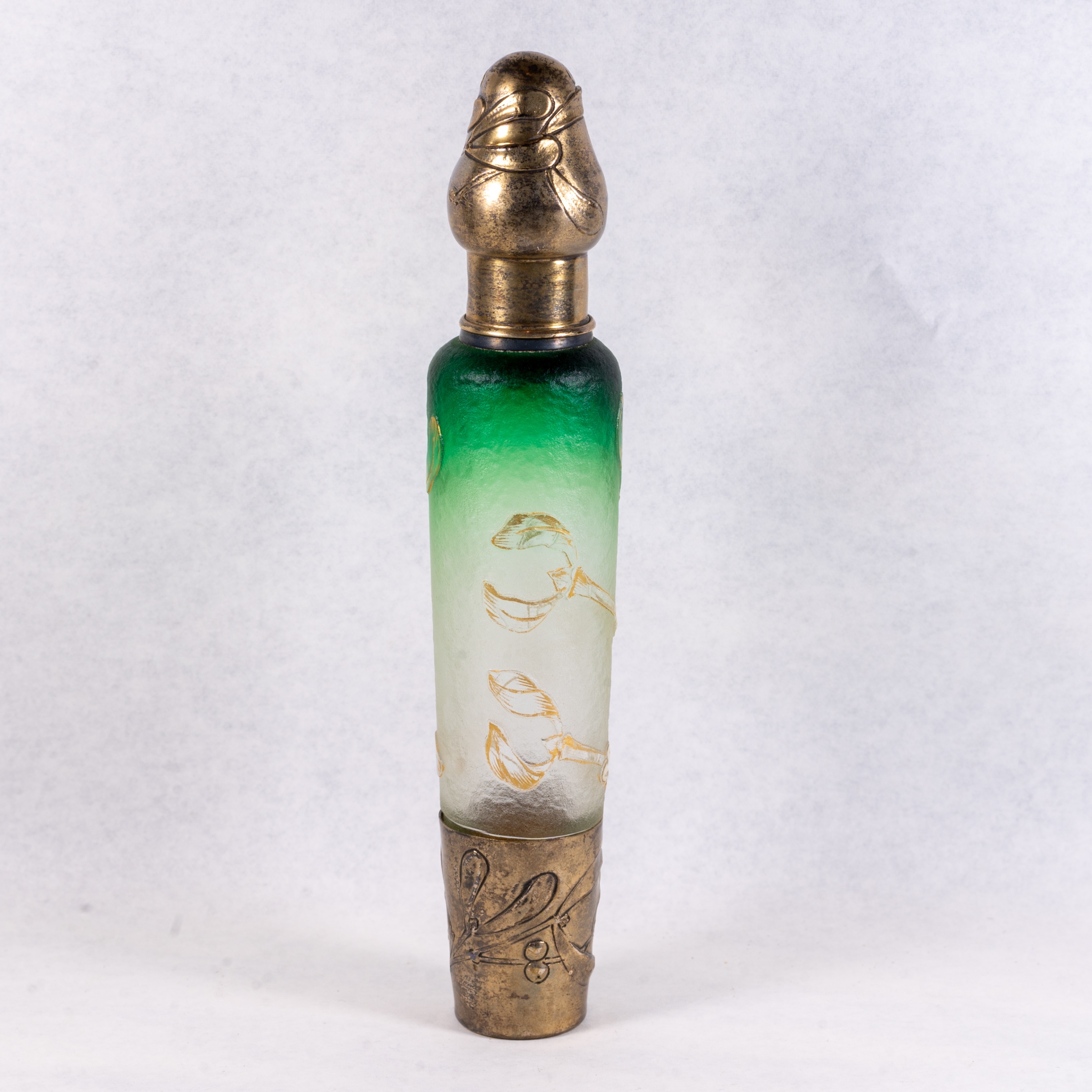
Cameo and art glass of the Art Nouveau years. From about 1890 to 1914 the glasshouses of Nancy, Gallé, Daum, Muller, and of Paris, Legras, Saint-Louis, made glass in layers of colour and cut or etched the outer layers away to leave a picture standing in relief: landscapes, flowers, insects, mistletoe at Christmas. The English houses, Thomas Webb above all, did the same in white on a coloured ground. This is the glass most worth getting right, because the difference between a signed, wheel-finished piece and an acid-etched production piece of the same year is a multiple, and the difference between either and a modern reproduction is everything.
What to look for: the signature, which the factories put in the glass itself, in cameo or engraved, and which the scanner enlarges and compares with how the house signed in that period; the layers, visible at a chipped or ground edge; the quality of the carving under magnification, since wheel work shows facets and acid work does not; and the mounts, where a silver-gilt cap or base carries its own hallmark and its own silversmith. What raises value: a signature the record confirms, a rare subject or colour, wheel-carving, an unusual form, and the mounts intact. What lowers it: worn gilding, a replaced cap, an acid signature in the wrong place, and the word 'Tip'.
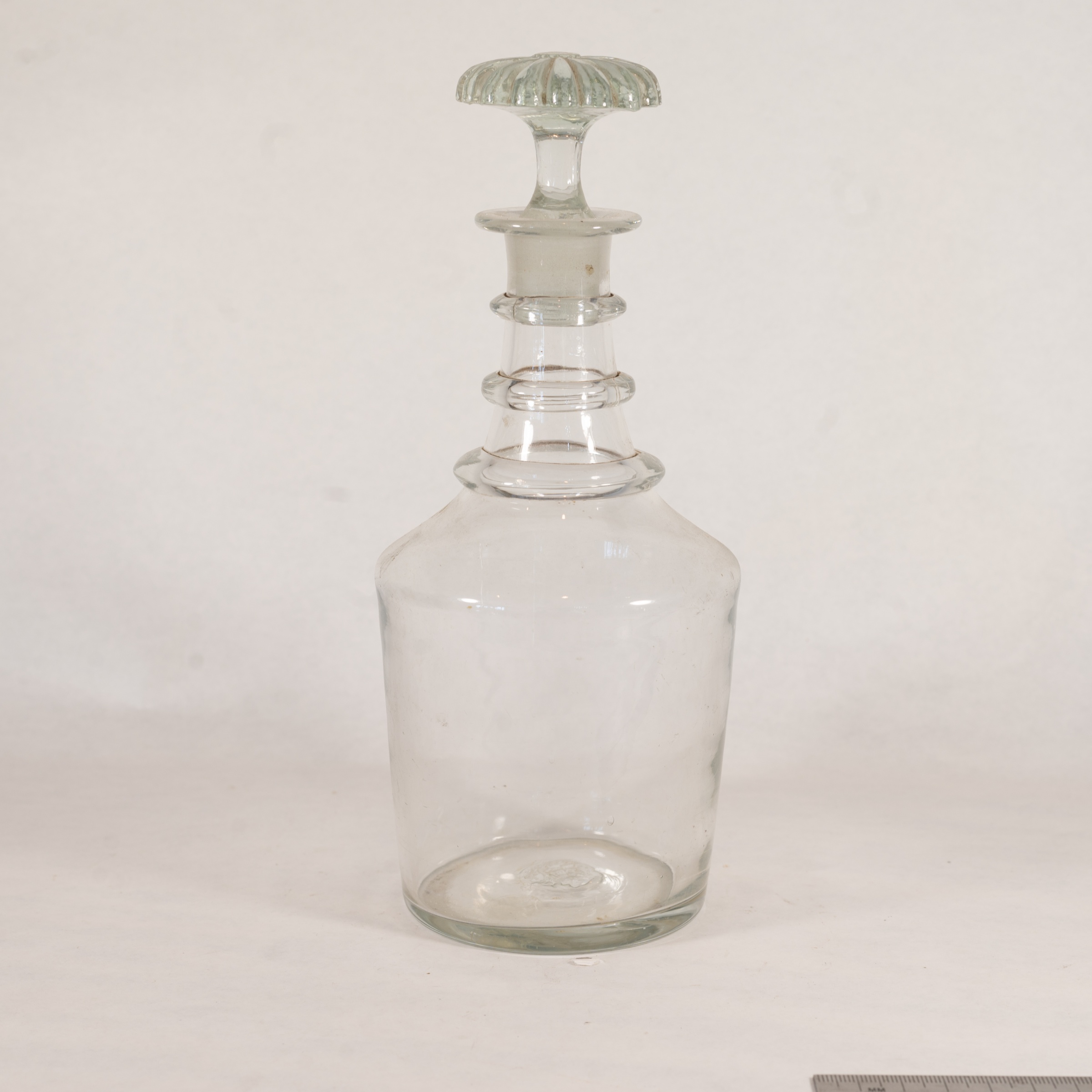
Georgian and Regency table glass. Decanters, wine glasses, rummers, finger bowls and salts, blown in lead crystal between about 1720 and 1830 and cut or engraved by hand, with the rough or polished scar of the pontil rod underneath. It is the most common genuinely old glass in British and Irish houses, and the surprise for most owners is how modestly it sells: a good plain decanter of 1820 costs less than a modern one, because so many survive and so few people now decant. The exceptions are specific, and a specialist knows them: eighteenth-century wine glasses with air-twist, opaque-twist or colour-twist stems, Jacobite and other engraved political glasses, and the rare marked Irish pieces.
What to look for: the pontil scar and the wear around it; the neck rings and the shape, which date a decanter to within a decade; a moulded mark on the base, since a few Irish houses, Cork and Waterford among them, marked their decanters; and whether the stopper fits the neck and matches the cutting. What raises value: a twist stem, an engraved subject, a maker's mark, a pair, an untouched stopper. What lowers it: cloudiness inside, a ground-down rim, a stopper from another decanter, and the ordinary fact of being a plain decanter in a market that has thousands.
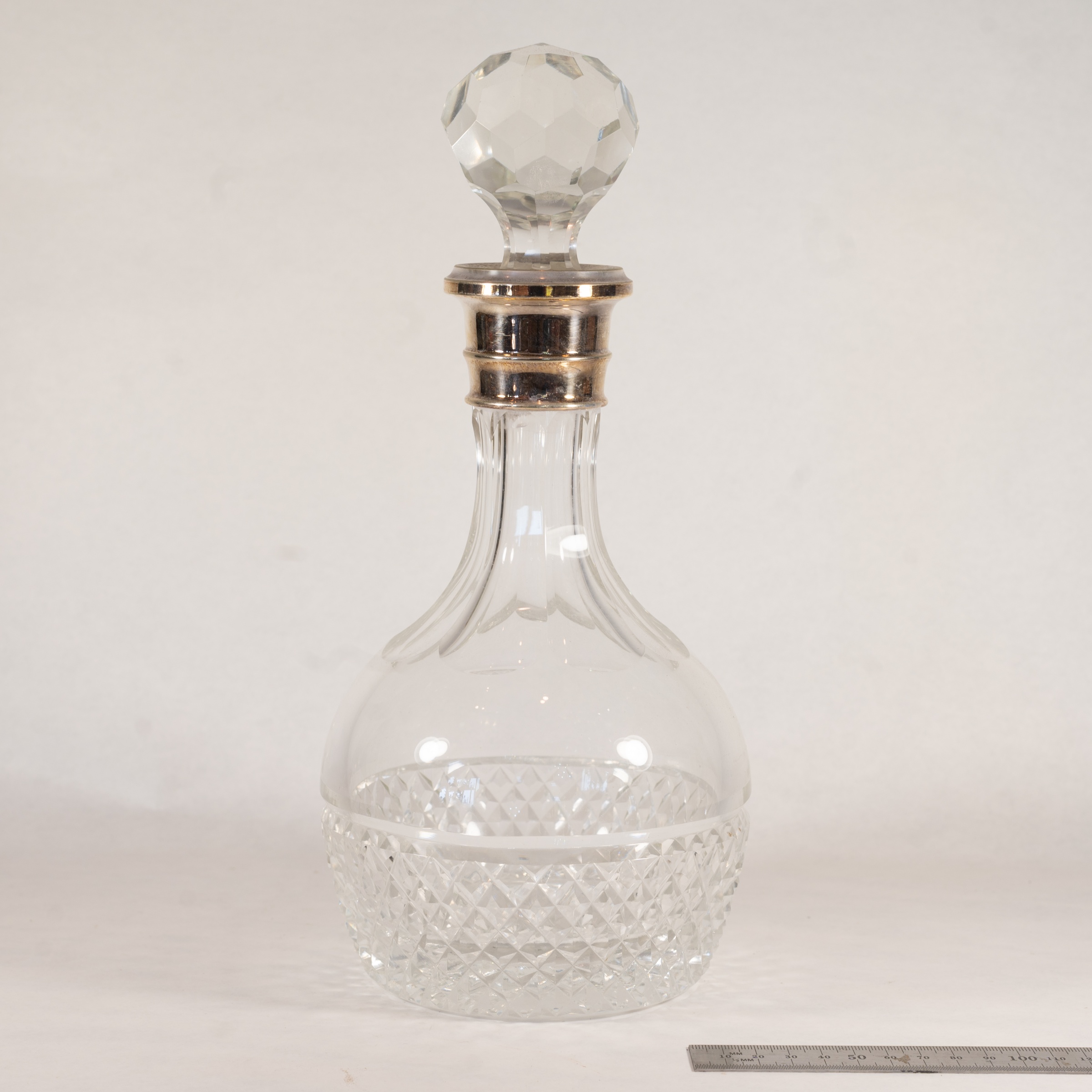
Victorian cut glass and the crystal that followed it. When the glass duty came off in 1845 the English factories cut deeper and heavier than anyone had before, and the great Stourbridge houses, Webb, Stevens & Williams, Richardson, made the glass of the Victorian sideboard: hobnail, strawberry diamond, fan and star, on decanters, claret jugs, bowls and centrepieces. The twentieth century kept the look going, at Waterford after its revival in 1947, at Stuart, Tudor, Edinburgh and Royal Brierley, and sold it as the wedding present of three generations. There is a great deal of it, and it sells for a fraction of what it cost. A silver collar or a silver-plated mount adds a hallmark, which dates the mount exactly, and adds very little money.
What to look for: the sharpness of the cutting under the thumb, since pressed imitations feel soft; the acid-etched mark on the base that the modern factories used; the hallmark on any collar; the stopper. What raises value: a documented Stourbridge maker, rock-crystal style engraving, intaglio work by a named engraver, and complete suites of a pattern. What lowers it: chips to the cutting, ground rims, a cloudy interior, and the pattern being a common one, which is usually the case.
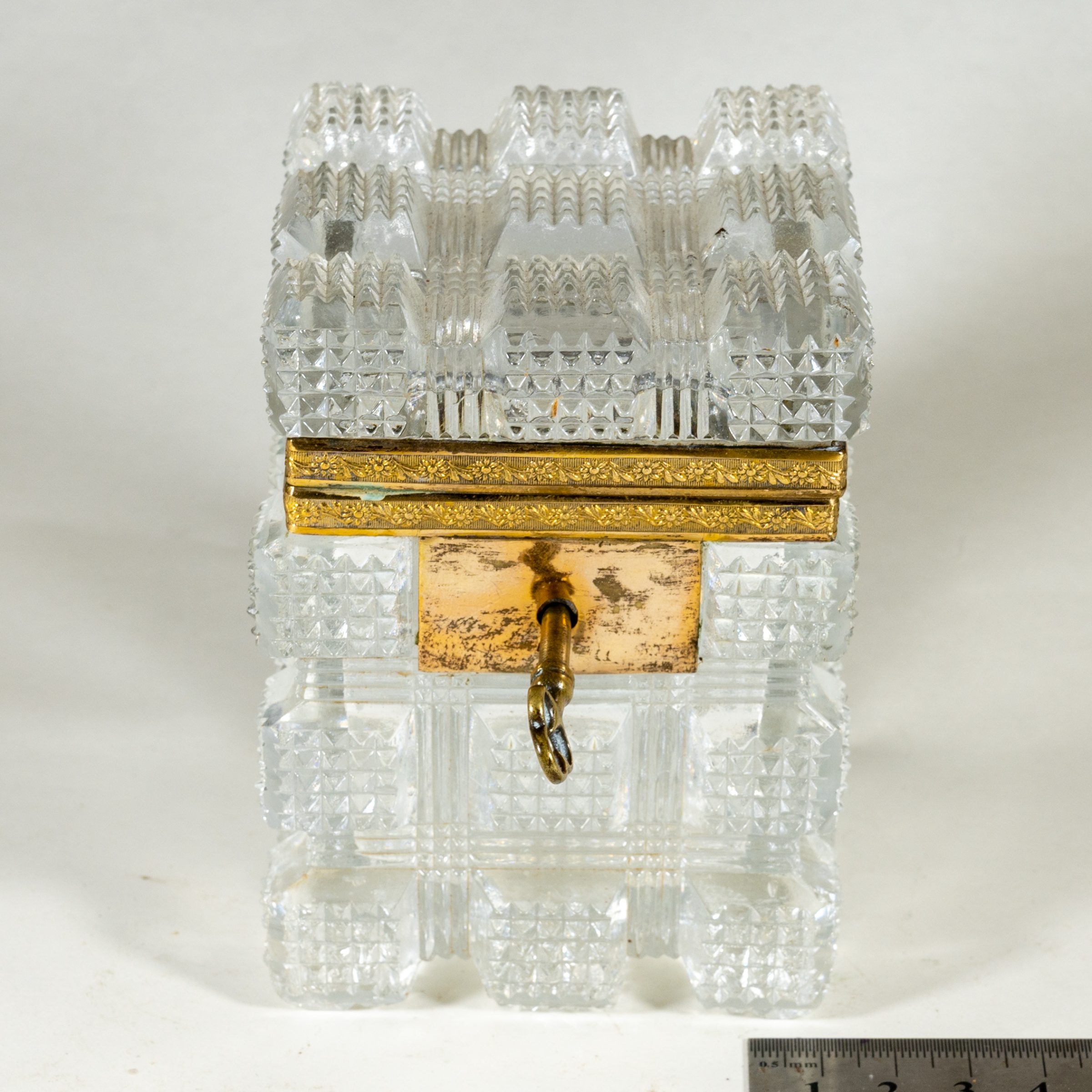
Mounted glass: ormolu, silver and plate. The French of the Restoration and the July Monarchy mounted cut crystal in gilt bronze, caskets, tazzas, salts, inkstands, and the Victorians and Edwardians mounted everything in silver and electroplate: claret jugs, biscuit boxes, sweetmeat dishes, scent bottles. The trick with mounted glass is that it is two objects. The mount can be dated and sometimes named from its marks; the glass is judged on its own, and the question is whether the two were born together. A crystal casket whose ormolu has worn to the bronze is an honest antique; a fine glass body in a later plated mount is a marriage.
What to look for: the marks on the metal, since French silver carries a guarantee mark and a maker's lozenge, English silver a date letter, and plate a maker's stamp; the fit of the mount, which should sit as if made for the glass; scratched assembly numbers under the foot, which show a piece was fitted by hand; the key, the lock, the liner. What raises value: an attributable glasshouse, Baccarat above all, a named silversmith, original gilding, a pair. What lowers it: re-gilding, worn plate, a replaced liner, and a mount that does not fit.
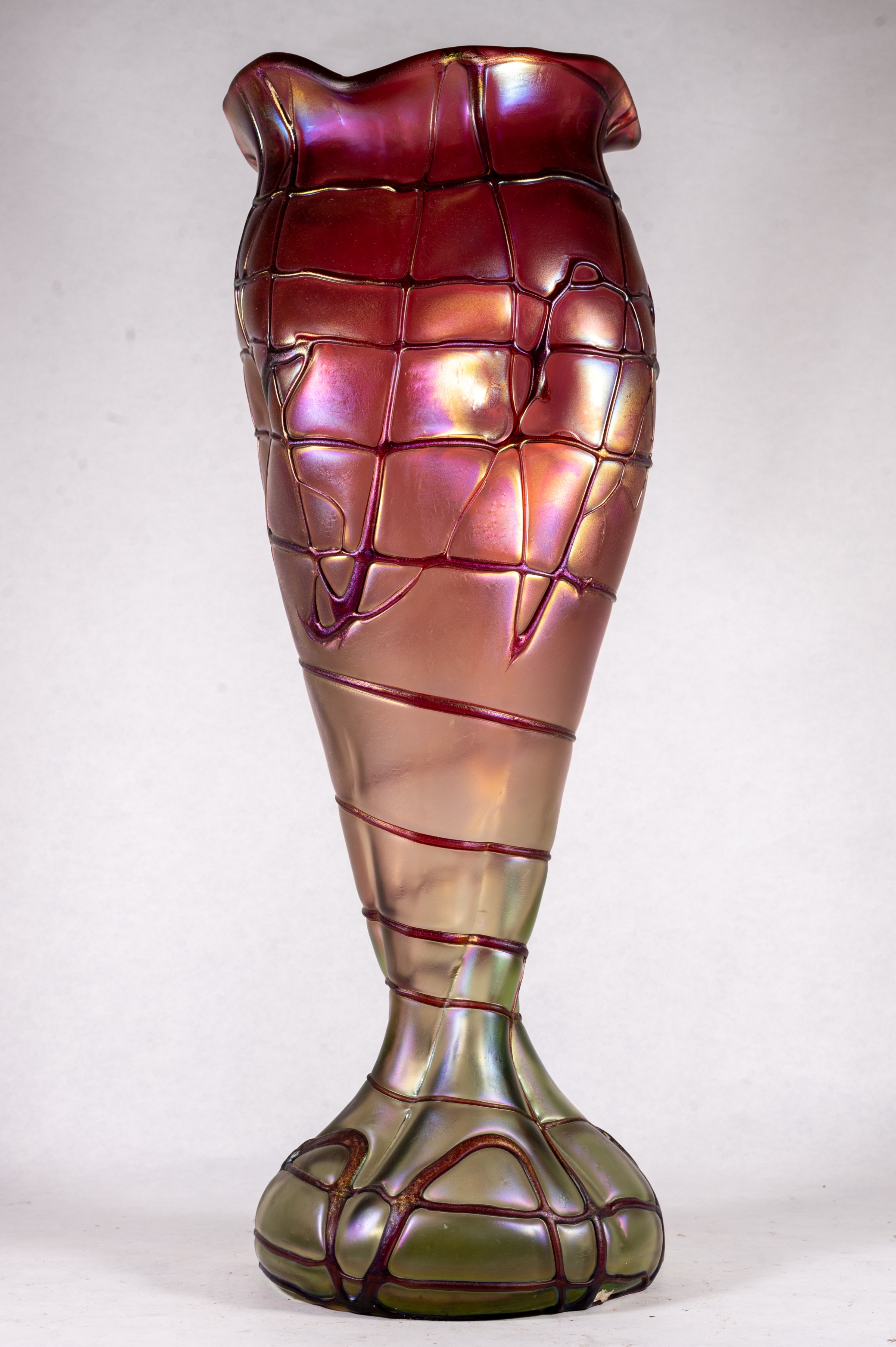
Iridescent glass of the Art Nouveau years. Tiffany in New York and Loetz in Bohemia made glass that shimmers like oil on water, and a ring of Bohemian neighbours, Kralik, Pallme-König, Rindskopf, made their own versions by the thousand, with trailed threads, pinched rims and lustre in cranberry, olive and gold. Almost none of it is signed: Loetz signed little beyond what it exported to America, and the neighbours signed almost nothing. So the whole field runs on attribution, by form, by the way the threads were applied, by the colour of the body glass, and the gap between 'Loetz' and 'attributed to Kralik' is often tenfold on pieces that look alike.
What to look for: the base, where a polished pontil and the particular colour of the ground glass speak for a factory; the decoration, since each house had its own repertoire of threading and pattern; and any damage, because these thin-walled pieces crack at the base and at the rim and a crack is the end of the collector's price. What raises value: a documented Loetz decor, a signed Tiffany Favrile, a large or unusual form, a silver or bronze mount from the period. What lowers it: a crack, a chip to a ruffled rim, dull or worn iridescence, and the plain fact that most of it was made in volume.
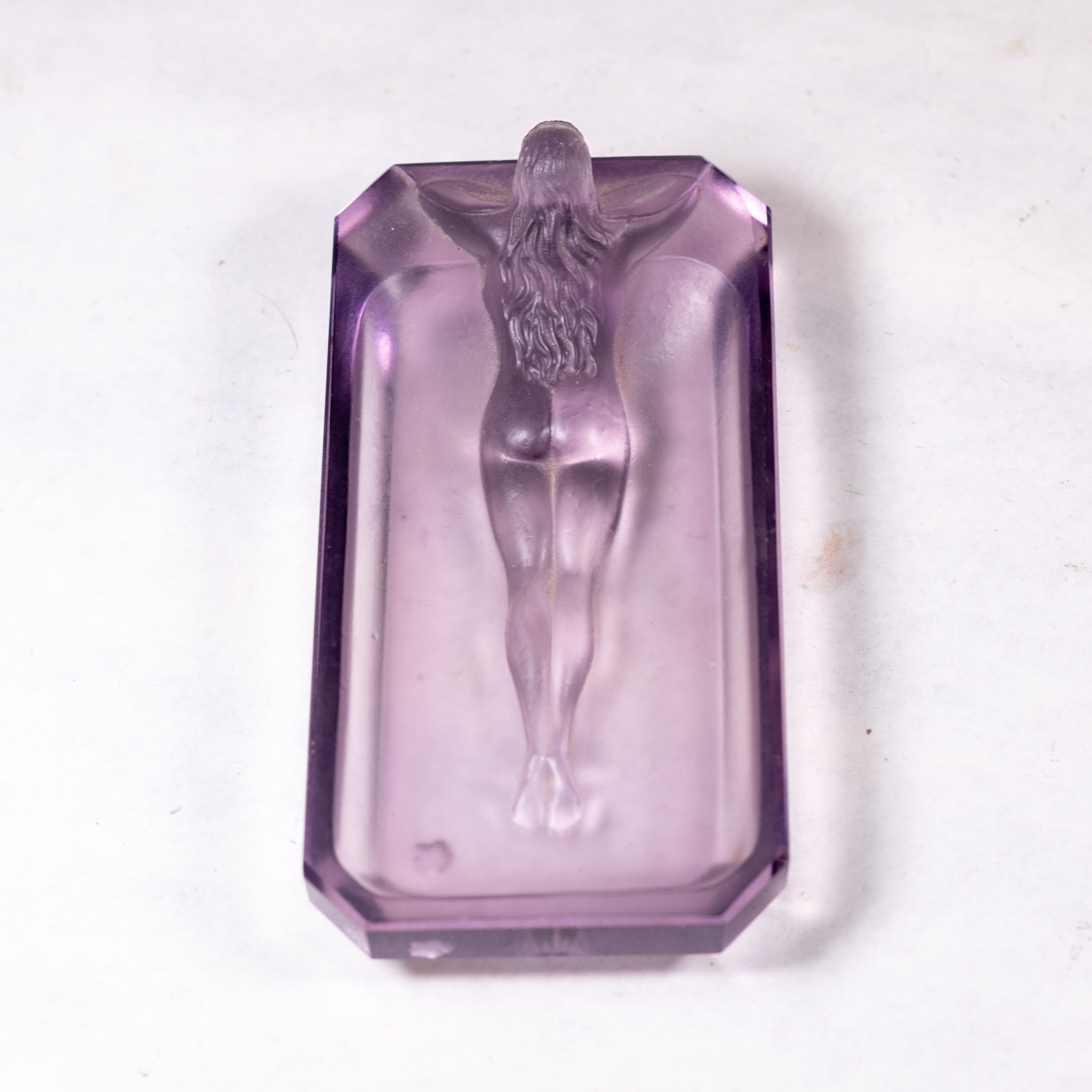
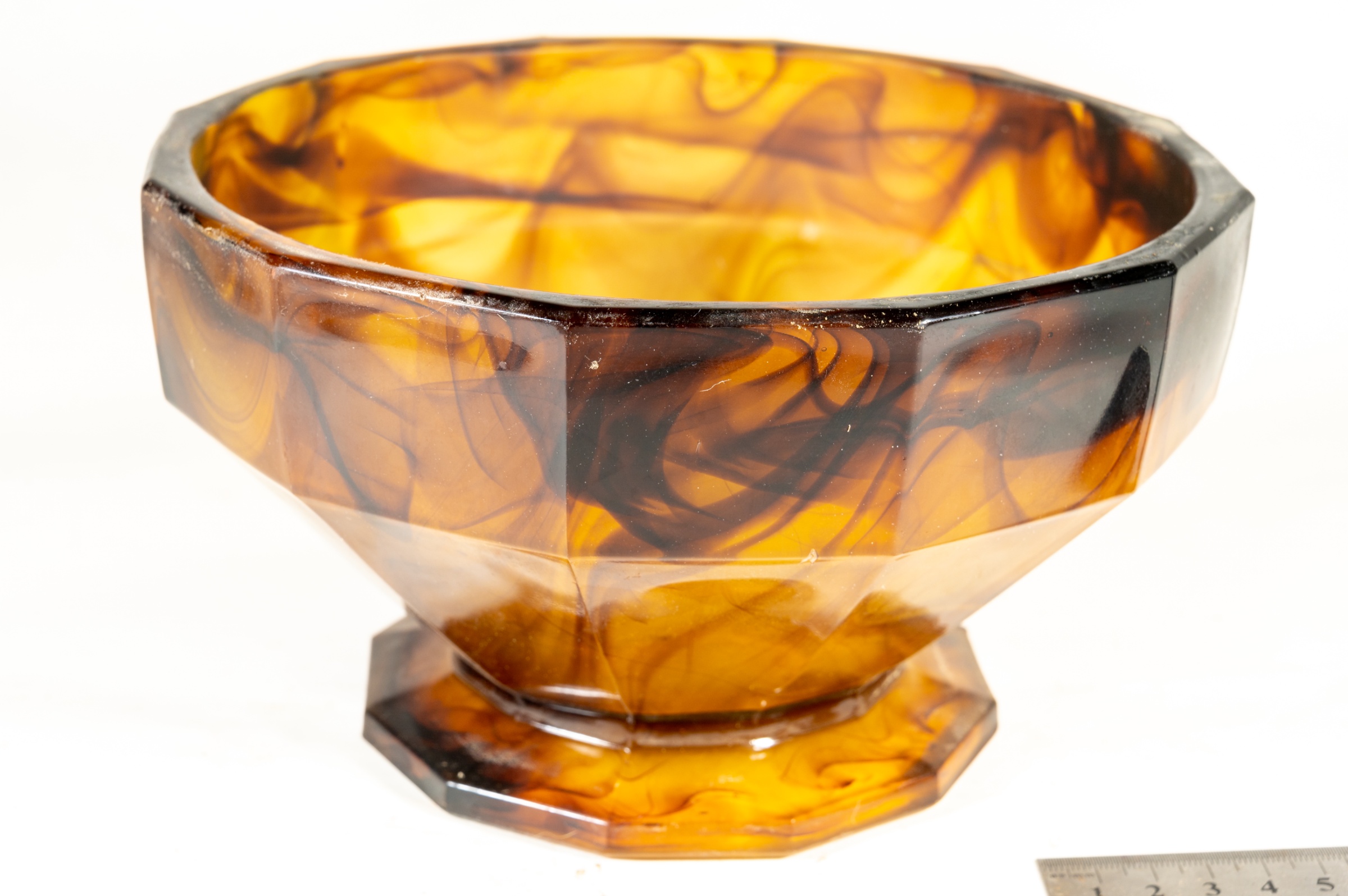
Pressed and moulded glass between the wars. Lalique made pressing an art, with a mould so good it carried a signature, and the trade followed: Sabino and Etling in Paris, Hoffmann and Schlevogt in Bohemia with their nudes in amethyst and malachite glass, and the English pressed-glass houses of the north-east, Davidson, Sowerby, Jobling, Bagley, whose 'cloud glass' and frosted figures furnished every sideboard of the 1930s. American Depression glass is the same story on a larger scale. It is the commonest inherited glass of all, and the honest news is that most of it is worth tens of pounds, with sharp exceptions for the best Lalique models, the rare colours, and the pieces that still have their stands, lids and frogs.
What to look for: the moulded mark, since Lalique, Hoffmann's butterfly and the English registration numbers were all in the mould; mould seams and the crispness of the detail, because a worn mould made a soft casting; the colour, which is the main variable; chips to the corners and the base. What raises value: an opalescent Lalique in a sought-after model, a rare cloud colour, a complete flower set with its frog, a pattern that the catalogues name. What lowers it: chips, a sun-bleached colour, a crack through the base, and the ordinary patterns, which were made by the ton.
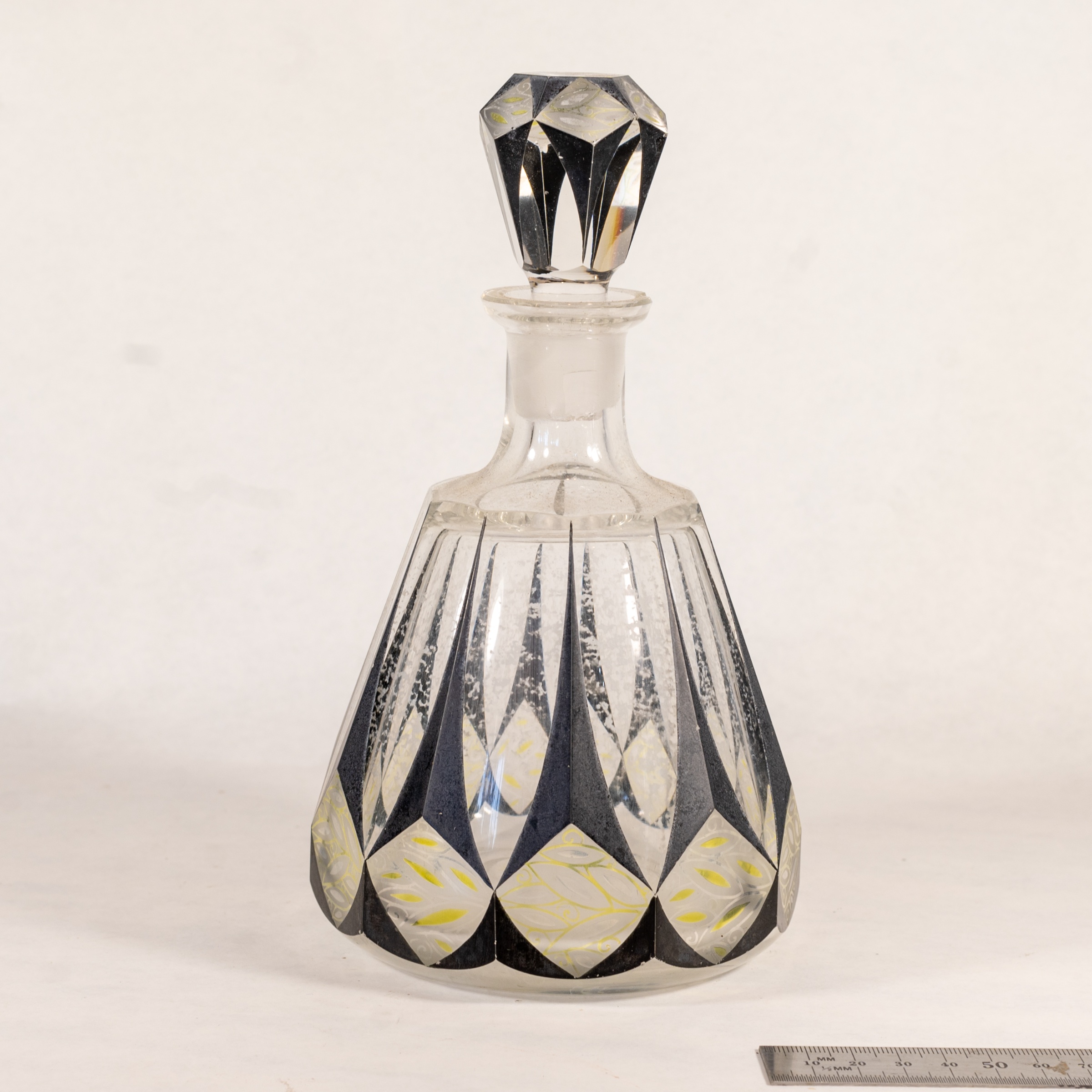
Bohemian cut and enamelled glass. The glass region of northern Bohemia, Haida, Steinschönau, Gablonz, produced cut, engraved, enamelled and gilt glass for the whole of Europe for three centuries: nineteenth-century ruby and overlay goblets, Moser's gilded and engraved crystal, the geometric black and yellow enamels of the 1930s that Karl Palda made famous, and the spa glass that every tourist brought home. Much of it is unsigned, and the attribution rests on the decoration, which the factories recorded in pattern books that the specialists know.
What to look for: the enamel, since cold-painted enamel flakes and fired enamel does not, and flaking is damage; the cutting under the enamel, which shows the quality of the blank; any acid-stamped or engraved mark, which Moser used and most others did not; the stopper on a decanter and the completeness of a set. What raises value: Moser, a named engraver, a documented Palda pattern, an intact set of decanter and glasses. What lowers it: flaking enamel, worn gilding, chips, and the thousands of spa souvenirs that look like something more.
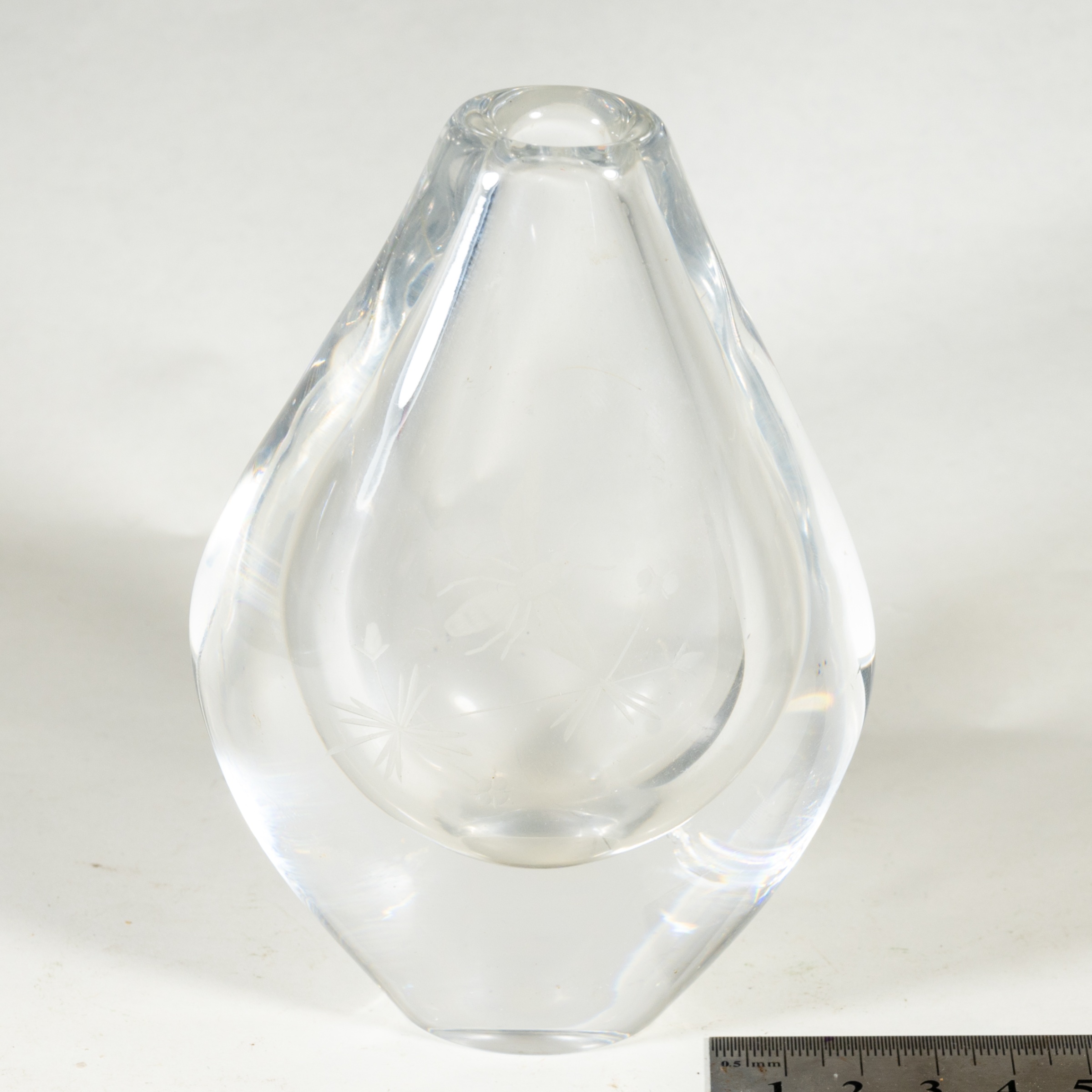
Mid-century and studio glass. From 1945 the design lead passed to Scandinavia, Orrefors, Kosta, Holmegaard, Iittala, Riihimäki, and to Murano, Venini, Barovier & Toso, Seguso, Cenedese, with Britain's Whitefriars and Caithness following. It is the glass of the 1950s to 1970s sideboard, and it has been the rising market of the last twenty years, which has brought with it a flood of unsigned lookalikes, unlabelled Murano, and 'in the style of'. The value lies in a name: a designer's engraved signature on a Swedish piece, a Venini acid stamp, a Whitefriars shape and colour that the catalogue confirms. Without one, a handsome decanter is priced as a handsome decanter.
What to look for: the base, where the Swedish factories engraved factory, designer and model number and the Italians stamped or stuck their names, and where a worn or faint engraving still leaves the form to be matched against the catalogue; the pontil, polished on good Murano and often rough on the copies; the colour and the technique, since sommerso, filigrana and the Swedish engraved and internal decorations are documented piece by piece. What raises value: a signed designer, a documented model, a large size, an original label, a rare colour. What lowers it: the absence of any of those, a chip to the rim, and the small catalogued pieces that were made in large numbers, which are priced honestly as such.
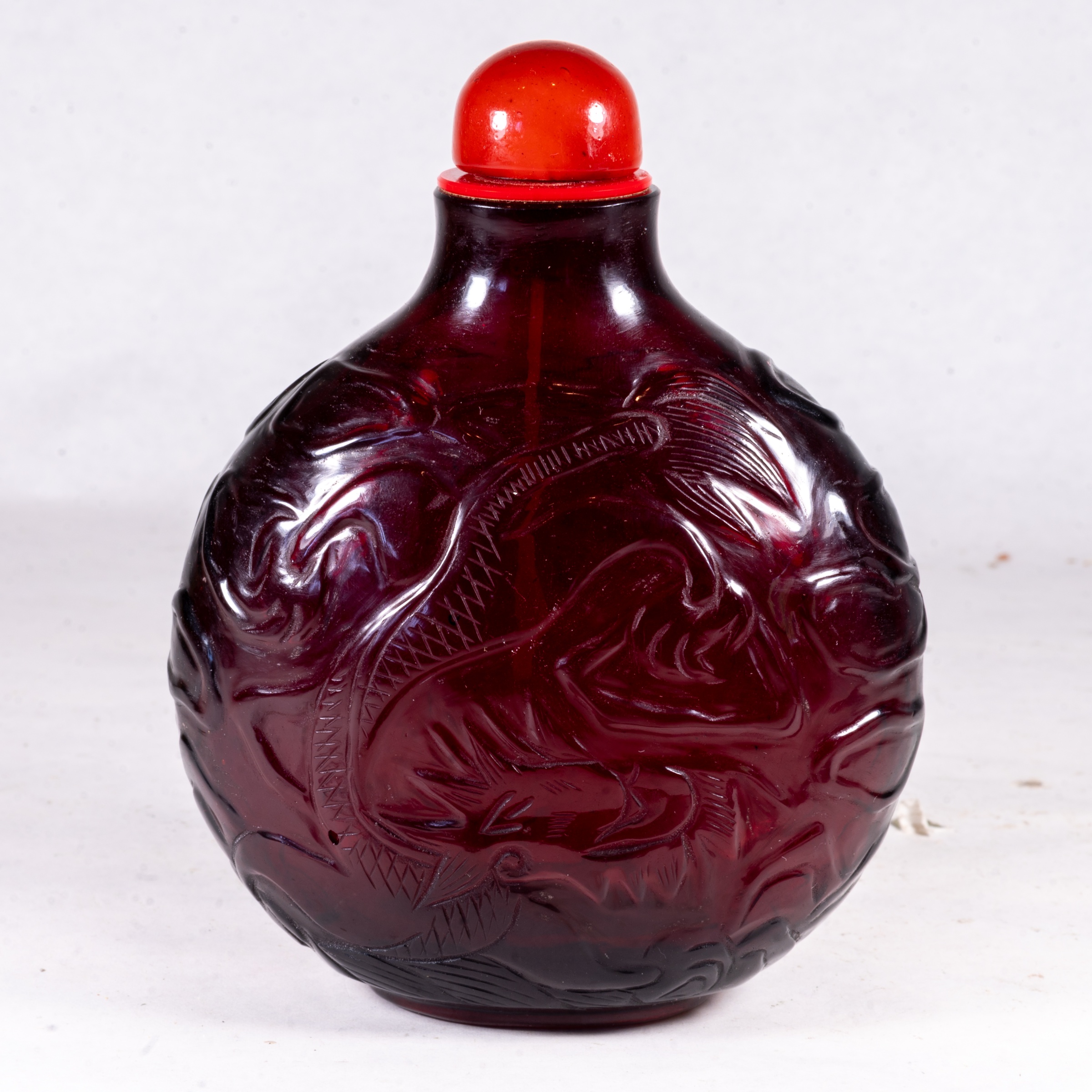
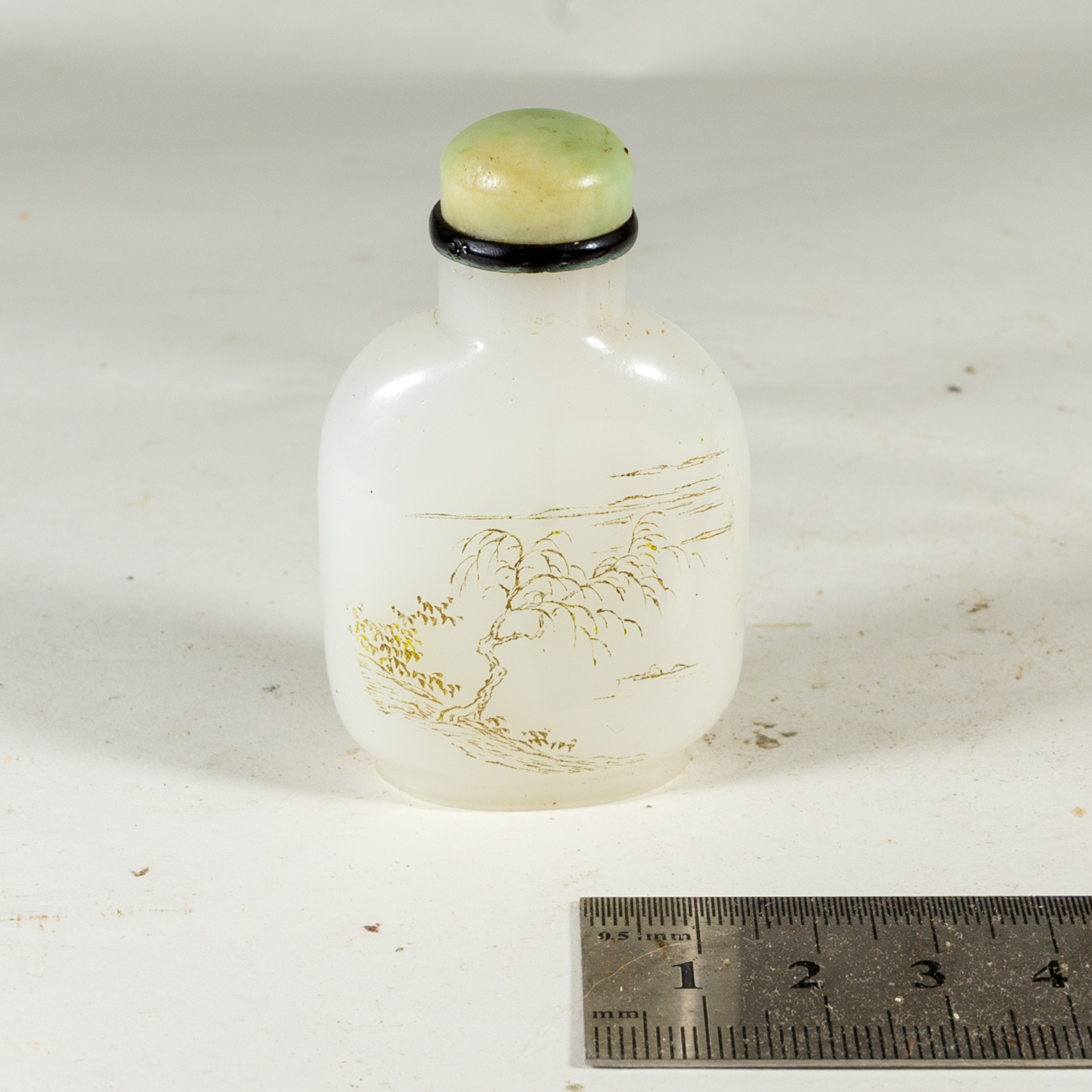
Chinese glass: Peking glass, snuff bottles and inside painting. The Qing emperors founded a glassworks inside the palace in 1696, with Jesuit help, and for two centuries it and the workshops around it made glass that imitated the stones the court prized: white glass for jade, red for realgar, yellow for the imperial colour, and overlay glass carved through one colour to another like European cameo. The snuff bottle was its great form, and the bottles come in every technique glass allows. From the 1880s a separate art grew up of painting the inside of a clear bottle through its neck with a bent brush, and the named masters of that art are collected by name; their modern successors run workshops whose pieces carry the master's signature on a student's work.
What to look for: the foot, where a reign mark is usually later than it claims and honest wear is the better evidence; the carving, since imperial-quality work is crisp and deep and the trade pieces are soft; the stopper, which is often replaced; on an inside-painted piece the signature, the date and the quality of the brush, which separate the master from the workshop. What raises value: multi-colour overlay, carving of imperial quality, a documented inside-painting artist, a period stopper, a provenance. What lowers it: wear to the gilding and the carving, a replaced stopper, a modern workshop piece signed with a famous name, and the flood of twentieth-century production that most bottles belong to.
Comparisons: the same kind of glass, a different price
The quickest way to see what moves the figure is to put pieces of the same kind side by side. Each row below is drawn from our own reports; the captions give the estimate, and the table says, in general terms, what separates them. Click any picture for its full report.
| Piece | Rung | What separates it | Estimate |
|---|---|---|---|
| Daum Nancy scent bottle | By | A cameo bottle with a faint signature that the scanner read, supported by the factory's documented technique and decoration and by the silversmith's mark on the mounts. The record of the factory's sales prices it | £900 – £1,400 |
| Orrefors 'teardrop' bud vase | Attributed to Palmqvist for Orrefors | A catalogued form with the factory's wheel-engraved decoration, but the engraved signature is faint or absent, so the piece is placed by the model rather than the mark. Six sales of the same model price it, and they are modest | $75 – $150 |
| Iridescent threaded vase | Attributed to Pallme-König or Kralik | An unsigned Bohemian vase placed by its form and threading among the Loetz neighbours, then marked down for a crack across the base. Condition is the whole story here | £100 – £200 |
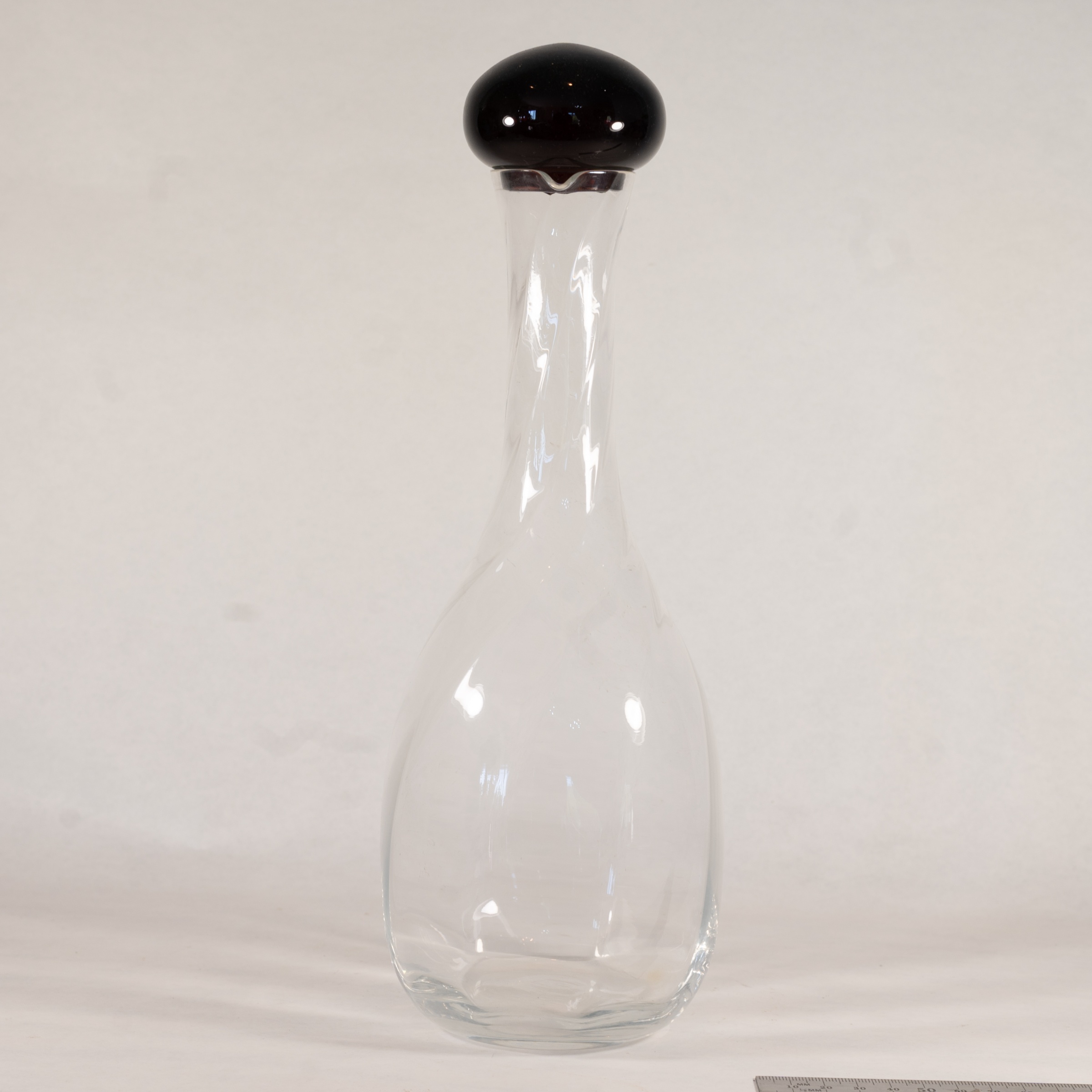
| Optic-twist decanter | Unsigned, maker uncertain | A well-made post-war decanter with no mark or label. The report weighs an Italian maker working for a Swedish retailer against the Danish and Swedish houses and settles on neither, so it is priced as a good decanter of its kind with a lower confidence level | $150 – $250 |
| Piece | Date | What separates it | Estimate |
|---|---|---|---|
| Irish 'Prussian' decanter | c. 1815–1830 | Genuinely Georgian, hand-blown with a pontil scar and three neck rings, and read as a marked Cork piece. Thousands survive and few people decant, so two centuries of age buy no premium; the mark and the stopper are what lift it above the rest | £150 – £250 |
| Palda-type enamelled decanter | c. 1930 | A striking Art Deco design in a collected style, but the black enamel is flaking across the body. The design would price higher; the condition brings it to the same figure as the Georgian piece | £150 – £250 |
| Orrefors 'teardrop' bud vase | 1950s | A named Swedish factory and a catalogued designer, in excellent condition, and still modest: small engraved pieces were made in quantity and the record shows it. The name is worth more on a large or rare model | $75 – $150 |
| Ship's decanter | 1982 | Modern lead crystal with a hallmarked silver collar that dates it to the year. Well made, entirely common, and priced where the market puts late cut glass, hallmark or not | $75 – $150 |
.jpg?alt=media&token=6aaaf67d-1cf3-48c7-bc3f-ca4c8a4739c8)
| Piece | Glass and mount | What separates it | Estimate |
|---|---|---|---|
| Cameo claret jug | Acid-etched and gilt glass attributed to Legras; silver mounts in the Art Nouveau taste | Both halves are good and they belong together: a scratched assembly number under the foot shows the mount was fitted to this body. Mounted cameo jugs are a collected form in their own right | £1,500 – £2,500 |
| Crystal casket | Deep-cut crystal attributed to Baccarat; gilt-bronze mounts with lock and key | A Charles X form the record knows well. The glass is crisp; the gilding is worn to the bronze, which is honest and is priced as such. Baccarat did not stamp its glass until 1936, so the attribution rests on the cutting | £500 – £800 |
| Cameo scent bottle | Daum cameo glass; silver-gilt cap and base cup with a French silversmith's mark | The glass carries a faint signature and the mounts carry their own maker's mark, and the two were made for each other, which is the ideal case. Worn gilding on the glass and tarnish on the silver-gilt are the honest faults that hold it inside its band | £900 – £1,400 |
| Piece | Maker | What separates it | Estimate |
|---|---|---|---|
| 'Small Meditation' pin dish | Heinrich Hoffmann, Gablonz, with his moulded butterfly mark | A named model in a collected colour, alexandrite glass that shifts from amethyst to blue, with the designer's mark in the mould. A small chip holds it below the top of its band | £80 – £150 |
| Amber cloud glass bowl | Attributed to George Davidson & Co., unmarked | Identified from the pattern and the colour with high confidence, since the cloud-glass range is fully catalogued, but it is one of the commonest patterns in a common colour. Scarce colours in the same range sell for several times more | $75 – $125 |
| Piece | The name | What separates it | Estimate |
|---|---|---|---|
| White glass snuff bottle | Signed Zhou Honglai, early 20th century | Milky glass made to pass for white jade, incised with a landscape and a long inscription and filled with gilt, and signed by an artist whose work the auction record contains at several times this figure. Heavy wear to the gilding is what holds it here | £1,200 – £1,800 |
| Ruby-red Peking glass bottle | Unsigned, 19th century | Carved in relief with carp turning into dragons, with a worn foot that argues for age. A good trade bottle rather than an imperial one, priced among the sales of its kind, and the stopper is a later replacement | £150 – £350 |
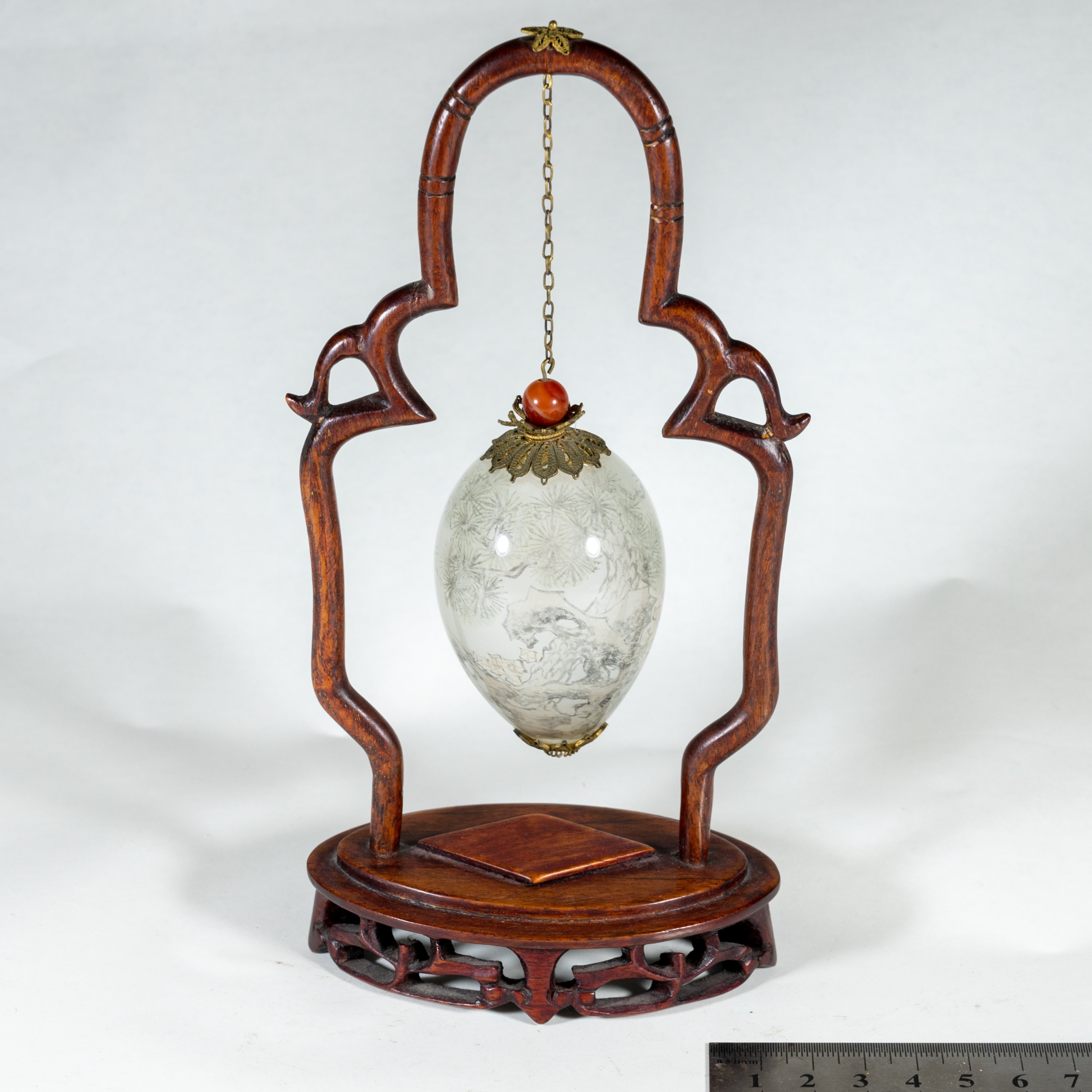
| Inside-painted egg on a stand | Signed Wang Xisan, dated 1990 | The signature of a famous living master on a piece the evidence places in his workshop, the Ji school, rather than in his hand. The report says so, and prices it against sales of workshop eggs, not the master's bottles | $100 – $250 |
How glass is marked, and what the mark proves
| Maker | How it is marked | What to know |
|---|---|---|
| Gallé (Nancy) | Signature in cameo or engraved in the glass, in many styles | A star beside the name means 1904 to about 1914, after Émile Gallé's death. Reproductions marked 'Tip' exist in quantity, sometimes with the 'Tip' ground off |
| Daum (Nancy) | 'Daum Nancy' with the cross of Lorraine, engraved, enamelled or in cameo; 'Daum France' on modern pieces | Unsigned pieces are attributed on decoration and form; silver mounts carry their own French marks |
| Lalique | 'R. Lalique' moulded, engraved or stencilled before 1945; 'Lalique France' without the R afterwards | The R is the dividing line in price. Opalescent glass commands a premium over clear in the same model |
| Loetz, Kralik, Pallme-König | Loetz signed mainly pieces for export; the others did not sign | The whole field runs on attribution by form, decor and base glass; a confidence level comes with it |
| Baccarat | Acid-etched mark from 1936; paper labels before | Earlier glass is attributed on cutting and form, as with the casket above |
| Irish Georgian (Cork, Waterford) | A few decanters carry a moulded factory name on the base | Most are unmarked and attributed on shape, rings and cutting; modern Waterford has an acid-etched mark |
| Whitefriars | Paper labels only, usually long gone | Attribution by shape, colour and the factory catalogues; colour is the price |
| Murano | Foil or paper labels; Venini and a few others acid-stamped or engraved | A 'Murano' sticker names an island, not a maker; a named factory or designer is where the value is |
| Orrefors, Kosta and the Swedish houses | Engraved on the base: factory, designer's initials, model number | The engraving is a catalogue entry; the report reads it and finds the model |
| English pressed glass (Davidson, Sowerby, Bagley, Jobling) | Registration numbers and trade marks in the mould on some pieces | Registration numbers date the design, not the piece; patterns are fully catalogued |
| Chinese glass and snuff bottles | Reign marks on the foot; incised or painted artists' signatures and dates on inside-painted and gilt-decorated pieces | A reign mark is usually later than it claims. An artist's signature is checked against the record, and a famous name on a modern piece most often means the workshop |
| Silver and plated mounts | Hallmarks (English date letter; French guarantee mark and maker's lozenge) or a plater's stamp | They date and name the mount, not the glass. Scratched assembly numbers show the two were fitted together |
What to send, and what you get back
Send the four photographs above and anything else that worries you: a chip, a crack, a cloudy interior, a mount that moves. Put a ruler or a coin at the edge of one shot for scale. If the piece is one of a pair or a set, photograph them together once and the best one alone.
The written report identifies the piece and names the maker or the attribution with a confidence level and the reasons, says how it was made, assesses the condition that photographs allow and names what they do not, cites the comparable sales with lot, price and venue, and compares the routes to a sale, a specialist glass auction, a general one, a dealer, an online listing, with a band for each and an estimate of what you would take home after fees. Glass travels badly and the venue advice takes that into account.
Upload the photographs and we will send back a documented valuation with the comparable sales we used, drawn from the specialist glass sales and the regional rooms where most glass actually changes hands. We do not buy and we do not take consignment, so the figure is not shaped by what anyone would like to pay you. Your first valuation is free.
Reviewed by The Findthevalueof research team. Last reviewed 14 Oct 2026.
Common questions
How can I tell if my glass is lead crystal?
- By weight, sound and light. Lead crystal is noticeably heavier than soda glass of the same size, it rings when flicked with a fingernail where soda glass gives a dull note, and a cut edge throws rainbow colours in daylight. Under an ultraviolet lamp lead glass tends to glow blue-white and soda glass green or yellow, though that is a rough test. Lead crystal is the norm for English and Irish cut glass from the eighteenth century on and for most twentieth-century 'crystal'; it is not in itself a sign of value.
Is my Gallé, Daum or Lalique genuine?
- The signature is the start, not the end. The report enlarges it and compares it with how the house signed in the period the piece claims to be from: Gallé's many signature styles and the star of 1904 to 1914, Daum's cross of Lorraine, the R that Lalique dropped after 1945. It then checks the glass against the signature: the layers, the quality of the carving, the colours, the form. A signature in the wrong style for the date, in the wrong place, or on glass whose quality does not match it, is the usual way a reproduction gives itself away. 'Tip Gallé' pieces are reproductions by definition.
There is a chip on the rim. How much does it matter?
- More than it would on a plate. Glass cannot be filled or invisibly restored, so a chip stays, or the rim is ground down to remove it, which shortens the piece and shows to a buyer who measures. For ordinary glass a chip takes it to the decorative floor; for a signed art-glass piece it can halve the figure; for a rare piece collectors will still compete, at a discount. The report prices the piece as it is and says what the same piece would fetch undamaged, so you can see what the damage is costing.
My decanter is cloudy inside. Can it be cleaned?
- Usually not with anything in the kitchen. The cloud is etching, a roughening of the glass surface by years of wine, water and standing damp, and the trade calls the piece 'sick'. Soaking, rice and denture tablets remove deposits but not etching. A glass polisher can sometimes tumble it clear, at a cost that is only worth paying on a good decanter. Sick glass sells for a fraction of clear, and the report says whether it is worth treating.
Does it matter that the stopper is not the original?
- Yes. Stoppers were ground to fit one neck and were often numbered to match, and a replacement that rocks, sits proud or does not match the cutting is the first thing a specialist checks. A decanter with its own stopper is worth noticeably more than the same decanter with a stranger's, and a decanter without a stopper is worth very little. Photograph the stopper out of the neck so the report can judge the fit.
Is cut glass worth more than pressed glass?
- Generally, piece for piece, because cutting is hand work on a blown blank and pressing is a mould. But fashion has turned the rule inside out at the edges: ordinary Victorian cut glass and modern wedding crystal sell cheaply, while the best pressed glass, a Lalique opalescent model, a rare-colour Davidson, Sowerby's Victorian patterns, sells well above them. The report identifies the technique and then prices the piece in its own market rather than by the general rule.
Is Murano glass valuable?
- Some of it, and the difference is a name. Murano is an island with dozens of factories, and the clowns, fish and ashtrays sold to tourists since the 1950s are worth very little. Pieces by the named houses and designers, Venini, Barovier & Toso, Seguso, Cenedese, Scarpa, Bianconi, Martens, are a serious market with catalogued models. A 'Murano' label by itself proves only the island. The report looks for a factory stamp, an engraved signature, a documented technique and a catalogued form, and says when none can be found.
What is my wedding crystal worth?
- Less than it cost, usually a great deal less. Waterford, Stuart, Edinburgh, Royal Brierley and their peers sold cut crystal suites as the wedding present of three generations, so the supply is enormous and the demand has gone. Complete sets sell for modest sums, part sets for little, and individual glasses for a few pounds each, with the rarer discontinued patterns the exception. The report identifies the pattern and tells you honestly where it sits.
What makes a glass paperweight valuable?
- Factory, date and quality of the canes. The classic weights were made in France between about 1845 and 1860 at Baccarat, Clichy and Saint-Louis, with millefiori canes that can carry a date and a factory initial, and those sell for thousands and up. Later Scottish and English weights, Caithness, Perthshire, Whitefriars, have their own collectors and sell for tens to low hundreds, and the Chinese and Murano souvenir weights for a few pounds. The base, the profile of the dome and the canes are what the report needs photographed.
Is my iridescent vase Loetz or carnival glass?
- They are different things. Carnival glass is pressed, patterned in the mould and sprayed with an iridescent finish, made in America and England from about 1908 and worth tens of pounds for most pieces. Loetz and its Bohemian neighbours blew their glass and worked the iridescence into it, with trailed threads, pinched rims and polished pontils. The report tells them apart from the base, the walls and the decoration, and then places a blown piece among the Bohemian factories, usually as an attribution with a confidence level, since so little of it was signed.
Is my Chinese snuff bottle glass or jade, and does it matter?
- Often glass, and yes. The Qing glassworks made white glass to imitate jade, red to imitate realgar and yellow for the court, and a great many 'jade' snuff bottles are Peking glass. Glass is warmer to the touch, lighter for its size, may show tiny bubbles against the light, and takes a mould seam or a polished pontil where jade cannot. The report says which it is looking at. Glass bottles have their own market, from a few hundred for a good trade piece to thousands for imperial overlay work or a signed inside-painted bottle by a named master.
Glass is hard to photograph. Will that affect the valuation?
- It can, which is why the report says what the photographs could not settle. The fixes are simple: a plain light background, daylight rather than flash, one shot with the light coming through coloured glass, the base in focus, and the signature or mark filling the frame. If a chip or a crack is hard to see, put a finger beside it. Reflections on cut glass are expected and do not matter.
Where should I sell glass, and what will I actually receive?
- It depends on the piece and on the fact that glass breaks in the post. Signed art glass and the collected mid-century names do best in specialist glass and design sales, which exist in London, New York and several regional rooms; Georgian and Victorian glass sells in general antiques auctions; pressed glass and wedding crystal sell online or to dealers, where the cost of safe packing matters. The report compares the routes, recommends one, and estimates what you would take home after a typical seller's commission.
How long does a glass valuation take, and what does it cost?
- Most reports arrive within ten minutes; a signed piece that triggers a deeper research route can take a little longer. Your first valuation is free. After that a single piece is $5, and packs bring it down to $2.25 a piece. There is no subscription, and nobody will try to buy the glass from you afterwards.
Is this an appraisal I can use for insurance, probate or tax?
- No. It is a researched valuation with the evidence attached, which is what you need to decide what to do with a piece and to check an offer against the sale record. For an insurance schedule, a probate filing or a tax deduction, have the report reviewed by a qualified appraiser; it will make that work faster and cheaper.
Worked examples in this category
- French Art Nouveau Cameo Glass and Silver-Gilt Scent Bottle by Daum Nancy, circa 1900
- An Art Nouveau Silver-Mounted and Gilt Cameo Glass Claret Jug, Glass Attributed to Legras & Cie (Mont Joye), Mounts Attributed to Bruckmann & Söhne
- A Fine Chinese Incised and Gilt White Glass Snuff Bottle, Signed Zhou Honglai (周鴻來), Early Republic Period, circa 1910-1920
- A French Charles X Gilt-Bronze Mounted Cut-Crystal Casket, Attributed to Baccarat, circa 1830
- A Chinese Carved Ruby-Red 'Peking' Glass Snuff Bottle, Qing Dynasty, 19th Century
- An Irish Regency Lead-Crystal 'Prussian' Form Decanter, Attributed to the Waterloo Glass Company (Cork), circa 1815-1830
- Bohemian Art Nouveau Threaded Iridescent Glass Vase, Attributed to Pallme-König & Habel or Wilhelm Kralik Söhne, circa 1900-1905
- Czechoslovakian Art Deco Cut and Enameled Glass Decanter, Attributed to Karl Palda, circa 1930
- Mid-Century Modern Optic-Twist Glass Decanter
- A Chinese Inside-Painted Glass Egg on Stand, Signed Wang Xisan (b. 1938), Ji School, Dated 1990
- Art Deco 'Small Meditation' Alexandrite Glass Pin Dish by Heinrich Hoffmann, circa 1930
- Sven Palmqvist for Orrefors Engraved Crystal 'Teardrop' Bud Vase, Sweden, circa 1950s
- Elizabeth II Silver-Mounted Lead Crystal Ship's Decanter, Attributed to Barker Ellis Silver Co.
- Art Deco Amber Cloud Glass Faceted Bowl, Attributed to George Davidson & Co.