What is your porcelain or ceramic piece worth?
Researched valuation of porcelain and ceramics. Cited auction comparables, maker attribution, and a written market report — usually within the hour.
A porcelain or ceramic piece is worth what a comparable example has recently sold for at auction or through a specialist dealer, adjusted for condition, rarity, and the strength of the maker's mark. To give you a defensible figure we look up real recent results — not guide prices — and cite them in the report.
Values in this category span four orders of magnitude. A transfer-printed Staffordshire plate from the 1880s typically trades for $20 to $80. A documented Clarice Cliff Bizarre piece in a sought-after 'Fantasque' pattern such as 'Sunray' or 'Solitude' can clear $3,000 to $8,000; the earlier 'Original Bizarre' banded jugs and Isis forms typically sit in the $800 to $2,500 range, depending on shape and condition. An 18th-century Sèvres soft-paste vase with the correct date letter and a recognised painter's mark sits in the five- to six-figure bracket. The same form in a 19th-century Samson reproduction is worth a small fraction of that. Attribution is the lever — and where most owners under- or over-estimate.
Our written report covers: maker attribution (Meissen, Sèvres, Worcester, Derby, Wedgwood, Royal Doulton, Clarice Cliff, Beswick, Moorcroft, Belleek, Royal Copenhagen, Chinese export, Japanese Imari and Satsuma, plus the major studio potters); date range from the mark, body, glaze and decoration; condition grading against the standard auction lexicon (hairline, star crack, restored, retouched); and three to five cited comparable sales from the last 24 months with hammer prices and venues. If the piece is a known fake or later reproduction we tell you that plainly, with the diagnostic that gave it away. Photograph the base, any marks, and any damage clearly — most pieces can be appraised from good photographs alone.
Porcelain is the original luxury good of the European world — the one material the Renaissance princes could not synthesise and the late-Ming literati had been refining for eight hundred years before them.
The word itself was borrowed. Porcellana, the Italian name for the small white cowrie shell, was given to the white-glazed Chinese wares by Marco Polo's contemporaries because the surface of a Yuan-dynasty cup resembled the iridescent inside of the shell. For the next three centuries Europe knew porcelain only as a thing, the most expensive thing, that arrived with the Portuguese fleets and the Dutch East Indiamen. The craftsmen at Faenza and Delft tried for two hundred years to copy it and could not — they had clay, they had tin-glazes, but the kaolin chemistry and the firing temperature were a secret kept in Jingdezhen.
It took an alchemist's prisoner in a Saxon fortress to crack it. Johann Friedrich Böttger had been locked up at Königstein in 1701 by the Elector of Saxony for failing to make gold; six years later he, working with the physicist Ehrenfried Walther von Tschirnhaus, produced the first hard-paste porcelain in Europe. The Elector founded the Meissen factory the year after. Within a generation, Sèvres in France, Vienna, Berlin, Naples (Capodimonte), Saint Petersburg (Imperial), and Worcester in England were all making the white stuff to a high standard. By 1800 the secret was no longer one. The market had begun and has never quite stopped.
What survives across that eight-hundred-year arc is identifiable, datable, and saleable — provided one can read the body, the mark, the foot, and the kiln signature. An 18th-century Chinese export blue-and-white plate, a Meissen Harlequin from Kändler's modelling workshop, a Worcester tea bowl with the underglaze square crescent mark, a Clarice Cliff Bizarre vase in the rare 'May Avenue' pattern, a Lucie Rie thin-walled bowl in white-on-bronze — each tells a different story, and each is placeable, precisely, in a market.
This page tells you what we look at, what changes the figure, and what your written report covers when you upload photographs. Comparable prices are drawn from the auction record of the last twenty-four months — Bonhams, Christie's, Heritage, Sotheby's, and the specialist salerooms — not from retail or guide prices.
A porcelain or ceramic piece is worth what a comparable example has recently sold for, adjusted for condition, rarity, and the strength of the maker's mark. To give you a defensible figure we look up real recent results — not guide prices — and cite them in the report.
Values in this category span four orders of magnitude. A transfer-printed Staffordshire plate from the 1880s typically trades for $20 to $80. A documented Clarice Cliff Bizarre piece in a sought-after 'Fantasque' pattern can clear $3,000 to $8,000. An 18th-century Sèvres soft-paste vase with the correct date letter and a recognised painter's mark sits in the five- to six-figure bracket. The same form in a 19th-century Samson reproduction is worth a small fraction of that. Attribution is the lever — and where most owners under- or over-estimate.
What changes the price
Five things matter, in roughly this order. Maker attribution comes first: a piece firmly tied to a recognised factory or studio potter — Meissen, Sèvres, Worcester, Wedgwood, Clarice Cliff — outperforms an anonymous piece of similar age and quality by an order of magnitude or more. Period and decoration come next: an 18th-century hand-painted piece will normally outprice a 19th-century transfer-printed example of the same form.
Condition is the most movable variable. A hairline crack on a porcelain rim can take 30 to 60 percent off; a star crack or visible restoration on a structurally important area can halve a piece. Provenance — a documented previous owner, a known collection, a published reference — can add 20 to 50 percent. Finally, pattern rarity matters inside any single factory's output: Clarice Cliff's rarer Fantasque variants run multiples of her commoner Bizarre lines, and the same is true of Sèvres ground colours or famille rose palettes.
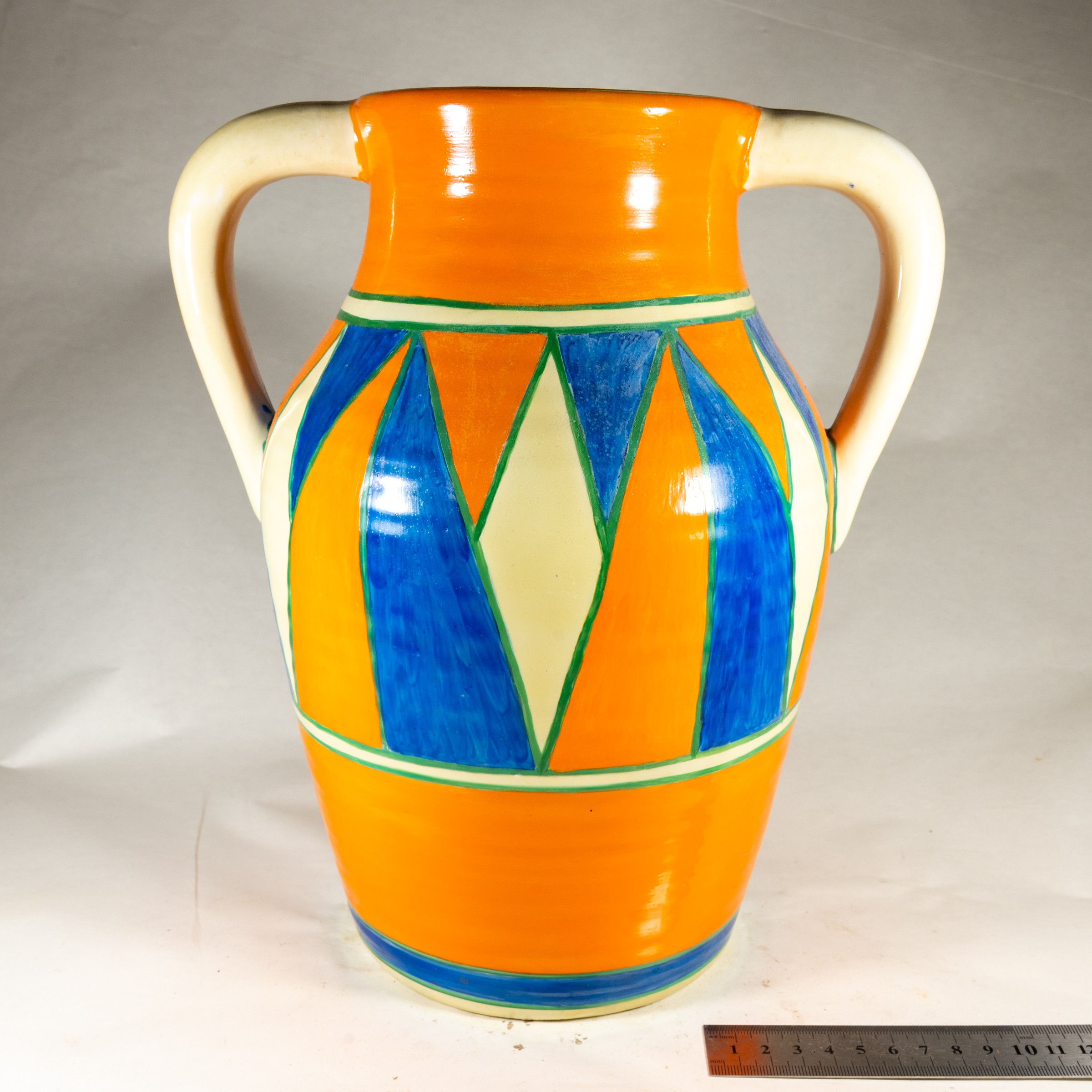
Clarice Cliff, 'Original Bizarre' Lotus Jug, c. 1928-29. This is the earliest phase of Cliff's Bizarre output at Newport Pottery, produced while she was still in her twenties. The two-handled Lotus form, the bold banded geometry, and the painted Newport Pottery mark together date it tightly to the 1928-29 window.
A piece in this condition typically clears $800 to $1,100 at Bonhams or Heritage. A sought-after 'Honolulu' or 'May Avenue' pattern on the same form would push it past $6,000; exceptional examples have cleared five figures.
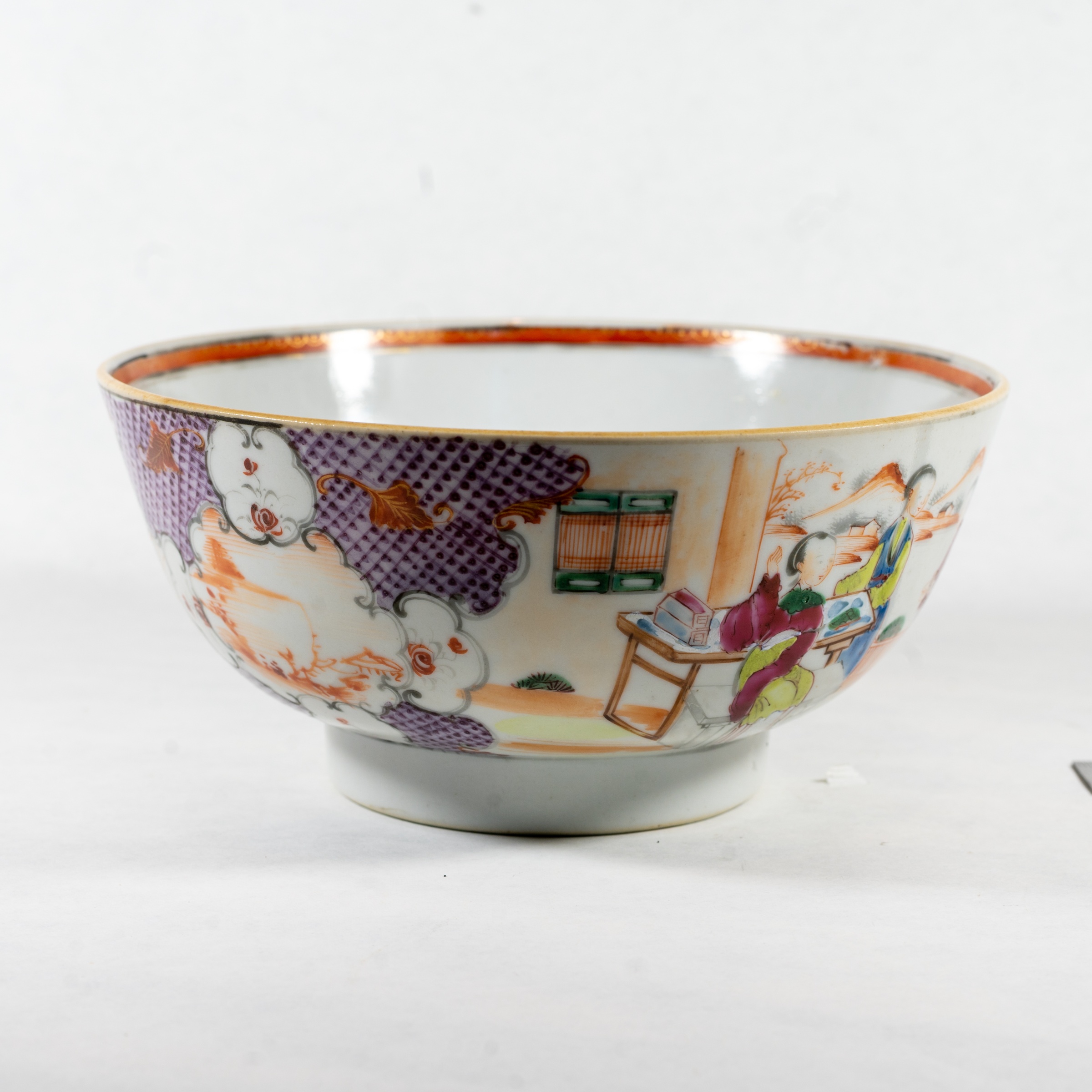
Chinese Export, 'Mandarin Palette' Famille Rose Punch Bowl, Qing Dynasty, c. 1760-1795. Made at Jingdezhen for the European and American market — the figural panels and rich pink-and-gilt enamels are the 'Mandarin' palette that defined late-Qianlong export ware. Size, the strength of the figural painting, and rim condition are the three levers.
This bowl sits at $310 to $470 at typical condition for the form. A larger bowl with crisp painting and no rim wear runs into four figures; a damaged or repainted example can struggle to clear $200.
Reference: makers and what they typically run
| Maker / type | Period | Typical price range |
|---|---|---|
| Meissen — figural, armorial | 18th c. | $2,000 – $50,000 |
| Meissen — 19th-c. revival | 1840 – 1900 | $200 – $3,000 |
| Sèvres — soft-paste, documented | 18th c. | $5,000 – $200,000+ |
| Sèvres-style Samson revival | 1860 – 1900 | $400 – $2,500 |
| Vienna (du Paquier) — early | 1719 – 1744 | $3,000 – $40,000 |
| Berlin KPM | 1763 – 1900 | $300 – $30,000 |
| Limoges — hand-painted | 1850 – 1930 | $80 – $1,500 |
| Italian maiolica — 16th-c. | 1500 – 1600 | $1,500 – $80,000 |
| Dutch / English delftware | 1650 – 1780 | $200 – $5,000 |
| Wedgwood Jasperware | 1780 – 1900 | $40 – $1,500 |
| Royal Worcester — hand-painted | 1860 – 1930 | $80 – $8,000 |
| Royal Doulton HN figurines | 1913 – 1990 | $30 – $2,000 |
| Doulton Lambeth stoneware | 1870 – 1910 | $100 – $2,000 |
| Belleek — first-period black mark | 1863 – 1891 | $150 – $1,500 |
| Clarice Cliff Bizarre / Fantasque | 1928 – 1936 | $400 – $10,000 |
| Moorcroft — Macintyre to early Burslem | 1898 – 1925 | $200 – $4,000 |
| Studio potters — Leach, Rie, Coper | 1920 – 1990 | $500 – $500,000+ |
| Chinese imperial — Qing reign marks | 1644 – 1911 | $5,000 – $500,000+ |
| Chinese Ming — blue and white | 1368 – 1644 | $1,000 – $10m+ |
| Chinese Song / Yuan — monochromes | 960 – 1368 | $2,000 – $1m+ |
| Chinese export Famille Rose | 18th c. | $300 – $15,000 |
| Yixing — signed teapots | 1700 – 1949 | $200 – $20,000 |
| Japanese Imari — Edo period | 1660 – 1840 | $300 – $20,000 |
| Japanese Satsuma — signed Meiji | 1868 – 1912 | $200 – $10,000 |
| Korean Goryeo celadon | 918 – 1392 | $2,000 – $200,000+ |
Two patterns we keep seeing
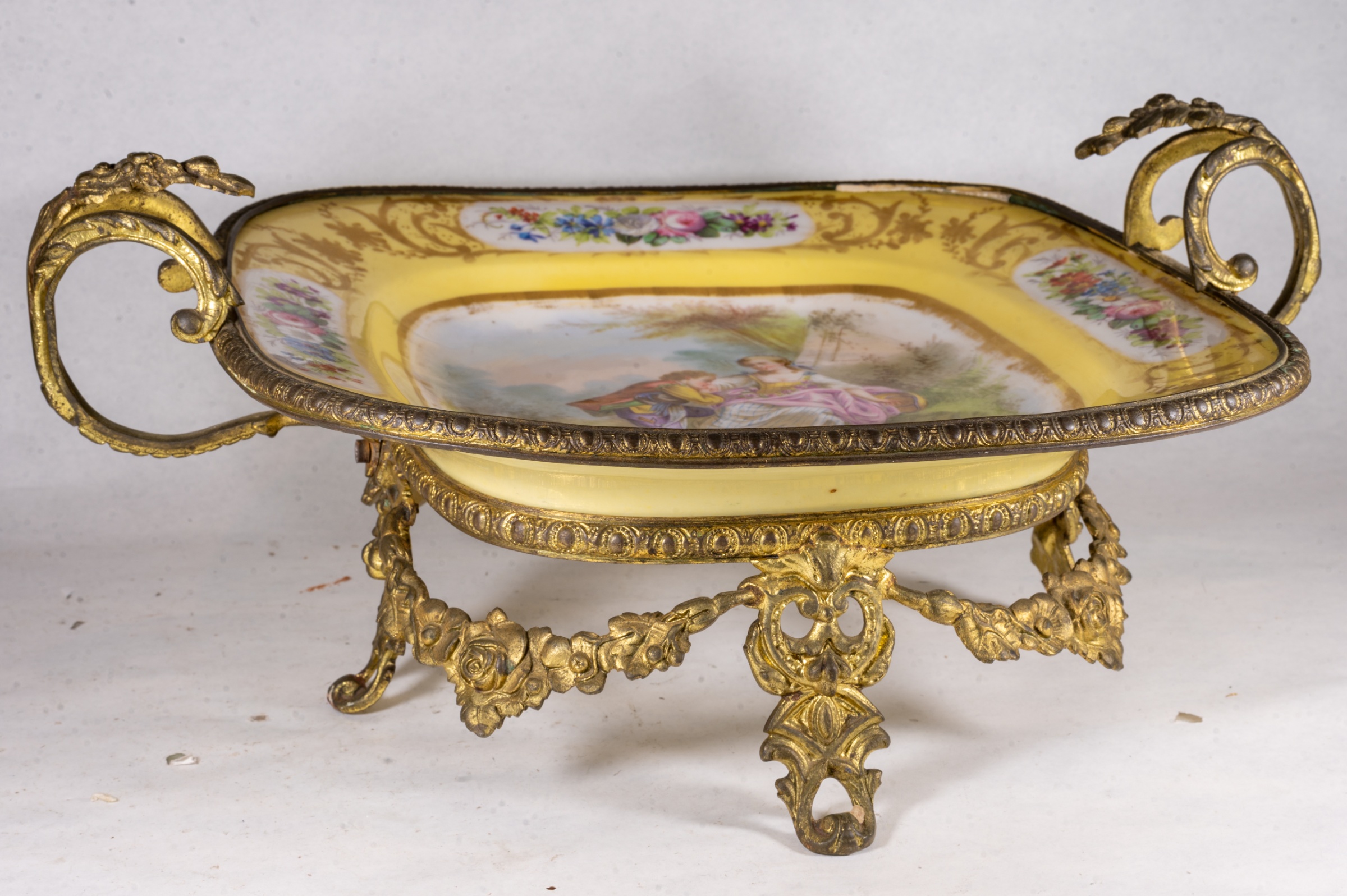
French Sèvres-Style Gilt-Bronze Mounted Centerpiece, Napoleon III Period, c. 1870. This is the most-confused category in 19th-century French ceramics: gilt-bronze ('ormolu') mounts elevate even modest porcelain, and the Napoleon III decades gave the form a long run. True Sèvres soft-paste from the period carries a characteristic ground colour — bleu céleste, bleu de roi — and the interlaced-L mark enclosing an underglaze-blue date letter; a Samson revival from the same decade in the same form runs $800 to $1,200.
A documented Sèvres piece in this form runs several multiples of the Samson, frequently into five figures. The difference, almost always, is the body and the marks — not the gilt.
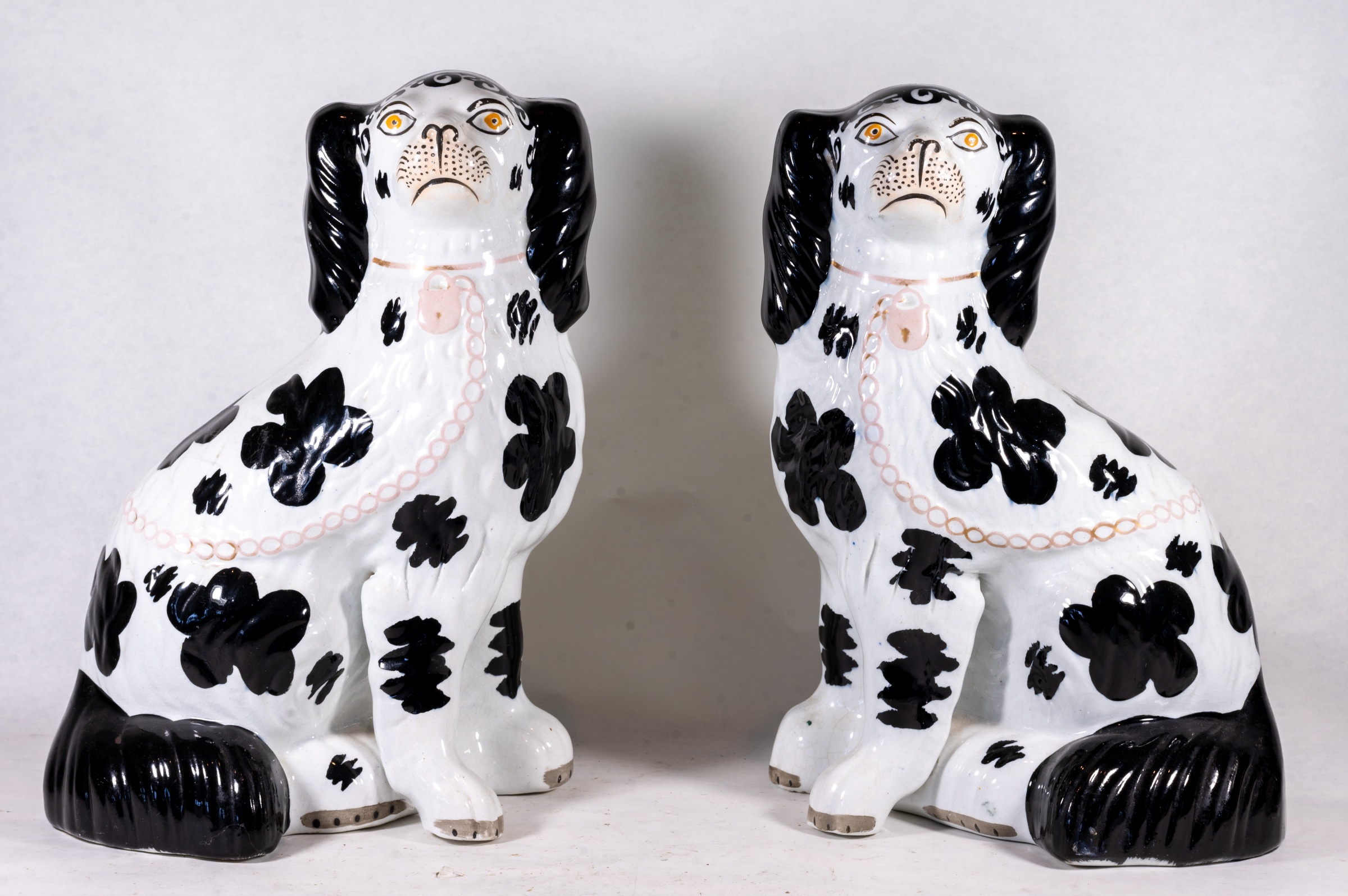
A Pair of Victorian Staffordshire Earthenware Hearth Spaniels, c. 1870-90. The everyday end of the category, but instructive: a 'good' pair is matched (the dogs face each other, not the same way), original-tongued (look for over-painted patches), unrestored at the ears, and confidently potted.
The pair runs $150 to $250 in this condition. Earlier 19th-century pearlware examples in the tradition of Walton, Sherratt, or Sampson Smith can hit $400 to $1,000. Exceptional decoration — rare colourways, sponge-decorated or marbled bases on earlier pearlware examples — can pull the upper end higher again.
Practical things to think about
Porcelain is brittle and it tarnishes nothing. The mistakes it punishes are different from silver's.
Storage and display. Porcelain wants stable temperature and humidity. A hairline crack that hasn't shown for a hundred years can propagate in a single heated winter if a thin-walled piece sits on a south-facing windowsill next to a radiator. Display in a closed cabinet, away from forced-air vents and exterior walls. Eighteenth-century soft-paste (Sèvres, Chelsea, Bow) is the most fragile of the group — the body is fluxed at a lower temperature and the foot is more porous than the hard-paste of later Meissen, Worcester, or Capodimonte.
Handling. Always two hands, always under the body. Never lift a teapot by the handle alone — it is the single most-repaired component on hollow porcelain, and the next time you lift it by the handle is the time you find out. The same goes for figurine arms, tureen finials, and any thin-walled vessel with an attached spout.
Cleaning. Warm water and mild detergent only, never the dishwasher for anything pre-1960s. Gilt rubs off in detergent solutions over time, the thermal shock of a wash cycle cracks glaze, and any restored piece will give itself away under sustained soaking. Hand-rinse, soft cloth, no abrasives.
Restoration. There are two views on this. A well-done invisible restoration on a display piece preserves the appearance and is acceptable on Asian-art-trade rules; the same piece for the collector market loses 30 to 60 percent of its figure if the restoration goes undisclosed. We test for restoration under longwave UV — any modern resin or paint added after the original glaze firing fluoresces violet-white. We will tell you what we find.
Insurance. Photograph the base, photograph every mark, photograph any chip or hairline. Specific-listed coverage on any single piece over $2,000 — and lift the limit on anything inherited where the provenance is only partly known. Loss-of-provenance is uninsurable, so document the chain while the people who knew it are still around.
Use it (sensibly). The eighteenth-century pieces were made for English breakfast rooms, not museum vitrines. A Worcester tea bowl is more durable than its appearance suggests.
Upload photos of your piece — the base, any marks, any damage — and we'll send back a documented valuation with the comparable sales we used (by lot number, hammer price, and venue) drawn from Bonhams, Christie's, Heritage, Sotheby's, and the specialist saleroom records. We state a confidence level on the figure and tell you what would move it. We don't buy and we don't take consignment. Your first valuation is on us.
Reviewed by The Findthevalueof research team. Last reviewed 13 Jun 2026.
Common questions
How do I identify a Clarice Cliff piece?
- Genuine Clarice Cliff Bizarre-range pieces (c. 1928-1936, with some pieces running to c. 1941) carry a printed backstamp combining 'Bizarre by Clarice Cliff' with the maker name (Newport Pottery, Wilkinson Ltd, or Royal Staffordshire). The pattern name is often hand-painted below. Hand-painted enamels sit slightly proud of the glaze and show brush direction under raking light. Heavy modern reproductions and the officially-licensed Wedgwood reissues of the 1990s carry distinct, dated backstamps and are not original.
What's the difference between hard-paste and soft-paste porcelain?
- Hard-paste (true porcelain) is fired above 1300C from a kaolin-and-petuntse body — translucent, glassy where chipped, cold to the touch, and rings when tapped. Meissen, Chinese export, and most 19th-century European factories used it. Soft-paste (used at Chelsea, Bow, early Worcester, Sèvres before 1769) is fired lower from a glass-and-clay mix — slightly granular at a chip, warmer to handle, and prone to firing flaws. Soft-paste of any quality is rarer and usually more valuable than hard-paste of the same date.
Does a chip or hairline crack destroy the value?
- It depends on the piece. A hairline on a $40 Victorian transferware plate roughly halves it. A hairline on a five-figure Meissen figure typically takes 30-50% off, not 100%, because the underlying rarity still drives the market. Professional restoration helps display but auction houses must disclose it, so a restored piece trades at a discount to an untouched one. Always photograph damage rather than trying to hide it — buyers and appraisers spot retouching under UV light.
How do I tell genuine Meissen from a later copy?
- The crossed-swords mark alone is not enough — it has been copied for 250 years. Look at the body (true Meissen hard-paste is exceptionally white and dense), the modelling (crisp undercuts, separately-applied flowers with hollow stamens on 18th-century figures), and the palette (the iron-red and underglaze blue have characteristic tonalities). Samson of Paris, Carl Thieme of Potschappel, and unmarked Thuringian factories all produced Meissen-style wares in the 19th century, often with deliberately misleading marks.
Are Royal Doulton figurines still collected?
- The market has softened sharply since 2005. Standard HN-series figurines that retailed at $200-400 new now trade at $30-80 secondhand. The exceptions are limited-edition pieces, prototypes, withdrawn early designs, pieces by named modellers (Leslie Harradine HN figures, Charles Noke prestige work), and associated studio potters who worked independently (Charles Vyse from his Chelsea studio) — these still bring $500-3,000. The Bunnykins and Beswick character jugs from the early production runs hold up better than the lady figures.
How do I value a Chinese export porcelain piece?
- Date is the first lever — Kangxi (1662-1722) blue and white commands a premium over later Qianlong (1736-95) and Jiaqing (1796-1820) production. Then comes the decoration: armorial services made for European families, famille rose with figural subjects, and underglaze-blue with the well-known double-circle marks all trade above plain floral wares. Beware modern reproductions of Kangxi — they appear weekly on online marketplaces. We check the foot rim, the glaze pooling, and the cobalt tone against documented examples.
Should I get my piece valued before selling at auction?
- Yes. Auction-house free valuations sit inside a commercial relationship — estimates may be pitched low to stimulate competitive bidding and clear the sale, or occasionally inflated to win the consignment away from a rival house. An independent written valuation gives you the comparable-sales baseline you need to set a realistic reserve and to decide between auction, specialist dealer, or private sale. For pieces above $2,000 the cost of independent advice is recovered many times over by a better-set reserve.
What information should I include with my photographs?
- Measurements (height, width, base diameter), any text or numbers on the base however faint, where the piece came from (inherited, bought at sale, etc.), and the date you acquired it. Photograph the front, both sides, the base, any marks at close range, and any damage. Natural daylight against a plain background reads better than flash on patterned cloth.
Do you appraise studio pottery — Bernard Leach, Lucie Rie, Hans Coper?
- Yes. The 20th-century British studio-pottery market is narrow but deep — a documented Lucie Rie footed bowl regularly clears $15,000-50,000, a Hans Coper spade form can reach six figures, and a Bernard Leach St. Ives standard-ware mug typically runs $150-400, with stronger forms (lidded jars, larger jugs) reaching $500-1,000. Attribution turns on impressed seals, paper labels, and provenance. We cite the specialist sales (Bonhams, Maak, Phillips Design) rather than general decorative-art auctions.
Worked examples in this category
- A Clarice Cliff 'Original Bizarre' Two-Handled 'Isis' Vase, circa 1928-1929
- A French Sèvres-Style Ormolu-Mounted Yellow-Ground Porcelain Centerpiece, Circa 1880–1910
- A Chinese Export 'Mandarin Palette' Famille Rose Porcelain Punch Bowl, Qing Dynasty, Late Qianlong Period, c. 1760-1795
- A Clarice Cliff 'Fantasque' Bizarre 'Sunray' Pattern Yo-Yo Vase, Shape 378, Circa 1929-1931
- A Pair of Victorian Staffordshire Earthenware Hearth Spaniels, Unidentified Potteries, circa 1870-1890