What is your silver or silverware worth?
Researched valuation of antique and sterling silver. Hallmark reading, weight-vs-melt analysis, cited auction comparables — written report within the hour.
A piece of silver is worth what a comparable example has recently sold for at auction or through a specialist dealer, adjusted for maker, weight, condition, and whether the piece is solid silver, plated, or a weighted-base form. To give you a defensible figure we read the hallmarks, weigh the silver content against the live spot price, and cite three to five real recent results in the written report — not guide prices.
Values in this category span four orders of magnitude, and the difference is almost always the maker. A Victorian electroplated nickel silver (EPNS) teapot trades at $30 to $80 — the silver in EPNS is a microns-thin coating over a copper-nickel-zinc alloy that contains no silver at all. A 1920s American sterling tea set by Gorham or International, monogrammed and unremarkable, sits at $400 to $900 with most of the value in the .925 weight (sterling is 92.5% silver, hence the '925' stamp). A Paul Storr Regency coffee pot with a clean London leopard's head, a crisp duty mark, and the right date letter routinely clears $8,000 to $25,000 — Storr's current auction record is $124,235, set at Sotheby's London in 2025. A Tiffany & Co. Audubon flatware service for eight recently hammered $19,050 at Toomey & Co. on 25 September 2025, against a $4,000 to $6,000 estimate. Attribution is the lever, and weight is the floor.
Our written report covers: maker attribution (Tiffany & Co., Gorham, Reed & Barton, Kirk Stieff, Towle, Wallace, International, Lunt for the American makers; Paul Storr, Hester Bateman, Paul de Lamerie, Hunt & Roskell for the British; Georg Jensen, Buccellati, Christofle, WMF, Marius Hammer, and Fabergé for the Continental); the four-mark British hallmark sequence (sponsor's mark, lion passant for sterling .925, town mark, date letter — plus the sovereign's head duty mark for any piece struck between 1784 and 1890); the American sterling, coin silver (~.900), Continental .800 / .835 / .950, Russian 84 zolotnik (.875), and Britannia (.958) standards; current melt value at live spot price versus the collector premium that piece commands today; condition factors that matter (removed monograms, polished-down marks, married lids, regilded interiors, weighted bases); and three to five cited comparable sales from the last 24 months with hammer prices and venues. If the piece is plated, weighted, or after-marked we tell you plainly, with the diagnostic that gave it away. Photograph the base, every mark at close range, and any damage or repair — most pieces can be appraised from good photographs alone.
Silver in the European tradition has carried two valuations at once for a thousand years, and they have rarely agreed.
There is the older valuation — the eucharistic chalice, the wedding canteen, the chased communion plate, the ceremonial cup carried before the Lord Mayor in procession. This was the silver that mattered in the inventories of country houses for three centuries, listed piece-by-piece in wills, valued by name after every death, and melted only in catastrophe. The eighteenth-century goldsmith who struck his initials inside a coffee pot at the London Assay Office on Foster Lane, or at Birmingham under the anchor, or at Sheffield under the crown, was working in a trade that already had four hundred years of hallmarking law behind it. The Wardens of the Goldsmiths' Company had the statutory authority to break and re-make any piece that didn't pass — and did.
And there is the other valuation: the troy ounce, the refiner's margin, the spot price quoted that morning on the COMEX. This is the silver of the Hunt Brothers' 1980 corner, of the 2011 bullion spike that emptied jewellery drawers across America, and of the recurring cycles in which a generation of perfectly serviceable Edwardian flatware gets melted for the metal it contains and the chasing it carried is simply lost.
Most pieces sit somewhere between the two valuations. A Paul Storr Regency soup tureen at the top end is so far above its melt value that the bullion price is a footnote. A monogrammed Victorian fish slice at the bottom end is so close to melt that the engraving is, in plain commercial terms, a tax on the figure. The work of an honest appraisal is to tell you exactly where on that spectrum your piece sits, and why — without flattering either the family who inherited it or the refiner waiting at the door.
This page tells you what we look at, what changes the figure, and what your written report covers when you upload photographs. Comparable prices are drawn from the specialist auction record of the last twenty-four months — Sotheby's, Christie's, Bonhams, Heritage, Doyle, Skinner, Toomey, Lyon & Turnbull — not from retail or guide prices.
A piece of silver is worth what a comparable example has recently sold for, adjusted for maker, weight, condition, and whether it is solid, plated, or weighted. Our written report identifies the piece, reads the marks, places it in its market, and cites three to five recent results from the specialist auction record — by lot number, hammer price, and venue — not guide prices.
Values in this category span four orders of magnitude. A Victorian electroplated nickel silver (EPNS) teapot trades at $30 to $80 — the silver in EPNS is a microns-thin coating over a copper-nickel-zinc alloy that contains no silver at all. A pair of Old Sheffield Plate candlesticks from the George III or Regency period sits at $300 to $500 — a fused sheet of sterling on a copper core, made between 1742 and the 1840s before electroplating replaced the technique. A 1920s American sterling tea set by Gorham or International, monogrammed and unremarkable, runs $400 to $900. A Paul Storr Regency coffee pot with a clean London leopard's head and the right date letter routinely clears $8,000 to $25,000 — Storr's current auction record is $124,235, Sotheby's London 2025. A Tiffany & Co. Audubon flatware service for eight recently hammered $19,050 at Toomey & Co. on 25 September 2025, against a $4,000 to $6,000 estimate. Attribution is the lever; condition is the multiplier.
What changes the price
Five things matter, in roughly this order. Maker attribution comes first — a piece tied to a documented silversmith (Storr, Bateman, de Lamerie for British; Tiffany, Gorham, Kirk for American; Jensen, Buccellati, Christofle, Fabergé for the Continental) outprices an anonymous piece of similar form and weight by an order of magnitude or more. Standard and country of origin come next: British sterling .925, Britannia .958, American sterling (post-1906 National Stamping Act), American coin silver ~.900, French first standard .950, German .800, Russian 84 zolotnik .875 — each carries its own marking system and its own collector base.
Condition is the most movable variable. A removed monogram takes 25 to 50 percent off; a buffed-down hallmark on a Storr-period piece can take 40 to 70 percent off. Form matters in a way it doesn't for ceramics: a teapot from a tea service is worth a fraction of the complete service, and a single fork from a service of twelve is worth less per piece than a sealed canteen. And finally, the solid-versus-plate-versus-weighted distinction has to be settled before any figure is meaningful. Old Sheffield Plate (1742-1840, fused silver on a copper core) is collectible in its own right at $200 to $3,000 — distinct from later Victorian electroplate, which rarely is. A 'sterling weighted' candlestick has the same outer skin as a solid piece but is filled with pitch, and the difference can be 90 percent of the figure.
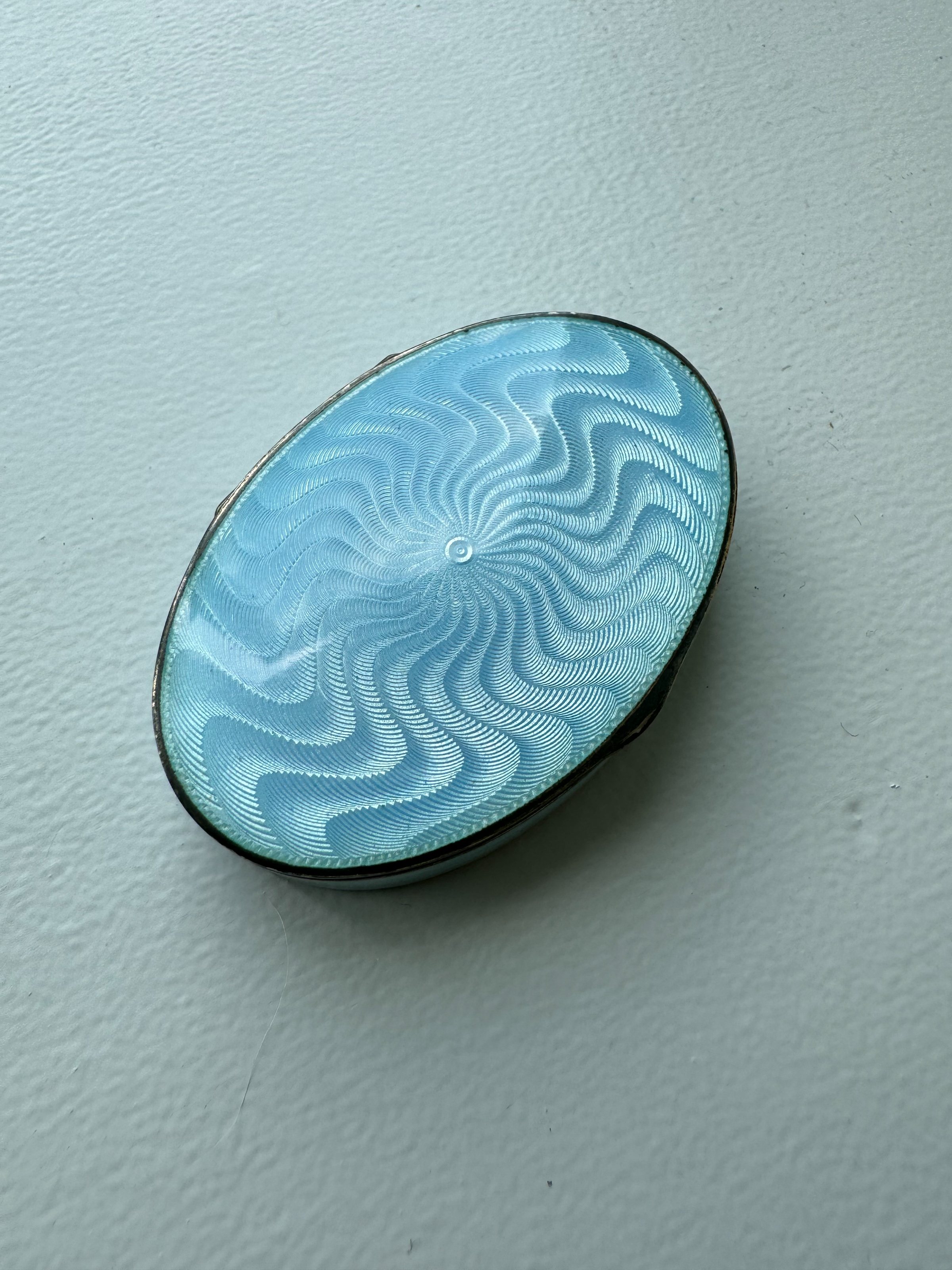
Marius Hammer, Norwegian 930 Silver and Guilloché Enamel Box, Bergen, c. 1900-1915. Hammer was the most prolific of the Norwegian guilloché-enamel workshops, and his pieces carry a script signature with the Bergen city mark and the '930' standard mark — slightly above British sterling (.925) and unusually high for the period.
A box in this size and condition runs $800 to $1,200 at auction. A larger covered box with figural enamel and original silk lining can clear $3,000. Comparable Scandinavian guilloché — David Andersen, J. Tostrup, Bolin — sits in the same bracket. Attribution turns on the script signature, the enamel execution, and the underside marks.
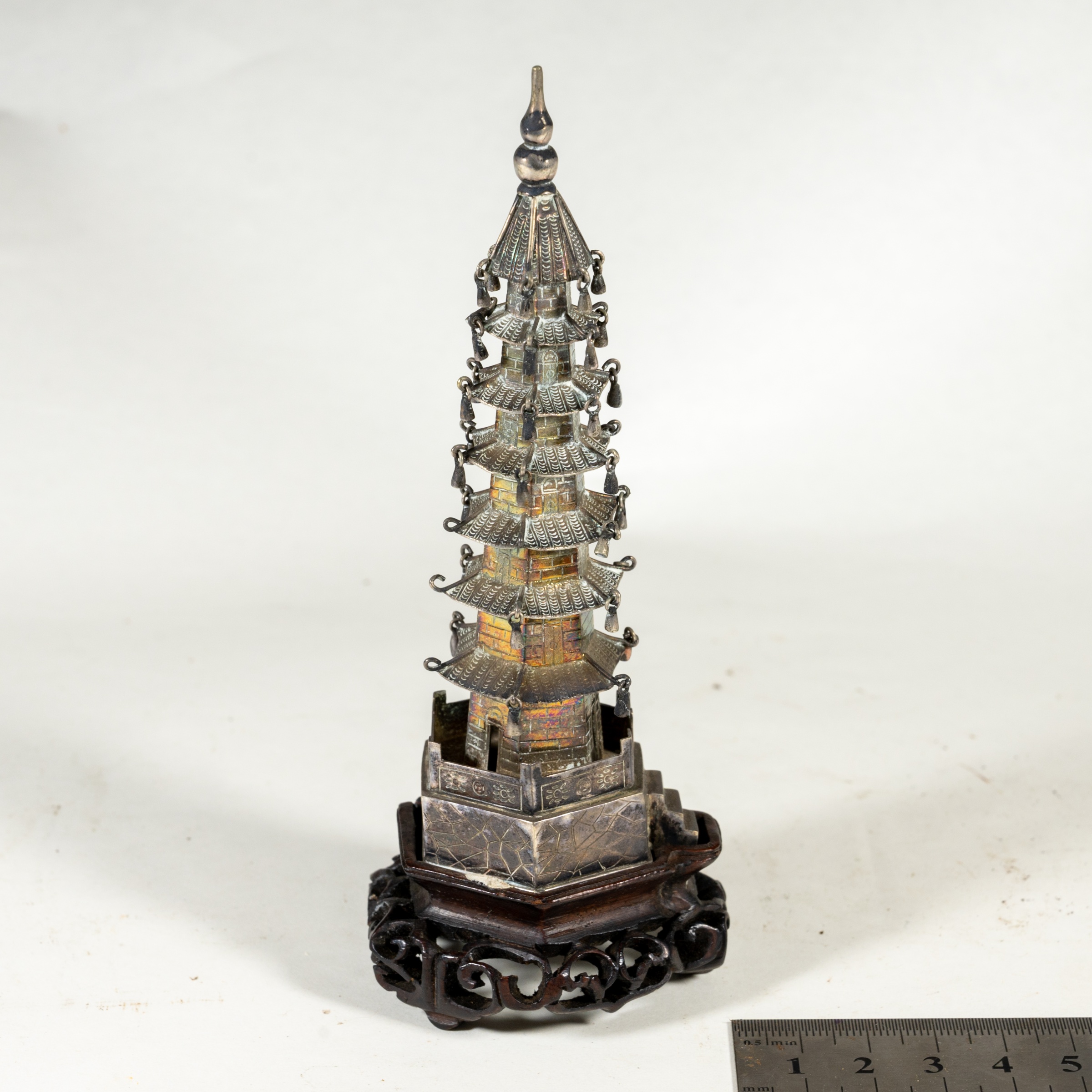
Chinese Export Silver Seven-Tiered Pagoda Model, in the manner of Yang Qing He or Cumwo, Late Qing Dynasty, c. 1900. Chinese export silver of the late Qing was made in Canton, Shanghai, and Hong Kong for the European and American homeward-bound trade. The major retailers — Wang Hing, Cumwo, Yang Qing He — stamped both a chop-mark cipher and a pseudo-British sterling sequence (a lion-passant-like mark with the retailer's initials).
This pagoda model sits at $300 to $500 for the form and condition. A larger, signed Wang Hing example with figural detailing can clear $3,000 to $5,000; a signed Yang Qing He hollowware piece can hit $10,000. The market for export silver has firmed sharply since the late 2010s, driven by mainland Chinese collectors repatriating diaspora silver.
Reference: makers and what they typically run
| Maker / type | Period | Typical price range |
|---|---|---|
| Paul Storr — Regency hollowware | 1792 – 1838 | $3,000 – $125,000+ |
| Paul de Lamerie — Huguenot London | 1712 – 1751 | $5,000 – $400,000+ |
| Hester Bateman — London | 1761 – 1790 | $400 – $20,000 |
| Mappin & Webb — Sheffield / London | 1860 – 1950 | $80 – $4,000 |
| Tiffany & Co. — Audubon / Chrysanthemum flatware | 1871 – 1965 | $1,000 – $25,000+ |
| Tiffany & Co. — hollowware, Moore period | 1868 – 1891 | $2,000 – $80,000 |
| Gorham — lion-anchor-G hollowware | 1868 – 1930 | $200 – $20,000 |
| Reed & Barton — Francis I flatware | 1908 – present | $300 – $8,000 |
| S. Kirk & Son — repoussé hollowware | 1815 – 1979 | $200 – $15,000 |
| American coin silver — early Federal | 1790 – 1860 | $150 – $5,000 |
| Old Sheffield Plate — Boulton, Fenton | 1742 – 1840 | $200 – $3,000 |
| EPNS / silverplate — generic Victorian | 1860 – 1920 | $20 – $150 |
| WMF — Jugendstil silverplate | 1900 – 1930 | $80 – $1,500 |
| Christofle — silverplated hollowware | 1850 – present | $80 – $4,000 |
| Liberty & Co. — Cymric / Tudric | 1899 – 1938 | $300 – $8,000 |
| Georg Jensen — Acorn / mid-century | 1915 – 1980 | $300 – $30,000+ |
| Buccellati — hand-chased hollowware | 1919 – present | $2,000 – $200,000 |
| German .800 — Bruckmann, Koch & Bergfeld | 1880 – 1940 | $200 – $5,000 |
| French .950 — Odiot, Puiforcat | 1840 – 1960 | $500 – $50,000 |
| Russian 84 zolotnik — Khlebnikov, Ovchinnikov | 1860 – 1917 | $500 – $50,000+ |
| Fabergé silver-gilt cloisonné enamel | 1885 – 1917 | $10,000 – $5,000,000+ |
| Chinese export — Wang Hing, Cumwo | 1850 – 1920 | $300 – $20,000 |
| Norwegian guilloché — Hammer, Tostrup | 1890 – 1940 | $300 – $5,000 |
| Mexican silver — Hector Aguilar, Spratling | 1935 – 1970 | $200 – $10,000 |
Two patterns we keep seeing
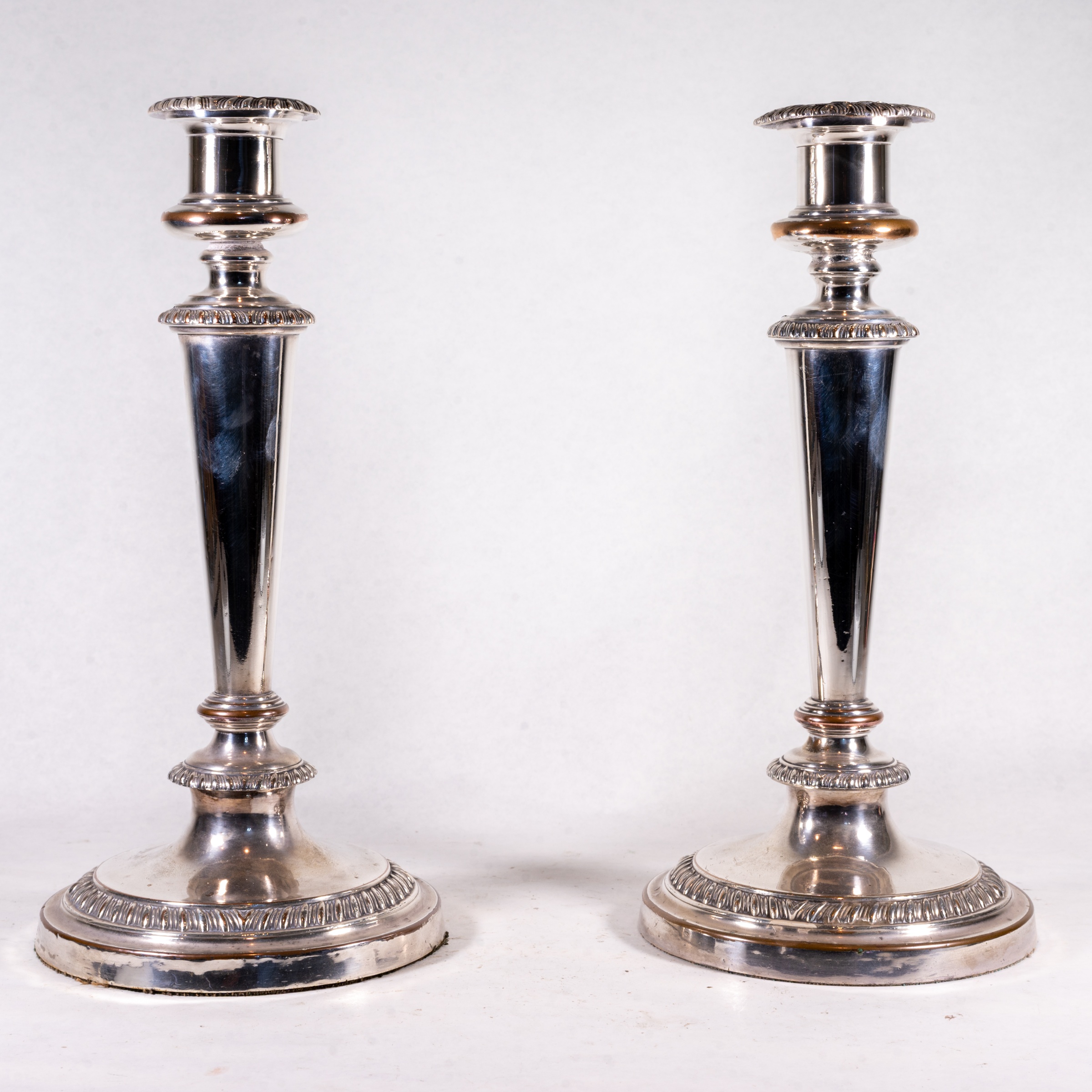
A Pair of English Old Sheffield Plate Candlesticks, George III / Regency Period, c. 1810-1820. This is the most-confused category in silver — and the single piece of vocabulary that costs sellers the most money. Old Sheffield Plate is a fused sandwich of sterling silver over a copper core, invented by Thomas Boulsover in Sheffield around 1742 and made until Elkington's electroplating patent of 1840 made the technique obsolete. It is specifically NOT Victorian silverplate.
The diagnostic is the warm reddish-orange copper showing through the silver at high-wear points on the column, the candle cup, and the rim — collectors call this 'bleeding', and on a period piece it is value-positive evidence of authenticity, not damage. A pair in this condition runs $300 to $500. A marked pair by Matthew Boulton, Fenton Creswick, or Watson & Bradbury runs $800 to $2,500; a sealed pair in original surface can clear $4,000. Victorian EPNS reproductions of the same form trade at $30 to $80.
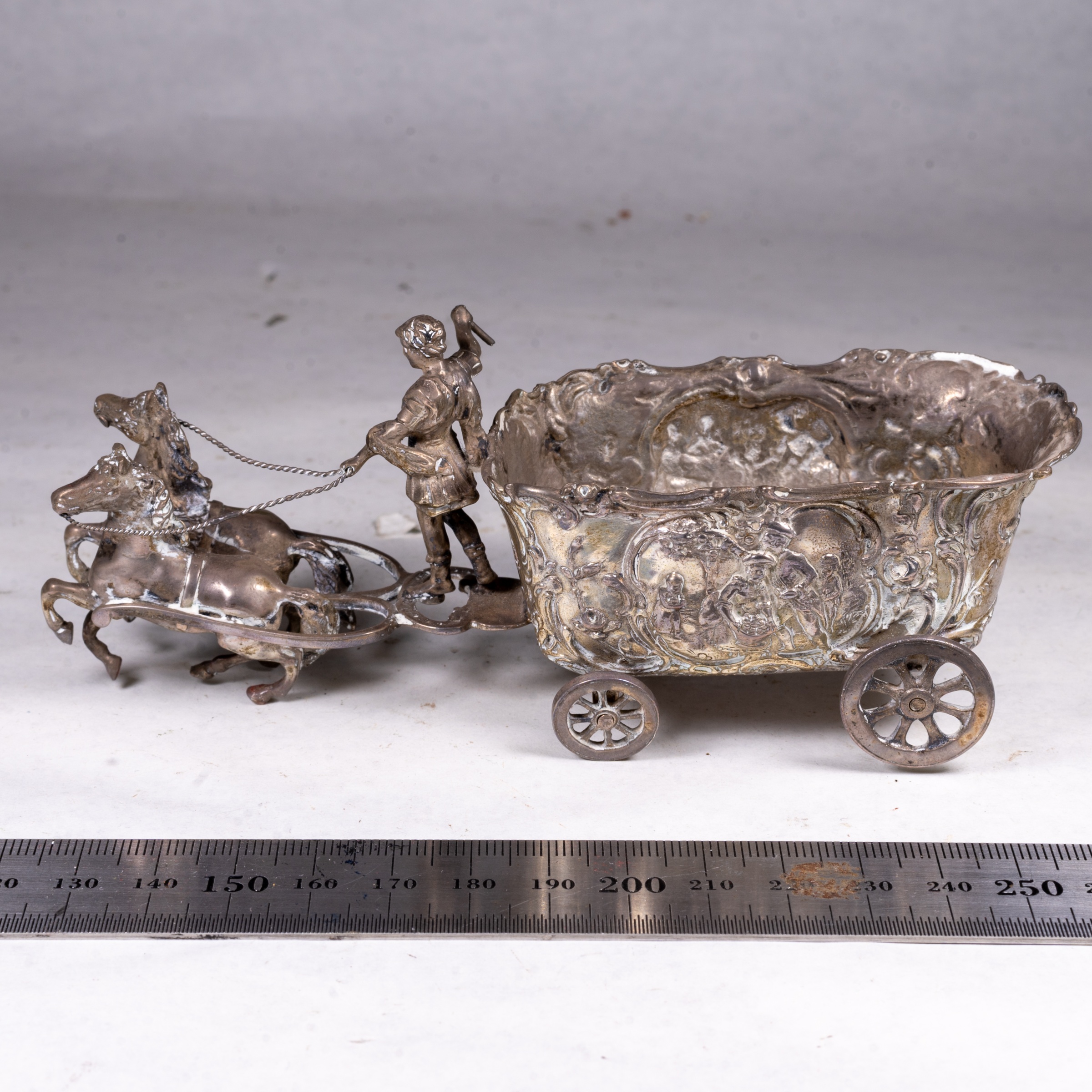
A German 800 Silver Figural Sweetmeat Dish, Attributed to Bruckmann & Söhne, Heilbronn, c. 1900. Bruckmann was the largest German silver factory of the period — the crescent-and-crown 'Halbmond und Reichskrone' mark plus the '800' fineness are stamped on every piece. German .800 sits below British sterling (.925) but well above the silverplate threshold, and the figural casting on this form is the upper tier of the workshop's output.
A piece in this size and condition runs $800 to $1,200. A larger Bruckmann centrepiece with multiple figural elements can clear $3,000. Comparable German .800 — Koch & Bergfeld, Wilkens, Kesselstatt — sits in the same bracket. Continental .800 silver is consistently under-priced relative to British sterling of equivalent age and form, which is where the value sits.
Practical things to think about
Two centuries of European silver were designed to be used, and almost any solid sterling piece will outlive its current owner if it is used sensibly. The rules are old, the materials are simple, and the most common mistakes are entirely avoidable.
Storage. Tarnish is silver sulphide — a thin black skin that forms when silver reacts with airborne hydrogen sulphide from rubber, wool, eggs, certain woods (oak and walnut especially), and the background levels of urban air pollution. The cure is to limit exposure. An anti-tarnish cloth bag with a small silica desiccant cube, stored away from rubber liners and felted drawers, keeps a coffee pot in display condition for years. Old chests with original baize-lined drawers are charming but the baize itself is now part of the problem — 1925 conservation standards do not match those of 1825. A silver chest fitted with proper polyethylene anti-tarnish strips (3M makes them) holds a flatware service indefinitely.
Display. Open-shelf display tarnishes within months in any normal urban interior; the older the piece, the slower the formation of new tarnish but the harder to remove it without damaging the chasing. A glazed cabinet with desiccant slows the process considerably. Avoid putting silver above or directly beside a radiator — thermal cycling cracks the solder joints on tea kettles, coffee pots, and any piece with a separately-attached spout or handle.
Polishing. Less is more, and gentler is better. A soft cotton cloth with a long-handled jeweller's rouge wipe, applied sparingly, is what the great Georgian pieces were maintained with for two centuries. Dipping solutions and abrasive pastes strip silver permanently — a Storr coffee pot put through Goddard's once a month for a decade loses the crispness of its chasing and the figure with it. Save the dip for daily flatware, never use it on hallmarks, and accept that some patina (the soft slight gradient in the recessed areas of the chasing) is read by collectors as evidence of age and is value-positive.
Insurance. Get specific-listed coverage on any single piece over $3,000, and photograph every hallmark, every monogram, and the underside of any weighted piece for the schedule. Refusing to insure family silver because 'it's only family stuff' is the single most common avoidable mistake in this market.
Use it. Sterling is mechanically robust — it has been used as tableware for a thousand years for a reason. Eat off it, drink from it, polish lightly. The patina builds with use rather than degrades. Weighted candlesticks and weighted compotes are the exception — the pitch fill cracks under repeated thermal shock and the thin silver shell distorts.
Upload photos of your silver — the marks, the form, any damage — and we'll send back a documented valuation with the comparable sales we used: lot number, hammer price, and venue, drawn from Sotheby's, Christie's, Bonhams, Heritage, Doyle, Skinner, and the specialist saleroom records. We state melt against collector premium, flag any plate-or-weighted diagnostic, and tell you what would move the figure. We don't buy and we don't take consignment. Your first valuation is on us.
Reviewed by The Findthevalueof research team. Last reviewed 17 Jun 2026.
Common questions
How can I tell if silverware is real silver?
- Look first for the standard mark. On American pieces, the words 'STERLING', 'STER', '925', or '.925' guarantee 92.5% silver and have been near-universal since the National Stamping Act of 1906. On British pieces, the lion passant (a side-on lion in a rectangular cartouche) together with a recognised assay-office town mark — London's leopard's head, Birmingham's anchor, Sheffield's crown or rose, Edinburgh's castle — confirms sterling. If you see 'EPNS', 'EP', 'A1', 'SP', 'Sheffield Plate', 'Silverplate', 'Triple Plate', 'Quadruple Plate', or just a maker's name with no fineness mark, the piece is plated or coin silver, not sterling. A magnet sticking strongly to the body is a quick second check: silver is non-magnetic, so a strong pull means base metal underneath.
What does EPNS on silver mean — is it worth anything?
- EPNS stands for ElectroPlated Nickel Silver. The 'nickel silver' base is a copper-nickel-zinc alloy that contains zero silver; only the thin outer plating is real silver, and on most pieces it's too thin to recover refining cost. 'A1' next to it is a plating-thickness grade, not a purity standard — it means 'first quality' to the maker, not 'sterling'. Most EPNS table silver trades at $20 to $80 regardless of weight. The exceptions are designer pieces — WMF Jugendstil, Christofle, Liberty & Co. Tudric — where the design carries the value rather than the metal. A WMF Art Nouveau bonbon dish in good condition is $100 to $200; a generic Victorian EPNS biscuit barrel is closer to $40.
Is silverplate worth anything, or is it just decorative?
- Plate has worth, but it's a fraction of sterling. Old Sheffield Plate (1742 to c.1840 — a fused silver-on-copper sandwich invented by Thomas Boulsover, before electroplating existed) is genuinely collectible: a pair of Georgian candlesticks runs $400 to $1,500, and 1stDibs records show old Sheffield Plate averaging around $1,525 across listings. EPNS and EPBM (electroplated Britannia metal) from the late 19th and early 20th centuries are mostly $30 to $150 unless the maker is notable (WMF, Christofle, Elkington's early Aesthetic Movement). 'Quadruple Plate' on American pieces by Meriden, Pairpoint, or Rogers Bros is heavier plating, but still no guaranteed silver content. The diagnostic that wrecks the value: copper or brass 'bleeding through' at the high-wear points where the plating has worn off.
What does the weight in grams or troy ounces tell me?
- On solid sterling the weight gives you the melt floor — the price you'd get from a refiner if all you cared about was the metal content. The formula is weight in troy ounces × 0.925 × the day's silver spot price; at silver's June 2026 spot of roughly $70 per troy ounce, a 100-gram sterling piece (3.215 troy oz) carries about $208 of melt value, and refiners pay 60 to 95 percent of that depending on volume and form. For collector pieces with a strong maker, the auction figure runs two to six times the melt floor — a Tiffany Chrysanthemum service is a recent example where the hammer was several times bullion. For monogrammed common-pattern table silver and unsigned Continental holloware the auction figure converges on melt. Our report focuses on the comparable-sale figure, since for collector-quality silver it is the maker, the condition, and the form that set the price; metal weight is the safety net underneath them, useful but rarely decisive.
How do I read British silver hallmarks?
- A full British hallmark from 1784 to 1890 contains five marks struck in a row: the sponsor's (maker's) initials, the lion passant for sterling .925 (or a seated Britannia for the higher .958 standard), the town mark for the assay office (leopard's head for London, anchor for Birmingham, crown or rose for Sheffield, castle for Edinburgh, harp crowned for Dublin), a date letter in a shaped cartouche that cycles every 20 to 25 years per office, and the reigning sovereign's head in profile confirming excise duty was paid. After 1890 the duty mark disappears; from 1999 the date letter and lion became optional. Each assay office runs its own date-letter cycle, so a 'M' in London is not the same year as a 'M' in Sheffield — you have to match the letter against that specific office's chart. The encyclopedia at 925-1000.com is the standard online cross-reference.
How do I tell Tiffany & Co., Gorham, or Reed & Barton from a 19th-century imitation?
- Tiffany sterling carries the full 'TIFFANY & CO.' stamp plus a director's initial — 'M' for the Edward C. Moore period (to 1891), 'T' for Charles L. Tiffany (1891 to 1902), 'C' for Charles T. Cook (1902 to 1907), 'M' again for John C. Moore (1907 to 1947), discontinued around 1965 — along with a four-digit pattern and order number. Gorham sterling uses the lion-anchor-G triple mark from 1868 onward, often with a year symbol (letter A through Q for 1868 to 1884, then pictorial symbols 1885 to 1933). Reed & Barton sterling typically carries an eagle, an 'R', and a lion in a row. The trap: many mid-19th-century American makers struck rows of British-style 'pseudo-hallmarks' — eagle head, profile bust, letter in a shield — that look like an English sterling sequence but mean nothing regulatory. If you see a lion-style mark next to a city-shield mark on a US piece, check the actual wording for 'STERLING' or '925' before assuming British origin.
What is Sheffield Plate, Old Sheffield Plate, and how is it different from Sheffield sterling?
- Sheffield sterling means solid .925 silver assayed at the Sheffield assay office — crown mark before 1975, rose mark since — by a maker like John Round, Mappin & Webb, or Walker & Hall. Old Sheffield Plate is something completely different: a fused silver-over-copper sandwich invented by Thomas Boulsover in Sheffield around 1742 and made until about 1840, when Elkington's electroplating patent (1840) made it obsolete. Most Old Sheffield Plate is unmarked — WorthPoint estimates 90% of pieces carry no maker mark at all — but the identifying tell is copper 'bleeding through' at points of wear, and a silver rim soldered around any exposed edge so the copper sandwich doesn't show. Confusing the two costs sellers thousands every year. A solid sterling Sheffield candlestick by Henry Wilkinson is a different object, and a different price bracket, from an Old Sheffield Plate candlestick by an unmarked Sheffield platers' workshop.
Will a monogram or removed monogram destroy the value?
- A monogram on common table silver typically takes 10 to 30% off the figure; an aggressively buffed-out monogram (look for a thin, polished patch in the centre of the bowl or back of the handle, often visible when you hold the piece up to a window) is worse — 25 to 50% off — because the buffing also damages the surrounding chasing. There are two exceptions worth remembering. First, a period monogram on a Georgian or Federal piece is often value-positive: collectors read it as evidence the piece was used by the family it was made for. Second, if the monogram ties the piece to a documented person or family (a presentation inscription, a royal cypher, a signed historical event), the engraving multiplies the value rather than reducing it. Never remove a monogram on a piece you might sell — bad removal work is impossible to repair and is the single most common avoidable mistake.
What is a weighted sterling piece, and why is it worth so little?
- Weighted sterling is a sterling silver shell — typically a candlestick, compote, or perfume bottle base — filled with pitch, plaster, or cement to give the piece stability and heft. The .925 silver is real, but only the thin outer skin is silver; the bulk of the weight is filler with no melt value. American weighted candlesticks by Gorham, International, Wallace, and Frank M. Whiting are stamped 'STERLING WEIGHTED' or 'STERLING REINFORCED' on the base. Inheritors often weigh a pair of candlesticks at 800 grams and expect a melt figure to match — the actual silver content can be under 60 grams, and the refiner figure correspondingly tiny. Weighted pieces are valued on the design and maker, not the gross weight, and we flag the distinction in the report.
How do I value Continental, Russian, or Chinese export silver?
- Continental silver typically runs at lower fineness than British sterling — French .950 first standard (Minerva head in an octagon, in use since 1838) or .800 second standard (Minerva head in a barrel cartouche); German .800 or .835 (the crescent-and-crown 'Halbmond und Reichskrone' mark, used since 1888); Italian .800 or .925 with a province two-letter code in a lozenge; Dutch .934 (lion rampant). Russian imperial silver carries a zolotnik fineness number — '84' for .875 (the most common standard), '88' for .916, '91' for .947 — plus the kokoshnik (a woman's head in traditional Russian headdress) facing left from 1899 to 1908 and right from 1908 onward, with a Greek-letter city code. Fabergé and the major Moscow workmaster shops (Khlebnikov, Ovchinnikov) command extreme premiums: a Fabergé silver-gilt cloisonné enamel salt cellar hammered £21,420 at Dreweatts in March 2025, and Heritage's May 2025 Imperial Fabergé sale realised $5.69 million — a record for the house. Chinese export silver of the late Qing period (figures like Yang Qing He, Cumwo, Wang Hing) runs $300 to $5,000 for typical forms, with rarer signed pieces clearing $10,000.
Should I clean or polish my silver before having it valued?
- No. Tarnish is surface oxidation; it has no effect on the silver content and lifts off in seconds when you actually need to. Aggressive polishing or chemical dips slash an antique's value by 15 to 30% by destroying the patina collectors prize — that soft, slightly gradient darkening in the recessed areas of the chasing is read as evidence of age. Over-polishing rounds the edges of the hallmark strike and flattens the crispness of repoussé and engraving, both of which knock the figure down further. A faint, weak hallmark on a Storr-period Regency piece can take 40 to 70% off the figure versus a crisply-marked equivalent of the same form. Photograph the piece as it is, send it for valuation first, then decide what to clean.
Do you appraise designer and studio silver — Georg Jensen, Liberty Cymric, Buccellati?
- Yes. Georg Jensen mid-century holloware in the Henning Koppel and Sigvard Bernadotte idiom is one of the strongest segments at auction right now — Heritage hammered a 510-piece Jensen Acorn service for twelve at $30,000, and Sotheby's runs a dedicated Jensen consignment channel. Liberty & Co. Cymric and Tudric (the Arts & Crafts ranges produced from 1899) are sought after, particularly early enamelled pieces: clocks, vases, vesta cases, and buckles can run $1,000 to $8,000 depending on condition and stone-set decoration. Buccellati holloware — hand-chased centrepieces, fluted bowls — trades $10,000 to $200,000 in the secondary market; flatware services run $10,000 to $25,000. Attribution turns on the full-script signature, the original retailer's box where present, and the design model number. We cite the specialist sales (Sotheby's, Bonhams, Heritage Fine Silver & Objects of Vertu Signature Auctions) rather than general decorative-art lots.
Worked examples in this category
- German Rococo Revival .800 Silver Figural Chariot Table Toy, Importer Berthold Müller, circa 1897
- A WMF (Württembergische Metallwarenfabrik) Silver-Plated Art Nouveau 'Jugendstil' Two-Part Bonbon Dish, Model 218, circa 1900-1910
- Late Victorian Silver-Plated Chinoiserie Biscuit Box, London Manufacture, circa 1880
- Chinese Export Silver Seven-Tier Pagoda Model on Carved Hardwood Stand, Late Qing Dynasty to Republic Period, Circa 1890–1930
- An English Sterling Silver and Blue Guilloché Enamel Pill Box, circa 1900-1935
- Marius Hammer, A Norwegian 930 Silver and Guilloché Enamel Box, Bergen, circa 1900-1915
- A Pair of English Old Sheffield Plate Candlesticks, George III/Regency Period, circa 1810-1820