What is your Japanese woodblock print worth?
Researched valuation of Japanese woodblock prints — Hiroshige, Utamaro, Kunisada, shin-hanga. Original or later reprint, with cited comparable sales.
A Japanese woodblock print is worth what other impressions of the same design, from the same printing and in comparable condition, have sold for recently. The single biggest determinant is which printing you have: a lifetime Edo-period impression, a later restrike from worn blocks, or a twentieth-century recarving that carries the same signature and seals. The written report identifies the artist, the design and the publisher, reads the censor and date seals, assesses colour, margins and condition, cites comparable sales with lot, price and venue, states a confidence level, and tells you which physical checks remain before a sale.
The most influential pictures in the history of Western painting were, for a few years, wrapping paper.
That is the story, anyway, and like most good stories it is about a quarter true. Japanese prints did reach Paris in the 1850s stuffed around porcelain in packing crates, and the etcher Félix Bracquemond did find a volume of Hokusai's 'Manga' sketches at his printer's shop in 1856 and carry it round the cafés like a relic. But by the time Monet had two hundred of them on the walls at Giverny, van Gogh was copying Hiroshige's plum orchard in oils and Whistler was painting London girls in kimonos, the prints were being imported and sold on purpose, at prices that would have astonished the Edo townsman who bought the original for the cost of a bowl of noodles.
That is the first thing to know about ukiyo-e, the 'pictures of the floating world'. They were not made as art. They were made as media: the celebrity portraits, theatre posters, fashion plates, travel brochures and pin-ups of a city of a million people with money to spend and, under the Tokugawa shoguns, not much they were allowed to spend it on. The government that closed Japan to the outside world in the 1630s spent the next two centuries policing what its own subjects could look at. The small seals in the corner of a print are there because every design had to pass a censor; 'kiwame' means 'examined'. Luxury was banned so often that the ban became a style, and when the reforms of 1842 forbade pictures of actors and courtesans, Kunisada drew the same actors, called them ancient heroes, and everyone in Edo knew exactly who they were.
Four names carry most of the money. Utamaro, the great portraitist of the Yoshiwara, who was manacled for fifty days in 1804 over a print of the warlord Hideyoshi and was dead within two years. Hokusai, who signed himself 'the old man mad about painting', moved house ninety-three times and published the Great Wave at seventy. Hiroshige, the hereditary fire warden who walked the Tōkaidō road in 1832 and came home with the fifty-five views that made his name and, fifty years later, van Gogh's. And the Utagawa school, the vast commercial studio of Toyokuni, Kuniyoshi, Kunisada and their pupils, which turned out tens of thousands of designs and gave the nineteenth century its samurai, its ghosts, its kabuki stars and its cats.
Every one of those prints was made by four people who never got equal billing: the publisher who commissioned and paid for the design, the artist who drew it on thin paper, the carver who pasted the drawing face down on a block of cherry and cut it away line by line, and the printer who rubbed each colour from its own block with a bamboo-leaf pad called a baren. The artist's name is on the print. The carver's usually is not. The publisher's seal is the one a specialist reads first, because it says which printing this is, and the printing is the price.
This page tells you what we look at, what changes the figure, and what your written report covers when you upload photographs. Comparable prices come from the auction record and the specialist Japanese print dealers, not from retail or guide prices.
A Japanese print is worth what other impressions of the same design, from the same printing and in comparable condition, have sold for recently. The design tells you the artist; the seals tell you the publisher and often the month; the paper, the colour and the sharpness of the line tell you whether you are holding an Edo-period impression, a Meiji restrike from tired blocks, or a twentieth-century recarving. That last question is the whole game, and it is the one photographs answer least well.
The rungs below are all reports on this page. A Kunisada II 'Life of Buddha' of 1860 with its margins and its signature block eaten away: $50 to $80. A 1953 Bunraku stage-set print by Sadanobu III, badly faded: $75 to $150. Kunisada II's 'Yadorigi' from the Genji Cards series of 1857, a good impression in a bad frame: $100 to $200. A twentieth-century recarving of Hiroshige's 'Kinryūzan Temple in Asakusa': $150 to $250, against $3,965 at Bonhams in 2023 and $5,000 at Christie's in 2021 for the 1856 original. A Kunichika actor portrait of October 1872 with the colour intact and the margins gone: $200 to $400, and several times that with the margins on. A complete Kunisada triptych of Taira warriors from about 1844: $300 to $500. An Utamaro courtesan of 1804, the biggest name in the batch, in fair condition and with the lifetime-or-recarving question unresolved: $300 to $500. And a complete Yoshitsuya warrior triptych of 1857 with its white dragon and its colour intact: $2,000 to $3,000. Above that the rules are the same with more zeros. A first-edition Hiroshige 'Shōno' has made £2,375 at Christie's, a complete Hōeidō Tōkaidō set made $85,400 at Bonhams in 2011, and a fine early impression of the Great Wave is a seven-figure object.
Artist and printing are the lever. Colour and margins are the brake.
What changes the price
Five things matter, in roughly this order.
Which printing comes first. The blocks for a popular design were printed for years, sometimes decades, and then recut, so a 'Hiroshige' can be an 1833 Hōeidō impression, an 1850s reissue from worn blocks, a Meiji restrike, a 1920s recarving or a 1960s reprint, and all five carry the same signature and the same publisher's seal, because the carvers copied those too. Edo-period sheets are on soft, thin, hand-made mulberry paper with visible fibre, and the line has the slight softness of a block that has been used; later recarvings are sharper and brighter, on whiter, heavier paper, with the registration a little too perfect. Both Hiroshige reprints on this page were identified that way.
Artist, subject and series come second. Landscapes by Hiroshige and Hokusai, beauties by Utamaro, warriors and ghosts by Kuniyoshi, actors by Sharaku and Kunichika have the widest audience. Within an artist the famous series and the famous designs sell for multiples of the rest: the Great Wave is one of the Thirty-six Views, Shōno is one of the Fifty-three Stations, and a landscape from the same hand that nobody has heard of is a fraction of the price.
Impression and colour come third. An early impression from fresh blocks keeps the finest lines in the hair unbroken and the hand-wiped colour gradations (bokashi) subtle. Colour matters more here than in Western prints because the pigments were fugitive: the purples and pinks of the 1850s go tan, the aniline reds and purples of the 1870s shout, and the Prussian blue that arrived through Nagasaki in 1829 and made Hokusai's late career is the one that usually holds. A print that has kept its colour is not a variant. It is a different price bracket.
Margins and condition come fourth. Japanese prints were trimmed by their first owners, pasted into albums by their second and glued to boards by their third; the collector wants full margins, a clean back, no centre fold and no backing. Foxing, toning and the brown burn of an acidic mat all take money, and trimmed margins took most of it from the Kunichika on this page.
Completeness comes fifth. A triptych is three oban sheets designed as one image and sold as one; a single sheet from a triptych is worth a fraction, and a complete, matched, unfaded set is worth a good deal more than three sheets.
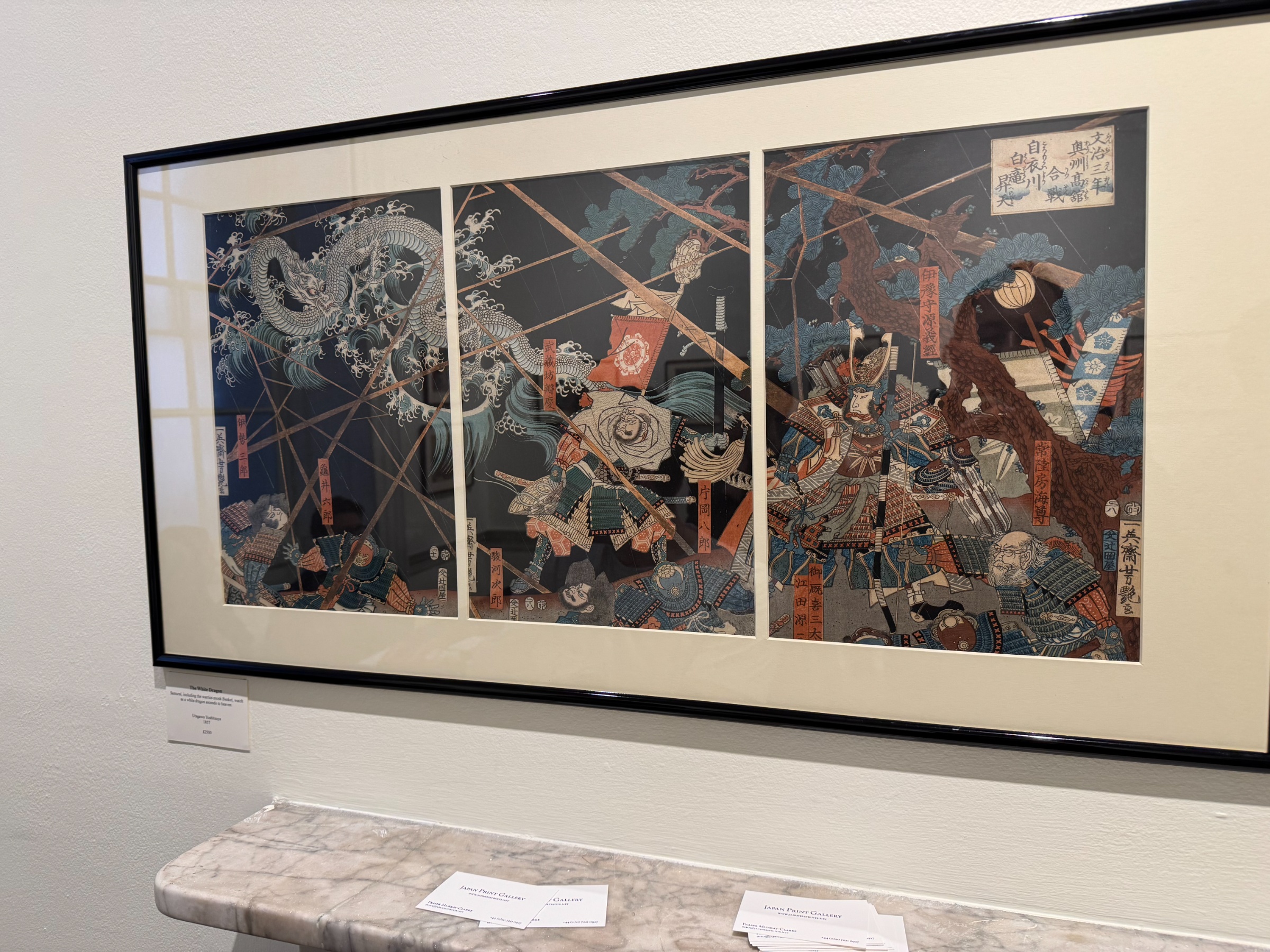
Utagawa Yoshitsuya (1822-1866), 'At the Battle of Takadachi in Ōshū Province in 1187, a White Dragon Ascends to Heaven from the Koromo River', oban triptych, November 1857. Yoshitsuya was Kuniyoshi's pupil and inherited his master's taste for the supernatural. Minamoto no Yoshitsune, the most romanticised general in Japanese history, makes his last stand in a storm of diagonal rain while a white dragon uncoils out of the river, and the warrior-monk Benkei holds the centre sheet. It is a musha-e, a warrior print, the genre the censors preferred to actors and courtesans, designed the year before the shogunate signed the treaty that opened the ports.
The report dated it from the censor seals, matched the signature, publisher and seals to the impression in the Smithsonian, and placed it where complete Utagawa-school warrior triptychs in fine colour sit, with a Yoshitoshi triptych at Christie's for $2,286 as the nearest comparable. What carries the premium is condition: the solid black ground, the hardest colour to keep, is unfaded, and the deep blues are intact, which means these three sheets spent most of a hundred and seventy years in the dark. One caveat: the gallery label says 1877, the seals say 1857, and the seals win.
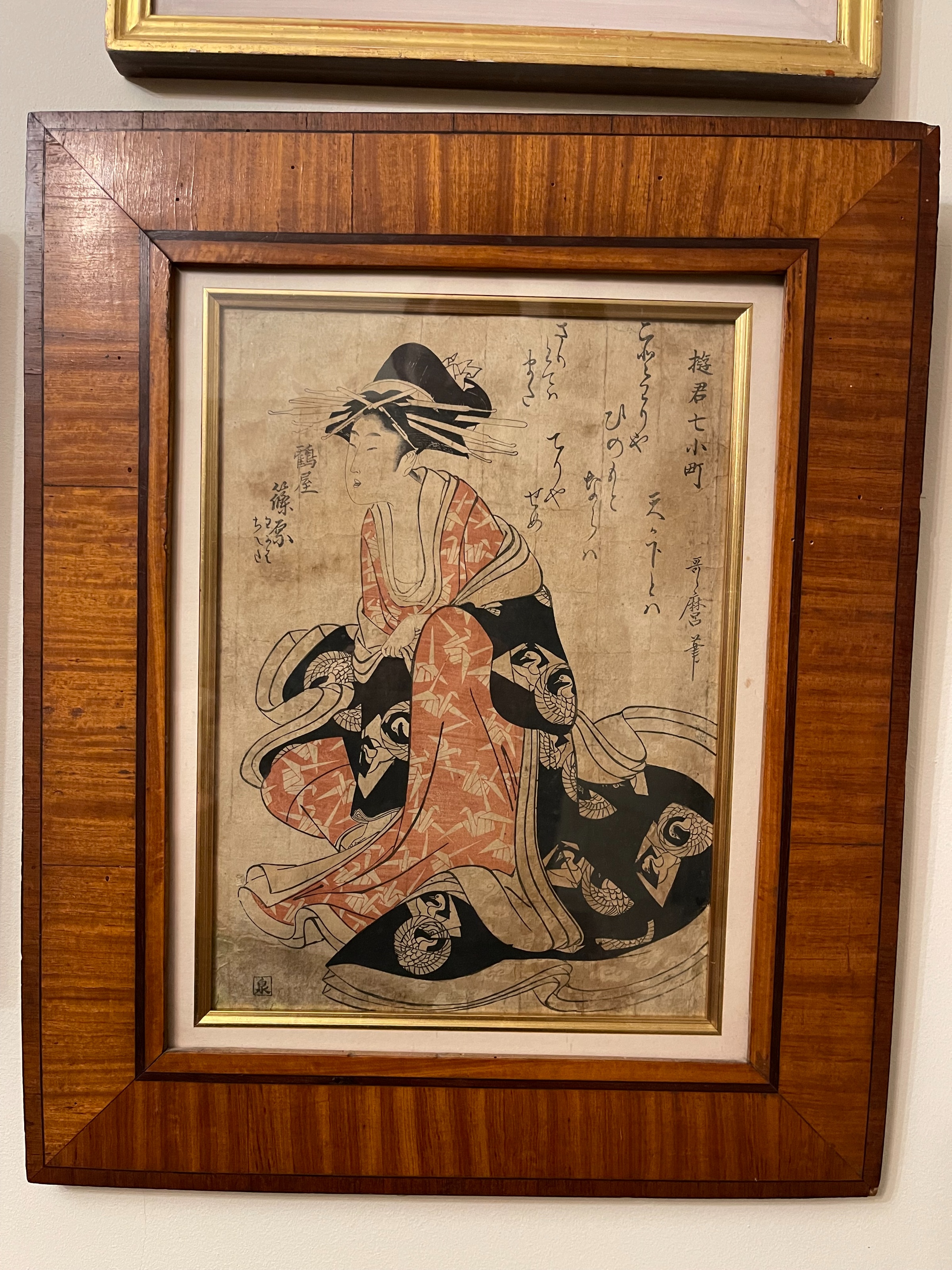
Kitagawa Utamaro (c. 1753-1806), 'The Courtesan Shinohara of the Tsuruya House', from 'Seven Komachi of the Pleasure Quarters', c. 1804-05. Utamaro is the reason Europe learned the word ukiyo-e: Edmond de Goncourt wrote his life in 1891 and called him the painter of the green houses. Shinohara was a real woman, an oiran of the Yoshiwara, and the print is, like all of them, an advertisement: cranes on black over a red kimono of folded-paper cranes, and above her a poem that compares the courtesans of Edo to the ninth-century poet Ono no Komachi.
This is the most instructive object in the batch, because it is the biggest name and the smallest number. The report confirmed the design, the signature 'Utamaro hitsu' and the publisher, then said what it could not: whether this sheet is a lifetime impression or one of the excellent recarvings made from the Meiji period onwards, a question that needs the back of the paper. The condition is fair, heavily toned and foxed, the fugitive reds gone to tan, trimmed on all sides, with a crease across the middle. So the estimate is $300 to $500 for a plausibly lifetime Utamaro in poor condition, at 55 percent confidence, with a sentence saying a twentieth-century reprint would be worth a tenth of that. A fine lifetime impression of the same design would be a five-figure print. Same artist, same design, same signature. The paper decides.
Reference: artists, print types and what they typically run
| Artist / print type | Period | Typical price range |
|---|---|---|
| Harunobu — early full-colour prints, lifetime impressions | 1765 – 1770 | $3,000 – $100,000+ |
| Utamaro — bijin-ga, lifetime impressions | 1790 – 1806 | $2,000 – $150,000+ |
| Utamaro, Hokusai, Hiroshige — Meiji and later recarvings | 1880 – 1950 | $50 – $400 |
| Sharaku — actor portraits | 1794 – 1795 | $20,000 – $500,000+ |
| Hokusai — Thirty-six Views of Mount Fuji, early impressions | 1830 – 1834 | $5,000 – $1,000,000+ |
| Hokusai — Manga volumes and book pages | 1814 – 1878 | $100 – $2,000 per volume |
| Hiroshige — Hōeidō Tōkaidō, first-edition impressions | 1833 – 1834 | $1,500 – $50,000+ |
| Hiroshige — One Hundred Famous Views of Edo, early impressions | 1856 – 1858 | $1,000 – $30,000+ |
| Hiroshige — later 19th-century restrikes from worn blocks | 1860 – 1900 | $100 – $800 |
| After Hiroshige and Hokusai — 20th-century recarvings (Watanabe, Uchida, Adachi) | 1920 – present | $50 – $400 |
| Kuniyoshi — warrior and ghost triptychs | 1830 – 1861 | $1,000 – $40,000+ |
| Kuniyoshi — single sheets: actors, heroes, cats | 1830 – 1861 | $200 – $5,000 |
| Kunisada (Toyokuni III) — actors, beauties, Genji series | 1810 – 1865 | $100 – $3,000 |
| Kunisada II, Kuniteru, Kunichika — Utagawa-school single sheets | 1850 – 1900 | $50 – $600 |
| Yoshitoshi — One Hundred Aspects of the Moon, Thirty-two Aspects | 1885 – 1892 | $500 – $15,000 |
| Meiji war, Yokohama and court prints — Kiyochika, Chikanobu | 1870 – 1905 | $100 – $3,000 |
| Surimono — privately commissioned deluxe prints | 1800 – 1840 | $500 – $20,000 |
| Shin-hanga — Hasui, Yoshida, Koson, Goyō | 1915 – 1960 | $200 – $20,000+ |
| Sōsaku-hanga — Hoshi, Saitō, Munakata, Sekino | 1930 – 1990 | $300 – $15,000 |
| Kuchi-e and book frontispieces | 1890 – 1915 | $30 – $500 |
| Modern offset and photomechanical reproductions | any | $5 – $50 |
Two patterns we keep seeing
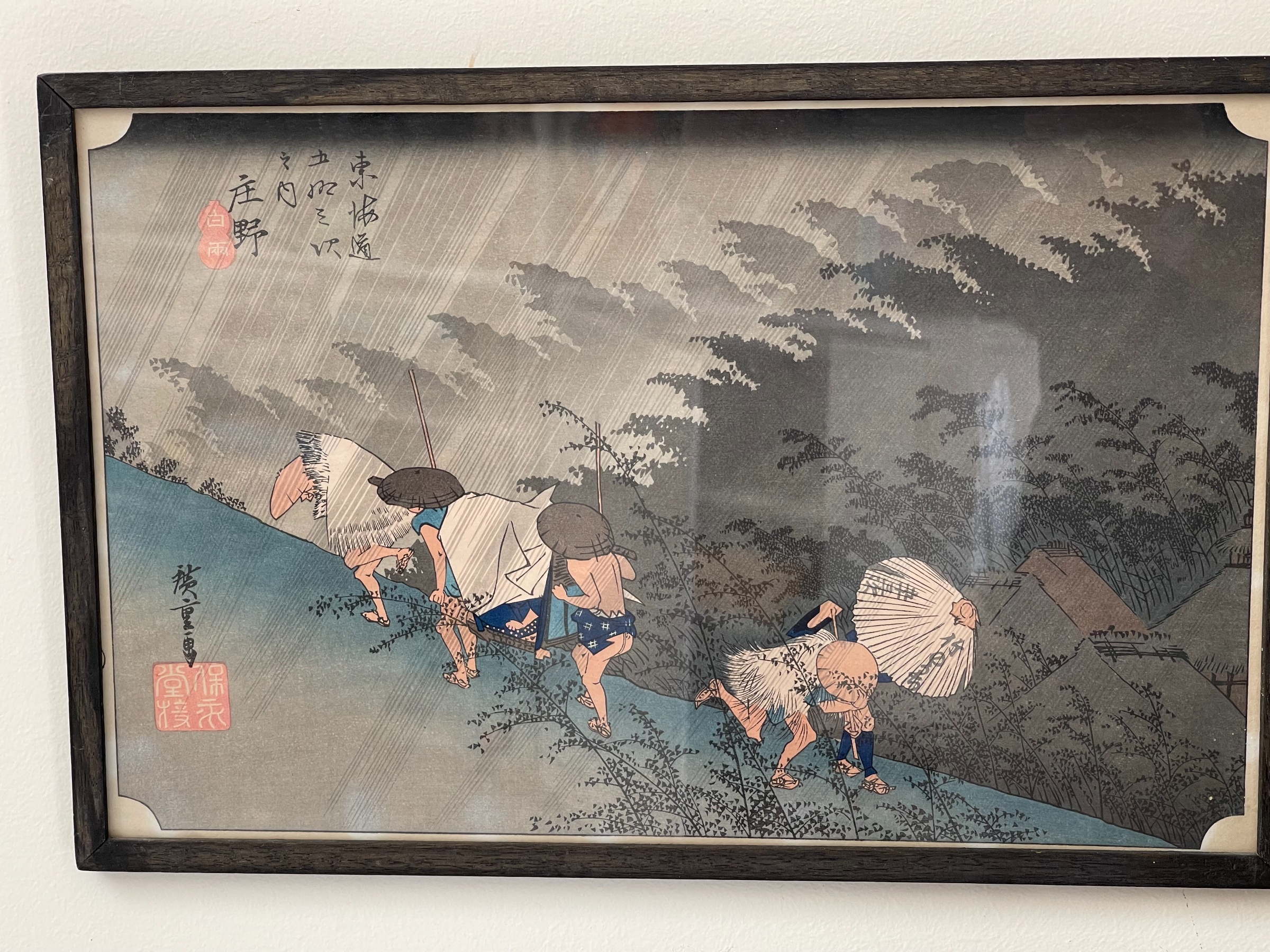
After Utagawa Hiroshige, 'Sudden Shower at Shōno' from 'The Fifty-three Stations of the Tōkaidō', a mid-twentieth-century woodblock reprint of the 1833 design. This is the most-confused object in Japanese prints and the one most often sold to a family as the real thing. The design is one of the two or three most famous in the whole tradition: porters and travellers bent double against a rain Hiroshige draws as a screen of diagonal lines, bamboo whipping, the road turning into a river. It is signed 'Hiroshige ga', it carries the Hōeidō publisher's seal, and every line of the original is present, because the twentieth-century carvers copied all of them.
What the report saw was paper too white, colour too bright, the line too clean and the sheet too flat for 1833, and it said so plainly: a high-quality Showa-era recarving, hand-printed from new blocks, framed to the image so the margins cannot be checked. Against the £2,375 a first-edition impression made at Christie's and the $85,400 for a complete Hōeidō set at Bonhams in 2011, this sheet is $200 to $400, which is what the good mid-century reprints (Uchida, Watanabe, Adachi) actually fetch. The report also says the one thing that would change its mind: the back of the sheet. If the paper is right, the number moves by a factor of ten.
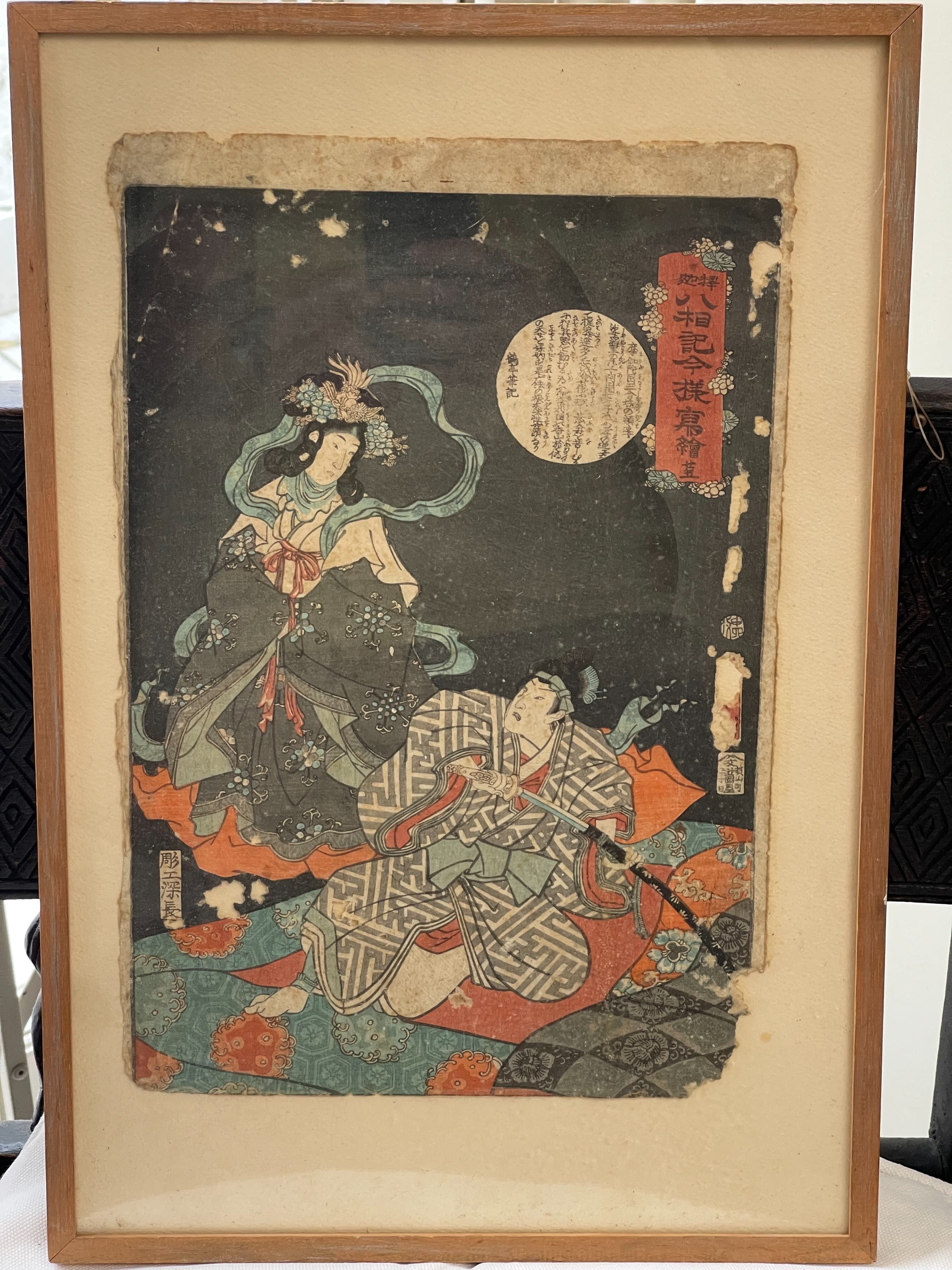
Utagawa Kunisada II (1823-1880), 'No. 24' from 'The Life of Buddha in Modern Pictures', June 1860. A celestial figure in a trailing robe descends towards a swordsman under a full moon whose disc is filled with text: the Buddha's biography retold as a kabuki spectacular, because that is how the Utagawa school retold everything. The publisher was Tsujiokaya Bunsuke, the carver signed as Fukachō, and the design went through the censors in the sixth month of 1860, the year the shogun's chief minister was cut down at the Sakurada Gate.
The everyday end of the market looks like this. The sheet is genuine, period and datable to the month, and the report confirmed the attribution against documented impressions because it had to: the artist's signature block is physically gone, along with most of the margins, and the dark ground has gone mottled with damp. Kunisada II single sheets in decent condition made £99 at Bishop & Miller and 500 SEK at Stockholms Auktionsverk in 2022; this one sits at the bottom of that market, $50 to $80, with a note that no saleroom will want it as a single lot. Most of the Japanese prints in Western drawers are Utagawa-school sheets of this kind, and most of them, foxed and trimmed, are worth about this. Knowing so before paying for conservation or a frame is what the report is for.
Practical things to think about
Japanese prints are the most light-sensitive objects a collector is likely to own. The museums that hold the best of them show a sheet for three months and then rest it in the dark for years, and they are not being precious.
Light first. The vegetable colours of the Edo period were never meant to last: the blue-purple from dayflower, the pink from safflower and the yellow from gamboge fade in years, not decades, in daylight, and a print that has kept them is worth a multiple of one that has not. Hang prints away from windows behind UV-filtering glass or acrylic, or better, keep them flat in a solander box and frame a reproduction. Never hang a good one in a kitchen, a bathroom or a hallway that gets the afternoon sun.
Then the mount. Almost every old Western frame around a Japanese print holds an acidic mat and a cardboard back, and the mat is slowly burning a brown line into the sheet; the Kunisada II 'Yadorigi' on this page is a good impression sitting in exactly that kind of frame, its mat foxed and discoloured around it. Conservation framing means an acid-free mat, hinges of Japanese tissue and wheat-starch paste, and nothing adhesive touching the print. Never dry-mount, never tape, and never let a framer trim the margins to fit: the margins are a third of the price.
Handling and storage. Mulberry paper is strong but soft. Handle sheets by the edges with clean dry hands, keep them flat, interleave them with acid-free tissue, and never roll or fold them. Damp is the enemy after light: the foxing and the mottled backgrounds on this page come from years in a humid room. Do not clean, bleach or flatten a print yourself; a paper conservator can reduce foxing and lift old backing, and the difference between a professional and an amateur job is visible to every dealer who sees it afterwards.
Paperwork. Keep the dealer's invoice, the old auction ticket, and above all any collector's seal stamped on the back. Japanese prints are one of the few fields where a previous owner's mark counts in the object's favour: a sheet from the Vever, Ledoux, Grabhorn or Chandler collections, or with a known Japanese dealer's stamp, carries that history into the saleroom and is priced accordingly.
Upload photographs of your print, the whole sheet, the signature and seals, and the back if you can reach it, and we'll send back a documented valuation with the comparable sales we used: lot, price and venue, drawn from Christie's, Sotheby's, Bonhams, the specialist Japanese print sales and the dealers who handle most of this market. The report says which artist and which printing, what the seals date it to, what colour, condition and margins are doing to the figure, and which physical checks remain before a sale. We don't buy and we don't take consignment. Your first valuation is on us.
Reviewed by The Findthevalueof research team. Last reviewed 24 Sep 2026.
Common questions
How can I tell whether my Hiroshige or Hokusai is an original or a reprint?
- Start by assuming it is a reprint, because most are: the famous designs have been recut and reprinted continuously since the 1880s, and the twentieth-century versions carry the original signature and publisher's seal because the carvers copied those too. An Edo-period impression is on soft, thin, hand-made mulberry paper with visible fibre, the line has the slight softness of a used block, the colour is muted where fugitive pigments have faded, and the back shows the pressure of the printer's baren. A recarving is on whiter, heavier, smoother paper, the colour is bright and even, the line is needle-sharp, the registration is perfect, and the sheet is often smaller than a full oban because it was framed to the image. The 'Shōno' on this page is a well-made mid-century reprint valued at $200 to $400; a first-edition impression has made £2,375 at Christie's. Photographs get most of the way there. The back of the sheet settles it.
What do the seals on a Japanese print mean?
- Reading from the signature outwards: the artist's signature usually ends 'ga' (drew) or 'hitsu' (brush), so 'Hiroshige ga' or 'Toyokuni ga'. Beside it sit the publisher's seal, which identifies the firm that financed the print, and the censor's seal: a round 'kiwame' (examined) before 1842, then the seals of the censors themselves from 1847 to 1852, then from 1853 a round 'aratame' seal with a separate date seal giving the year and month in the zodiac calendar. That is how the reports on this page date a print to November 1857 or October 1872. Some prints also carry a carver's seal ('hori' plus a name) and a series cartouche. A print with no seals at all is either heavily trimmed or a reproduction.
Why does a print by Kunisada carry the name Toyokuni?
- Because ukiyo-e artists changed their names as they rose. Utagawa Kunisada took the name Toyokuni in 1844, in succession to his master, and signed 'Toyokuni ga' for the last twenty years of his life; dealers call him Toyokuni III to keep him apart from the first Toyokuni and the short-lived Toyokuni II. His pupil Kunimasa III then became Kunisada II and later Toyokuni IV. The result is that a print signed 'Toyokuni' can be by any of three men and a print signed 'Kunisada' by either of two, and the reports on this page note that generalist auction houses regularly confuse them. The seals, the date and the style settle it, and the difference matters: Kunisada I's work is more collected than his pupil's.
Is a later impression from the original blocks still an original?
- Yes, but it is not the same object. A popular design stayed in print for years, and the blocks wore: the fine lines in the hair broke up, the colour gradations were dropped to save time, cheaper pigments were substituted, and the publisher sometimes changed the colours altogether. Specialists talk about early, middle and late impressions and price them accordingly; a first-edition Hōeidō 'Tōkaidō' sheet and a late impression from the same blocks can differ by ten times. A Meiji-period restrike from Edo blocks is still an original in the strict sense, and is priced well below a lifetime impression. A recarving from new blocks is a reproduction, however well made.
How much does fading cost?
- More than in any other print field. The organic pigments of the Edo period were fugitive: dayflower blue-purple and safflower pink can vanish in a few years of daylight, leaving the tan and grey ghosts you see on faded sheets. Because so many impressions of each design exist, buyers can wait for a fresh one, and they do. A print with its colour intact routinely sells for several times a faded impression of the same design and printing, and the Yoshitsuya triptych on this page owes most of its estimate to an unfaded black ground. Fading cannot be reversed; it can only be prevented, which is why the practical section above is mostly about light.
Do trimmed margins really matter?
- To a collector, a great deal. A full oban sheet is about 38 by 26 cm; a print framed to the image has lost the margins, and often the publisher's seal, the date seal or part of the signature with them. The Kunichika actor portrait on this page has strong colour and a sharp impression, and the report priced it at $200 to $400 with a note that the same print with full margins would be worth several times more. Never let a framer cut a Japanese print to fit a mat.
Is a single sheet from a triptych worth anything?
- Something, but a fraction. Triptychs were designed as one image across three oban sheets and were sold together; the sheets were also sold and framed separately, which is why so many survive as orphans. A single sheet from a Kuniyoshi or Kunisada triptych sells as a decorative print; a complete, matched set in the same state and condition is worth far more than three times that, and a complete set with its colour intact, like the Yoshitsuya on this page, is where the money is. If you have two sheets, it is worth finding out whether the third is still in the family.
What are shin-hanga and sōsaku-hanga, and how are they valued?
- Two twentieth-century revivals with opposite ideas. Shin-hanga ('new prints') kept the old division of labour, with a publisher such as Watanabe Shōzaburō commissioning designs from Kawase Hasui, Yoshida Hiroshi, Ohara Koson and Hashiguchi Goyō and having them carved and printed by craftsmen; they were made largely for Western buyers and are collected today in the $200 to $20,000 range, with early pre-earthquake Hasui impressions and rare Goyō designs at the top. Sōsaku-hanga ('creative prints') insisted the artist carve and print the block himself, from Munakata Shikō to Saitō Kiyoshi and Joichi Hoshi, whose 'Morning' of 1973 is on this page at $800 to $1,100 in water-damaged condition. Both are signed and usually numbered in pencil, and both have their own specialist sales.
What about the prints pasted into my grandparents' album?
- Leave them in. Nineteenth-century Japanese albums of prints, and the Western albums that collectors assembled around 1900, are sold as albums, and an album is worth more intact than as loose sheets that have been steamed off their pages. Have the album valued as a whole, photographing the cover, the binding, a few full pages and any labels or seals. If a conservator later advises removing the sheets, that is a decision to make after a valuation, not before.
Is a collector's stamp on the back good or bad?
- Good, if the collector is known. Japanese prints are one of the few fields where a previous owner's seal on the reverse counts in the object's favour: a sheet from the Vever, Ledoux, Grabhorn, Chandler or Mansfield collections, or with the stamp of a recognised Japanese or Paris dealer, carries that provenance into the saleroom. Photograph any stamp on the back and tell us what you know of the print's history.
Where is the best place to sell a Japanese print?
- By value. Prints over about $3,000 belong in the dedicated Japanese art sales at Christie's, Sotheby's and Bonhams in New York and London, which run twice a year and draw the international collectors. Below that, the specialist print auctions (Floating World Auctions in the United States, Catawiki's Japanese art sales in Europe) and the specialist dealers in London, New York and Kyoto reach the right buyers at lower cost, and several of the reports on this page recommend exactly those. Generalist salerooms catalogue Utagawa-school prints badly and sell them cheaply; online marketplaces are where reprints are sold as originals, and buyers there discount accordingly.
What information should I include with photographs?
- The full sheet straight on with the margins showing, the signature and every seal close up, the back if the print is loose, and one shot in raking light for the paper's texture. Give the sheet size and the image size. Say whether it is framed, and whether it came from an album. If it is one of a set, photograph all the sheets. If you have an invoice, an old auction label or a collector's stamp, photograph those too; in this field they materially change the figure.
Worked examples in this category
- Utagawa Yoshitsuya (1822-1866), 'At the Battle of Takadachi in Ōshū Province in 1187, a White Dragon Ascends to Heaven from the Koromo River,' Woodblock Print Triptych
- Kitagawa Utamaro, 'The Courtesan Shinohara of the Tsuruya House' from the series 'Yūkun Nana Komachi', Woodblock Print, c. 1804-1805
- After Utagawa Hiroshige (1797-1858), 'Sudden Shower at Shono' (Shono hakuu), Showa-era Woodblock Reprint, Mid-20th Century
- Utagawa Kunisada II, 'No. 24: Life of Buddha' from the series 'Shaka Hassō-ki Imayō Utsushi-e'
- Toyohara Kunichika (1835-1900), Original Japanese Woodblock Print (Nishiki-e) Depicting Ichikawa Sadanji I as Gojōgun Kanki, October 1872
- Utagawa Kunisada (Toyokuni III, 1786–1865), An Oban Triptych Woodblock Print, 'Heike Musha Kagami' (Mirror of Taira Clan Warriors), circa 1844–1845
- Utagawa Kunisada I (Toyokuni III, 1786-1865), 'Shigaya Kofuku' (Geisha Ofuku in the Snow), Woodblock Print, 1858
- After Utagawa Hiroshige (1797–1858), 'Kinryūzan Temple in Asakusa', Mid-to-Late 20th Century Woodblock Print Reprint
- Utagawa Kunisada II, Japanese Woodblock Print (Nishiki-e), 'Yadorigi' from 'Murasaki Shikibu Genji Karuta', 1857
- Utagawa Kunisada II (1823–1880), 'Kanadehon Chūshingura', Act 9: Yuranosuke's Country Retreat in Yamashina, Japanese Woodblock Print, circa 1851
- Hasegawa Sadanobu III (Konobu II), 'Bunraku Theater Stage Set for Kamakura Sandaiki' Woodblock Print
- Joichi Hoshi (Japanese, 1913-1979), 'Morning' (朝), Color Woodblock Print, 1973