What is your print, lithograph or engraving worth?
Researched valuation of prints — lithographs, engravings, mezzotints, screenprints, woodblocks, posters. Edition and signature checks, cited comparable sales.
A fine-art print — an etching, engraving, mezzotint, lithograph, screenprint or woodblock — is worth what other impressions from the same edition have sold for recently, adjusted for signature, numbering, state, paper and condition. The single biggest determinant is what kind of print it is: an original or period reproductive print has a market; a photomechanical reproduction, poster reprint or plate-signed book page has decorative value only. The written report identifies the print and its edition, reads the signature, numbering and inscriptions, cites comparable sales with lot, price and venue, states a confidence level, and tells you which physical checks remain before a sale.
Every print is a small conspiracy between an artist and a machine, and the market has spent five hundred years arguing about which of the two it is paying for.
Albrecht Dürer understood the arithmetic before anyone. A painting was sold once; an engraved copper plate could be sold two hundred times, and in the 1490s his wife Agnes was selling impressions from a stall at the Frankfurt fair while he was still cutting the blocks for the Apocalypse in Nuremberg. Rembrandt pushed the other way, reworking his plates state by state so that an early and a late impression of the same etching are not quite the same thing, which is why a print connoisseur will pay more for the difference between two states than most people pay for a car.
The eighteenth century turned printmaking into an industry. In London, John Boydell built a fortune publishing engravings after other men's paintings, sending Houghton Hall's Old Masters and the whole of Shakespeare out into the parlours of England one copper plate at a time, and the mezzotint, 'the English manner', became the way a Reynolds portrait reached a public that would never see the canvas. A print that says 'after Maratti' or 'after Mercier' is not a copy in the modern, dismissive sense. It is the original product of a trade whose entire purpose was reproduction, with its own engraver, its own publisher's line and its own market.
Then in 1796 a Munich playwright called Alois Senefelder, looking for a cheap way to print his scripts, found that grease and water would not mix on a slab of Solnhofen limestone, and lithography was born. It gave the world Toulouse-Lautrec's posters, the Mourlot workshop on the rue de Chabrol where Picasso, Chagall and Miró drew straight onto the stone, and, less happily, an ocean of photomechanical 'lithographs' bearing Salvador Dalí's signature whose authenticity the two competing Dalí catalogues still do not agree on. Warhol's Factory made the screenprint the medium of the 1960s; Hokusai and Hiroshige had made the colour woodblock the medium of Edo Japan a century before that; and today the same numbered-edition logic governs Banksy, Kaws and the hand-finished street-art screenprint with its gold leaf and its certificate.
What unites all of it is the edition: an original work of art that exists, by design, in multiples. Value lives in the answers to a short list of questions. Who made the image, who made the print, how many were made, is this one of them, and what condition is it in. This page tells you what we look at, what changes the figure, and what your written report covers when you upload photographs. Comparable prices come from the auction record and the specialist print dealers, not from retail or guide prices.
A print is worth what other impressions from the same edition, in comparable condition, have sold for recently, adjusted for signature, numbering, state, paper and the freshness of the impression. Because an edition produces many near-identical objects the comparables are usually there to be found; the work is establishing that your sheet is genuinely one of them.
The ladder in this category runs from decorative to serious money on the same wall, and every rung below is a report on this page. A modern reproduction of a 1950s Air France poster: $20 to $40, because it is a print of a poster and not the poster. A late-Georgian engraving from John Thane's 'British Autography', foxed: $75 to $125. A 1756 mezzotint after Philip Mercier, toned, in a battered period frame: $100 to $200. A Boydell 'Houghton Gallery' engraving of 1779 with its full publisher's line: $200 to $400. A signed Yaacov Agam screenprint: $400 to $600, pending a proper look at the signature. A Salvador Dalí artist's proof with mat burn: $800 to $1,200. A hand-finished, gold-leafed street-art edition of 25: $1,500 to $2,500. A signed and numbered Walter Battiss 'Orgy 3' from an edition of 45: $2,500 to $4,000, anchored by an artist's proof of the same image that sold for about $2,642 at Aspire Art in Johannesburg in March 2022. Above that the same rules apply with more zeros: a fresh, signed Picasso linocut or a Warhol portfolio screenprint runs into six figures, and lifetime impressions of Dürer, Rembrandt and Hokusai further still.
Attribution and edition are the lever. Condition is the brake.
What changes the price
Five things matter, in roughly this order.
What kind of print it is comes first, and it is where most of the money is lost. An original print is one the artist made or supervised: an etching, engraving, woodcut, lithograph or screenprint pulled from a matrix the artist worked on. A reproductive print is a period engraving of someone else's painting, an honest trade product with its own market. A photomechanical reproduction, a giclée, an offset poster or a 'plate-signed' book page is a picture of a print, and trades as decoration whatever name is on it. Under a loupe the last group shows a regular dot screen; the first two do not.
Edition and inscriptions come second. A pencil signature, a number such as 33/45, an artist's proof mark (AP, EA, épreuve d'artiste), a printer's or publisher's blindstamp, and a catalogue raisonné number (Mourlot 204 for Chagall's 'L'Accordéoniste', Michler & Löpsinger 1358 for Dalí's 'Tauromachie aux papillons') are what tie a sheet to a documented edition. The same image at the same size can be a signed deluxe impression from an edition of 90 or an unsigned page from a print run of 6,000.
Impression and state come third. Early impressions from a fresh plate are crisp; late restrikes from a worn one are grey and flat. A vertical crease through the centre of a Chagall or Miró lithograph means it was bound into a book (Verve, Derrière le Miroir, the Mourlot monographs); fold lines on an Agam mean it came out of the journal XXe Siècle. Neither is a fake, but a pencil signature added to either one is, and the 'upgraded' book plate is the single most common object we see described as a rare signed edition.
Condition is fourth and the most movable. Paper toning and mat burn (the Dalí on this page), foxing (the Thane), water damage (the Hoshi woodblock, discounted 40 to 60 percent against clean impressions in its report), light-staining, and trimmed margins that have taken the signature or the platemark with them. Prints are paper, and paper records everything that has happened to it.
Artist and market come fifth. Some markets live in one place. Battiss sells in Johannesburg, sōsaku-hanga at the Japanese print sales, English mezzotints through a handful of dealers, and a print offered in the wrong room is a print offered at the wrong price.
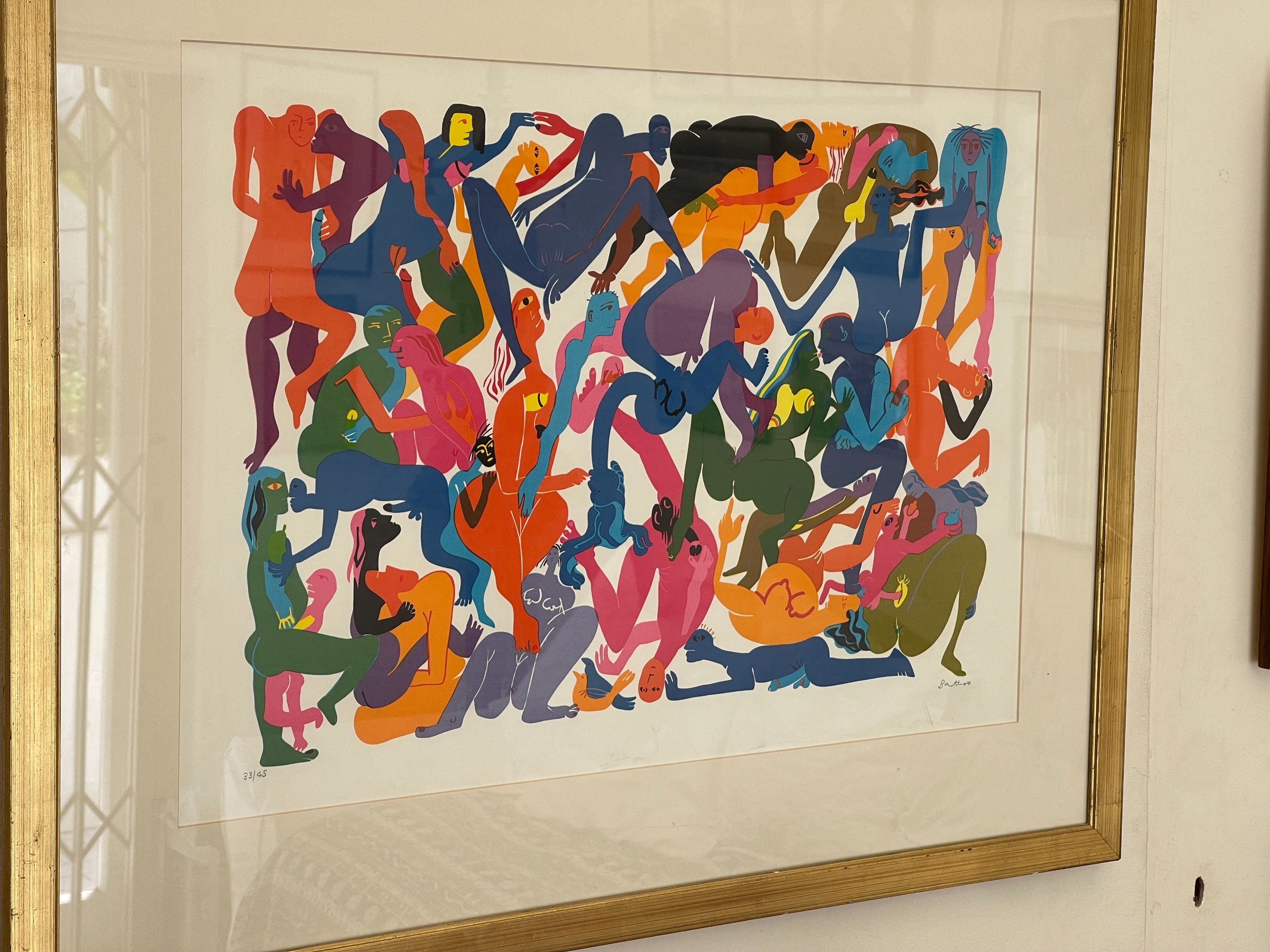
Walter Whall Battiss (South African, 1906-1982), 'Orgy 3', colour screenprint, c. 1973, signed in pencil and numbered 33/45. Battiss was the eccentric heart of South African modernism, the inventor of Fook Island with its passports, its currency and its language, and the 'Orgy' series of the early 1970s is his most sought-after graphic work: interlocking figures in flat, joyful colour that owe as much to the rock art he studied as to Matisse.
The report tied this sheet to a documented edition and found the market for it where it actually lives, in the South African salerooms. An artist's proof of the same image sold for about $2,642 at Aspire Art in March 2022, and a pen-and-ink 'Orgy' drawing for $3,561 in 2018. The figure was placed above the proof for a numbered impression in excellent condition and below a unique drawing. The mat has discoloured; the print behind it has not. One caveat the report flags: the cursive signature is easily misread, so for a sale at this level a comparison against a benchmark signature is worth the trouble.
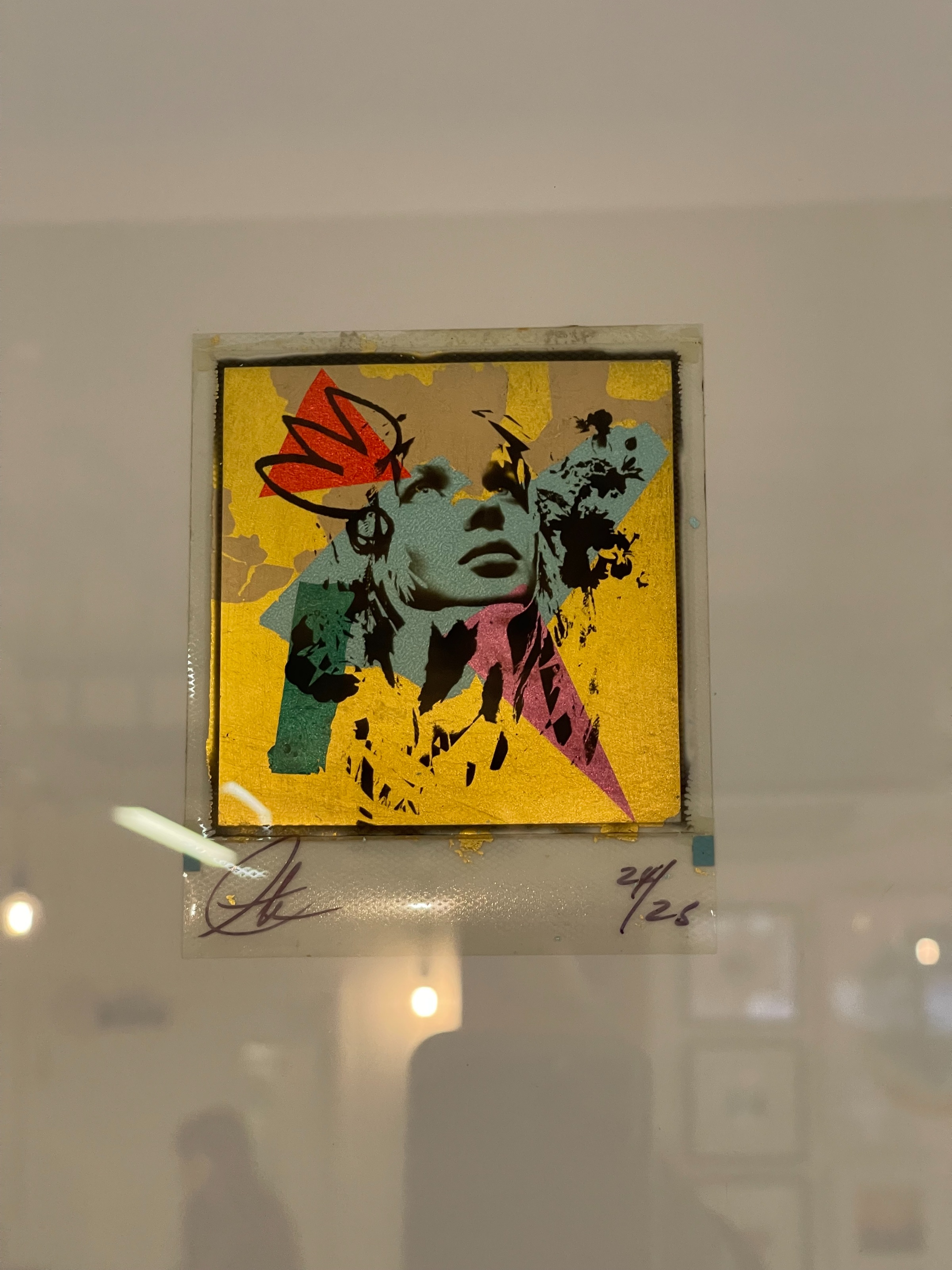
Attributed to Hush, hand-finished screenprint with gold leaf in the format of a Polaroid, signed with a monogram and numbered 24/25. This is the contemporary end of the print market, where the rules were rewritten in the 2000s: tiny editions, hand-finishing that makes each impression slightly unique, a monogram instead of a name, and a certificate from the artist's studio doing the work a catalogue raisonné does for Picasso.
The report attributed the piece on style, technique and the stylised signature to the British street artist Hush, while noting it shares characteristics with the stencil duo Snik, and set the range from the market for hand-finished editions by artists of comparable standing; a Martin Whatson sixteen-colour screenprint listed at $7,500 sits at the top of that comparison set. Confidence is 55 percent, and the report says why: without the studio's certificate, a gallery receipt or a signature match, the attribution is stylistic. This is the pattern with post-2005 editions. The certificate is not paperwork. Without it a buyer discounts, and so did this report.
Reference: artists, print types and what they typically run
| Artist / print type | Period | Typical price range |
|---|---|---|
| Albrecht Dürer — engravings and woodcuts, lifetime impressions | 1490s – 1528 | $5,000 – $500,000+ |
| Rembrandt — etchings, early states | 1628 – 1665 | $3,000 – $1,000,000+ |
| Old-master reproductive engravings — after Maratti, Reni, Rubens | 1600 – 1800 | $100 – $1,500 |
| Hogarth — engraved series (Rake's Progress, Marriage A-la-Mode) | 1730 – 1764 | $200 – $10,000 |
| English mezzotints — Houston, Watson, J. R. Smith after Reynolds | 1740 – 1810 | $100 – $3,000 |
| Boydell publications — Houghton Gallery, Shakespeare Gallery | 1774 – 1805 | $150 – $1,500 |
| Piranesi — Vedute di Roma, Carceri | 1745 – 1778 | $1,000 – $30,000+ |
| Audubon — Havell edition, Birds of America | 1827 – 1838 | $5,000 – $300,000+ |
| Currier & Ives — hand-coloured lithographs | 1835 – 1907 | $100 – $20,000+ |
| French history and reproductive engraving — Migneret, Desnoyers | 1800 – 1870 | $150 – $1,000 |
| Japanese ukiyo-e — Hokusai, Hiroshige, period impressions | 1780 – 1860 | $300 – $500,000+ |
| Sōsaku-hanga — Hoshi, Saitō, Munakata | 1930 – 1990 | $300 – $15,000 |
| Whistler — etchings | 1858 – 1890 | $500 – $50,000 |
| Toulouse-Lautrec — original lithographic posters | 1891 – 1900 | $5,000 – $300,000+ |
| Travel and advertising posters — original lithographs (reproductions $15 – $50) | 1900 – 1970 | $300 – $20,000 |
| Picasso — Vollard Suite, linocuts, Mourlot lithographs | 1904 – 1972 | $2,000 – $500,000+ |
| Chagall — Mourlot lithographs (signed deluxe vs. book plates) | 1950 – 1985 | $150 – $40,000+ |
| Miró — lithographs, etchings, aquatints | 1930 – 1983 | $500 – $80,000 |
| Dalí — lithographs; verify against Field and Michler & Löpsinger | 1960s – 1980s | $200 – $5,000 |
| Warhol — Factory Additions and published portfolios | 1962 – 1987 | $10,000 – $1,000,000+ |
| Hockney — etchings and lithographs | 1961 – present | $2,000 – $200,000+ |
| Hirst, Banksy, Kaws — signed editions with certificate | 2000 – present | $1,000 – $300,000+ |
| Agam, Vasarely — kinetic and Op screenprints | 1960 – 1990 | $150 – $3,000 |
| Battiss — South African modernist screenprints | 1960s – 1982 | $500 – $5,000 |
| Street-art editions — Hush, Whatson, Fairey, hand-finished | 2005 – present | $300 – $10,000 |
| Open-edition giclée and offset reproductions | any | $20 – $300 |
Two patterns we keep seeing
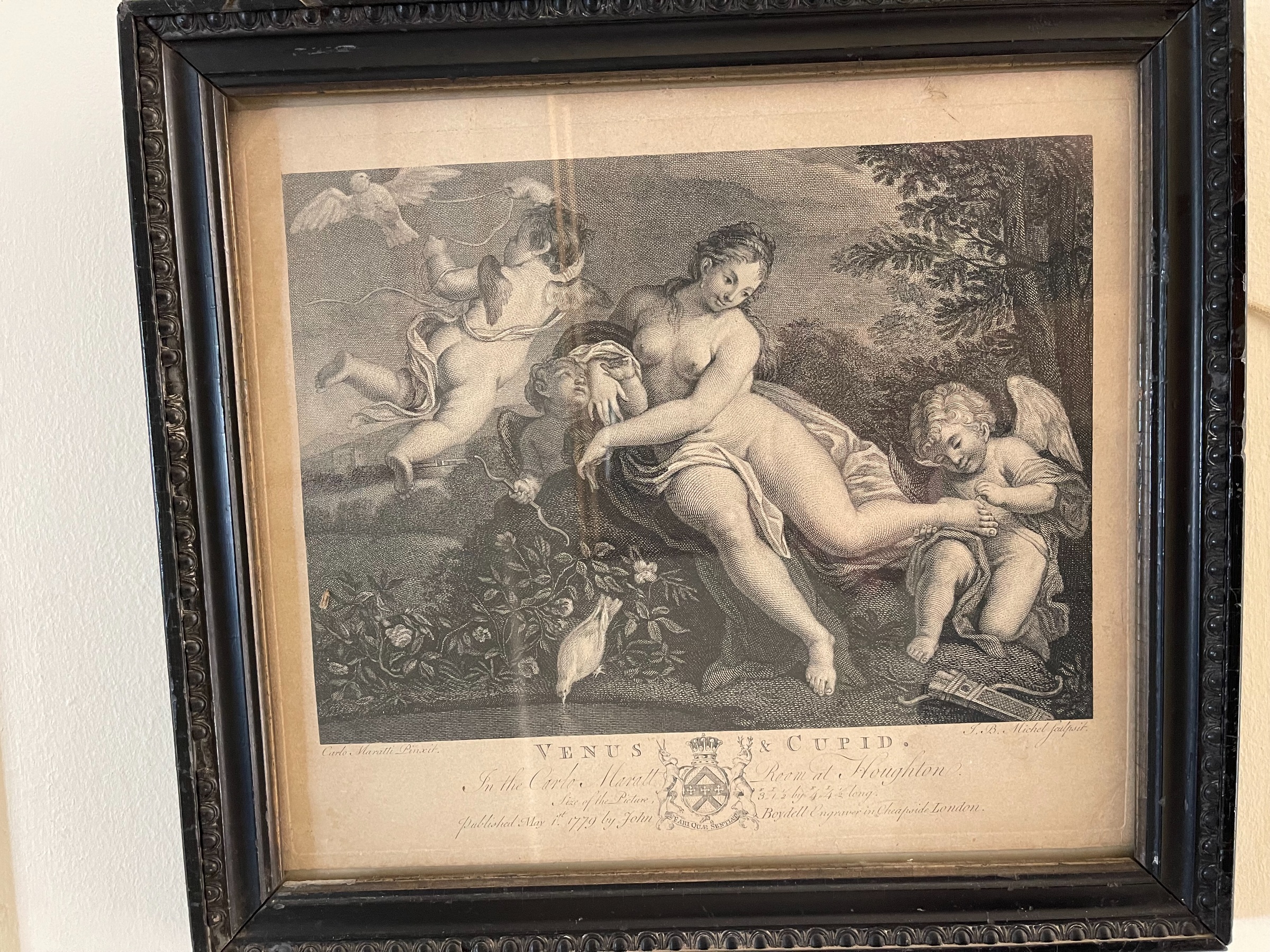
Jean-Baptiste Michel after Carlo Maratti, 'Venus and Cupid', plate 8 of the 'Houghton Gallery', published by John Boydell, London, 1 May 1779. This is the most-confused object in the category, and the vocabulary costs sellers money in both directions. The words 'after Carlo Maratti' do not mean a copy. They mean a period reproductive engraving: Michel cut the plate, Boydell published it, and the whole enterprise, a printed gallery of Sir Robert Walpole's Old Masters at Houghton Hall issued just as the paintings themselves were being sold to Catherine the Great, is a chapter of eighteenth-century art history in its own right.
The report confirmed the identification from the print's own inscriptions and against identical impressions in the British Museum and the Metropolitan Museum of Art. It also said what it could not settle from photographs: whether this is an early state or a later printing, which needs the paper and any watermark examined out of the frame. The value sits where Boydell plates in period frames with toning and foxing sit, and it is the toning, not the 'after', that holds it there.
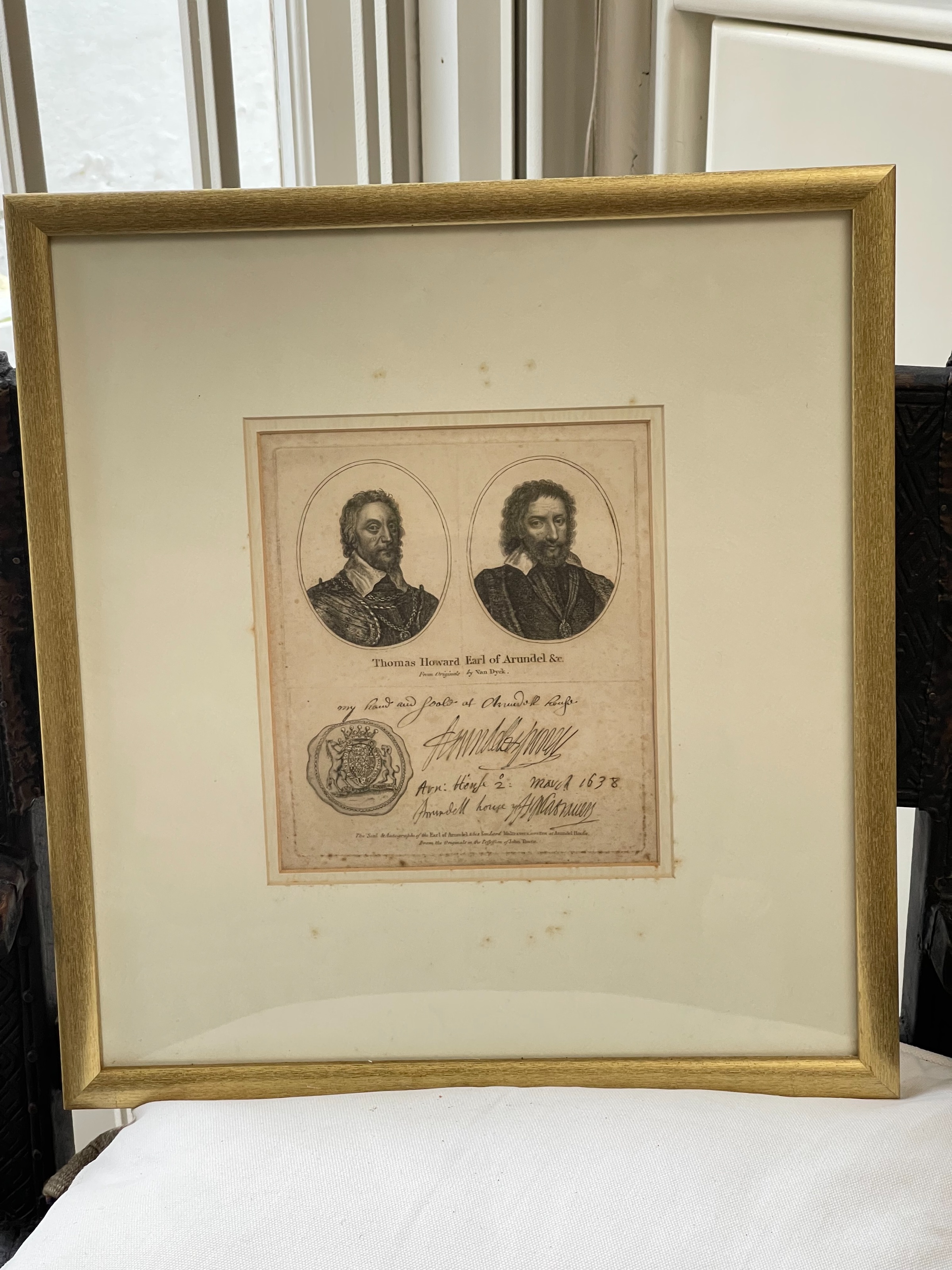
John Thane, publisher, 'Thomas Howard, Earl of Arundel, and Lord Maltravers', from 'British Autography', London, c. 1790: two oval portraits after Van Dyck above facsimiles of the sitters' signatures and a seal, engraved from documents in Thane's own collection. Thane was a London dealer in prints and autographs, and the series was made for exactly the collector who would buy this page today, someone who wants history in a frame for the price of a dinner.
The report established it as a genuine late-eighteenth-century impression (plate mark, laid paper, publisher's line, an identical example in the National Portrait Gallery) and then did what an honest valuer does at this level: it declined to use the comparables it found, because they were multi-volume books rather than single sheets, and priced it from the market for foxed antiquarian portrait engravings, with a suggested reserve of $60. This is the everyday end of the print market. Genuine, period, documented, and worth about what a good frame costs. Most old engravings are, and knowing so before consigning saves a seller's commission on a lot that will not cover it.
Practical things to think about
Prints are the most fragile things most people own and the easiest to ruin with good intentions.
Light is the enemy. Screenprint inks and hand-colouring fade; paper yellows; a print hung opposite a window for twenty years is a different object from the one that went into the frame. Use UV-filtering glass or acrylic, hang out of direct sun, and rotate anything you care about. Framing is the second enemy, or the first, depending on the framer. Acidic mat board and backing burn a brown line into the sheet (mat burn) and tone the whole thing; masking tape and dry-mounting are permanent. Conservation framing means an acid-free mat, hinges of Japanese tissue and wheat-starch paste at the top edge only, and a sealed back. It costs more, and it is the difference between 'good' and 'fair' in a condition report twenty years from now.
Humidity brings foxing, those rust-brown spots, and it brings the water damage that cost the Hoshi woodblock on this page roughly half its clean value. Store unframed prints flat, interleaved with acid-free tissue, in a solander box or a portfolio: not rolled, not in a garage, not in an attic. Do not clean a print. Do not erase foxing, do not bleach toning, do not iron a crease; a paper conservator can reduce all three, and an amateur attempt is visible to every specialist who sees it afterwards.
Keep the paper trail with the paper. The certificate for a contemporary edition, the gallery invoice, the auction receipt, the book or portfolio a plate was issued in: these travel with the print, and each one is worth money at the point of sale. For insurance, schedule anything with a four-figure value individually, by title, edition number and dimensions, with a photograph of the signature.
And before you sell, consider having a framer or conservator take the print out of its frame. Almost every report on this page ends with the same sentence: the watermark, the platemark, the margins and the back could not be examined through glass. Those are the checks that separate an early state from a restrike and a signed deluxe impression from an upgraded book page, and they are the checks a buyer's specialist will make. Better that you make them first.
Upload photographs of your print, the whole sheet, the signature and number, and the back if you can, and we'll send back a documented valuation with the comparable sales we used: lot, price and venue, drawn from Christie's, Sotheby's, Phillips, Bonhams, Swann, Heritage, Forum, Roseberys, the regional salerooms where a given artist's market actually lives, and the specialist print dealers. The report says what kind of print it is, how the sheet ties to a documented edition, what condition is doing to the figure, and which physical checks remain before a sale. We don't buy and we don't take consignment. Your first valuation is on us.
Reviewed by The Findthevalueof research team. Last reviewed 23 Sep 2026.
Common questions
What's the difference between an open edition and a limited edition?
- A limited edition is a fixed number of impressions (say 75) pulled from the same plate, stone, screen, or block, each numbered in pencil as '23/75' and signed by the artist. After the edition closes the printing matrix is cancelled or destroyed. An open edition is an unlimited reproduction — a photomechanical copy of an existing image, printed in any quantity the market will absorb. Open-edition giclées and offset lithographs are decorative goods; only limited editions have a meaningful secondary market.
What do AP, EA, HC, BAT, and PP mean on a print?
- AP (Artist's Proof) and EA (Épreuve d'Artiste, the French equivalent) are impressions outside the numbered edition, retained by the artist — typically around 10% of the main edition size and worth roughly the same as numbered impressions. HC (Hors Commerce) is 'not for sale', usually printer's and publisher's copies; market value is similar. BAT (Bon à Tirer, 'good to print') is the single proof the artist approved as the reference standard for the edition — often the most valuable impression. PP (Printer's Proof) is for the master printer and is typically valued at the same level as a numbered impression.
Is an engraving 'after' a painter an original print or a copy?
- It is an original print by the engraver of somebody else's picture, and for three centuries that was most of the print trade. 'After Carlo Maratti', 'after Reynolds', 'after Schnetz' names the painter; the engraver's name follows 'sculp.' or 'fecit', and the publisher's line gives the place and date. These reproductive engravings and mezzotints have their own market, typically $100 to $1,500 for a good period impression, more for Boydell, Hogarth or a celebrated mezzotint engraver. What they are not is a copy in the modern sense: a modern photomechanical reproduction of the same engraving is worth almost nothing, and telling the two apart (platemark, laid paper, no dot screen) is the first thing we check.
Is a print from a book or magazine worth anything?
- Often, yes, and the honest answer is 'a little'. Verve, Derrière le Miroir, XXe Siècle and the Mourlot monographs (Chagall Lithographe, Miró Lithographe) carried genuine original lithographs, printed from the artist's stones, as unsigned plates bound into the volume, often in editions of several thousand. They are real lithographs and they sell, typically in the low hundreds of dollars for a Chagall or Miró book plate, and they can be identified by the centre fold or fold lines and the lack of a signature. The trouble begins when someone adds a pencil signature and a number to make one look like the signed deluxe edition of 50 or 90 that was printed on better paper without the fold. A signed sheet with a flattened centre crease is the first thing a print specialist looks for, and it is why a report will ask to see the print out of the frame under raking light.
How do I tell an original vintage poster from a reproduction?
- Original travel and advertising posters were stone or offset lithographs printed for the client at the time, on thin poster paper, usually with the printer's name and address in small type at the foot, and in the standard sheet sizes of their country (about 100 by 65 cm for France; the 27 by 41 inch 'one sheet' in the United States). Reproductions are printed later on heavier, whiter, often glossy stock, frequently at a different size, and under a loupe they show the regular dot pattern of a modern halftone. The Air France 'Afrique du Nord' on this page is the design of a scarce 1950s original; the object in the frame was assessed at $20 to $40 because it is almost certainly a modern print of it. An original in good condition would be several hundred dollars or more. If the poster is out of its frame, the paper tells you in seconds.
Why do Salvador Dalí prints get such wide estimates?
- Because the Dalí graphic market is the most disputed in the field. Two reference works, Albert Field's 'Official Catalog' and Michler & Löpsinger's catalogue raisonné, disagree about which editions are authentic; Dalí is widely reported to have signed blank sheets in the 1970s and 1980s that were later printed on; and photomechanical reproductions on pre-signed paper are well documented. So two sheets with the same image and the same pencil signature can be a lifetime artist's proof or a worthless reproduction, and only the paper, the printing method and the catalogue entry settle it. The 'Tauromachie aux papillons' on this page carries its Michler & Löpsinger number and was assessed at $800 to $1,200 in fair condition, with the report stating plainly which authentication steps remained. Expect any honest Dalí valuation to come with those caveats.
How do I tell a Warhol screenprint from a poster?
- Start with Feldman & Schellmann, the Warhol catalogue raisonné, which lists every published edition with its size, paper, signature and numbering convention. The published Factory Additions and later portfolio prints are on heavy paper, signed and numbered in pencil, ballpoint or with a rubber stamp on the back, and carry no text. Exhibition posters and the licensed reproductions that followed are on lighter stock, unsigned or 'plate-signed', often with printed text or a museum's name, and under a loupe they show a halftone dot screen. The Andy Warhol Art Authentication Board closed in 2012, so verification today rests on the catalogue raisonné, the paper and printing method, and the sale history of the specific impression.
Does a low edition number make a print more valuable?
- Marginally, and only for a few markets. The earliest impressions from an intaglio edition (etching, drypoint, mezzotint) can show slightly crisper detail before the plate wears, and collectors sometimes pay a small premium for '1/75' over '74/75'. For screenprints and lithographs the matrix doesn't wear meaningfully across an edition, so the number is largely decorative. Don't pay a significant premium for a low number unless the comparable evidence supports it.
How does condition affect a fine art print's value?
- Heavily. The most common condition issues are light-staining (yellowing of the exposed sheet, telling against the protected margin under the mat), foxing (small brown spots from mould activity), mat burn (a brown line where acidic board touched the sheet), hinge tape residue on the back, trimming (cutting down the sheet — fatal to value if the signature, numbering or platemark is lost), water damage, and creases or tears. A heavily light-stained impression can be 30-50% off a fresh one from the same edition, and the water-damaged Hoshi woodblock on this page was discounted 40-60% against clean examples. Paper conservation can reduce foxing and discolouration, but auction houses must disclose restoration.
How do I verify a contemporary print is authentic?
- Look for the certificate of authenticity (COA) issued by the publisher with a matching impression number — Paragon Press, Counter Editions, Pace, Gagosian, and Other Criteria all issue COAs that can be cross-checked with the publisher directly. The pencil signature and numbering on the print itself should match. Beware of prints sold without a COA on online marketplaces, and beware of 'inkjet' surface texture under magnification on what is sold as a hand-pulled screenprint.
Should I get a print framed before selling?
- No. Auction houses prefer unframed sheets for inspection; frames are removed for cataloguing and condition assessment, then discarded or sold separately. If the print is already framed under non-archival materials (acidic backing board, non-conservation glass, hinge tape on the sheet), consider asking a conservator to remove it before consignment — but only after a written valuation. For a private sale, archival float-mounted framing behind UV-filtering glass adds presentational value.
What's the market for Hockney, Hirst, and Banksy editions?
- Three different markets. Hockney's editions from the 1960s and 1970s have the longest, steadiest record; signed impressions from the early portfolios trade consistently at auction and rarely go unsold. Hirst's spot, butterfly and spin editions rose steeply to 2021 and have fallen back since; signed, numbered limited editions with the publisher's certificate hold up far better than the open editions. Banksy is the most volatile and the most policed: only prints with a Pest Control certificate (the artist's own authentication body) are accepted by the major salerooms, and an uncertificated 'Banksy' is unsaleable there whatever it looks like. In all three cases the certificate and the catalogue entry are the value; the image alone is not.
What information should I include with photographs?
- Front of the print (in full, with margins), the pencil signature close-up, the edition number close-up, the verso (back of the sheet), any publisher's blindstamp (an embossed mark, often in a corner), and any condition issues. Note the dimensions of the sheet and of the image separately. If you have the original certificate of authenticity, invoice, or gallery receipt, photograph those too — provenance documents materially lift the value.
Where's the best place to sell a fine art print?
- It depends on the value bracket. Prints over $20,000 do best at the major print sales (Christie's, Sotheby's, Phillips, Bonhams print departments). $3,000-20,000 prints sell efficiently at specialist print auctioneers (Swann in New York; Forum Auctions, Roseberys, Lyon & Turnbull in the UK) where buyer's premium is lower. Below $3,000, well-photographed listings on Artsy, Heritage, or 1stDibs can outperform low-end auction estimates, and some artists sell best in their home market — Battiss in Johannesburg, sōsaku-hanga at the Japanese print sales. Avoid generalist online marketplaces for anything you believe to be a documented edition — buyers there discount heavily for uncertainty.
Worked examples in this category
- Walter Whall Battiss, 'Orgy 3', Color Screenprint
- Attributed to Hush, Contemporary Hand-Finished Screenprint with Gold Leaf, Edition 24/25
- Jean-Baptiste Michel (1748–1804) after Carlo Maratti (1625–1713), 'Venus & Cupid', Plate 8 from the 'Houghton Gallery' Series, Published by John Boydell, London, 1779
- John Thane (Publisher), Portrait of Thomas Howard, 14th Earl of Arundel, and Lord Maltravers, Engraving, circa 1790
- Yaacov Agam, Attributed to, 'Progression' (Trois Mouvements), Color Screenprint
- Joichi Hoshi (Japanese, 1913-1979), 'Morning' (朝), Color Woodblock Print, 1973
- Adrien Migneret, After Jean-Victor Schnetz, 'Charles Douze' (King Charles XII of Sweden Landing at Humlebæk), Large-Format French Romantic Engraving, circa 1840
- After Philip Mercier, Engraved by Richard Houston, 'The Prodigal,' Mezzotint Engraving, c. 1756
- French School (18th Century) Engraving of Jean-Baptiste Coignard II by Gilles Edme Petit, after Antoine Pesne, circa 1732
- Salvador Dalí, 'Tauromachie aux papillons' (Bullfight with Butterflies), Color Lithograph with Embossing, c. 1972
- After Vincent Guerra, 'Afrique du Nord' Air France Travel Poster