What is your jade worth?
Researched valuation of Chinese jade: nephrite and jadeite carvings, bi discs, belt plaques and pendants. Period or reproduction, with cited comparable sales.
A jade is worth what comparable pieces of the same material, period, quality and condition have sold for recently. The first question is what the stone is: nephrite, jadeite, or one of the look-alikes sold under the name. The second is period, where 'archaistic' pieces made in the ancient manner from the Song dynasty to last year are a different price from the archaic originals. The written report says which stone, which period and quality the piece is consistent with, how confident that is, cites comparable sales with lot, price and venue, and lists the physical tests that remain before a sale.
Gold has a price. Jade has none. The Chinese proverb is three thousand years old and it is still the first thing a dealer in Hong Kong will tell you, usually just before naming a price.
No other material has been loved for so long by one civilisation. The Liangzhu people of the Yangtze delta were grinding nephrite into bi discs and square-sectioned cong tubes five thousand years ago, with sand, string and patience, for reasons nobody has fully recovered. The Hongshan to the north made coiled 'pig-dragons' of it. By the Han dynasty a prince could be buried in a suit of two thousand jade plaques sewn together with gold wire, because jade was believed to keep the body from corruption: Liu Sheng's suit, dug out of a hillside at Mancheng in 1968, is the proof that they meant it. Confucius listed the virtues jade embodied, and the character yu, three horizontal strokes threaded on a vertical, is one of the oldest in the language and sits inside the character for emperor.
The stone itself came, for most of that history, from one place: the riverbeds below the Kunlun mountains at Khotan, on the far western edge of the Chinese world, where the White Jade River and the Black Jade River carry down pebbles of nephrite with a russet skin that the carvers learned to keep. That is the 'Hetian' jade of the auction catalogues and the 'mutton-fat' of the connoisseurs. When the Qianlong emperor's armies took Xinjiang in 1759 the supply opened, the palace workshops swelled, and the eighteenth century became the great age of Chinese jade: five-tonne boulders carved into mountains, thin-walled bowls in imitation of the Mughal jades the emperor collected and wrote poems about, and the archaistic cups and censers that copied bronzes two thousand years older than themselves.
Then, about the same time, a second stone arrived from Burma. Jadeite is a different mineral entirely, harder, glassier, and in its finest form the 'kingfisher' green that the Empress Dowager Cixi could not get enough of. It is the jade of the bangle, the cabochon and the bead necklace, and in 2014 twenty-seven beads of it that had belonged to Barbara Hutton sold in Hong Kong for twenty-seven million dollars. Two stones, one word, and the first job of any valuation is to say which one you have, and whether it is either.
Because the third thing to know about jade is that it cannot be carved. It is too hard for any blade. Every jade object ever made was ground and abraded, with sand on a bow-drill, a wire saw, and a treadle-driven wheel, and the marks those tools leave are how a specialist tells a Ming plaque from a 1990s copy made with a diamond burr. This page tells you what we look at, what changes the figure, and what your written report covers when you upload photographs. Comparable prices come from the auction record and the specialist dealers, not from retail or guide prices.
A jade is worth what comparable pieces of the same material, period, quality and condition have recently sold for, and in jade each of those four words hides a question that has to be answered before any figure means anything. Is it nephrite, jadeite, or one of the many stones sold under the name? Is it archaic, or made in the archaic manner centuries later, or made last year? Is the stone even and flawless and the carving fluent, or mottled and competent? And has it been dropped, cracked, re-polished or dyed?
The answers spread the market across four orders of magnitude. A modern pebble of grey stone, stained brown and heat-crackled to look excavated, is a decorative object worth tens of pounds. A genuine Qing pendant in good nephrite, a cicada or a chime or a boy on a lotus leaf, is worth hundreds to low thousands. A good eighteenth-century cup, censer or animal carving runs into the thousands and low tens of thousands. A Ming openwork belt plaque in fine white stone, a Qianlong mountain, a palace-workshop vessel in flawless white, run from tens of thousands into six figures, and the finest imperial pieces and the best jadeite jewellery into seven. The material at the bottom and the material at the top can look, in a photograph, like the same pale green stone.
Material, period and quality are the lever. Condition and the word 'archaistic' are the brake.
What changes the price
Five things matter, in roughly this order.
What the stone is comes first, and it is where most of the money is lost. Nephrite, the jade of Chinese history, is a tough felted mass of amphibole fibres, waxy rather than glassy, running from white through celadon green to spinach and black, often with a russet skin. Jadeite, from Burma, is a pyroxene, harder, more brittle and more translucent, the emerald green and lavender of the jewellery trade. Both are jade. Serpentine, bowenite, quartzite, dyed marble, soapstone and glass are not, and between them they make up most of what is sold under the word. A good valuer says 'hardstone' until the stone has been identified, and a density or refractive-index test settles it in minutes.
Period comes second, and in jade it is a trap, because the Chinese have been copying their own antiquities on purpose since the Song dynasty. A bi disc with clambering dragons can be Han, or a Ming scholar's homage to the Han, or a Qianlong workshop's homage to the Ming, or a 1990s export piece stained to look like all three. Each is a different price and the first three are all honest antiques. 'Archaistic' means 'in the ancient manner' and nothing more; a reputable description says which century it thinks the manner was adopted in.
Quality of stone and carving comes third. An even, unctuous white nephrite with no flaws, carved with the thin walls, fluent openwork and crisp detail of the eighteenth-century palace workshops, outprices a mottled stone with a competent provincial carving by ten or a hundred times. The clever use of a russet skin, a horse's mane or a lychee or a dragon picked out in the pebble's own brown rind, is a mark of quality. Brown applied with dye and heat to a pale stone is a mark of the opposite.
Condition and completeness come fourth. Jade does not fade, fox or rust, but it chips at thin edges, cracks along natural fissures, and gets re-polished, and a later polish that has erased the tool marks and the soft patina of handling takes the evidence of age away with the value. A cover, a stand, a matching pair, the chain that links a cover to its vase: these are part of the object and their loss is part of the price.
Provenance and venue come fifth and, at the top end, first. A jade with a documented collection history or a previous sale in a major Hong Kong, London or New York Asian-art sale carries that history into the next saleroom. The same piece offered at a generalist country auction with no history can fetch a tenth of the price, which is why where you sell is a decision and not an afterthought.
The forms of jade, and what to look for in each
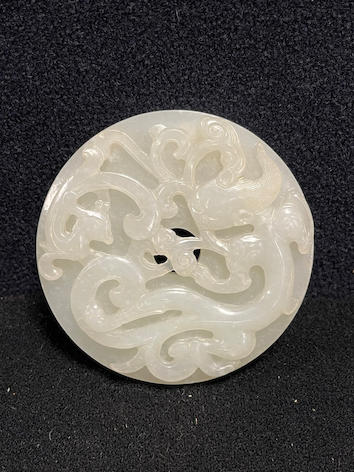
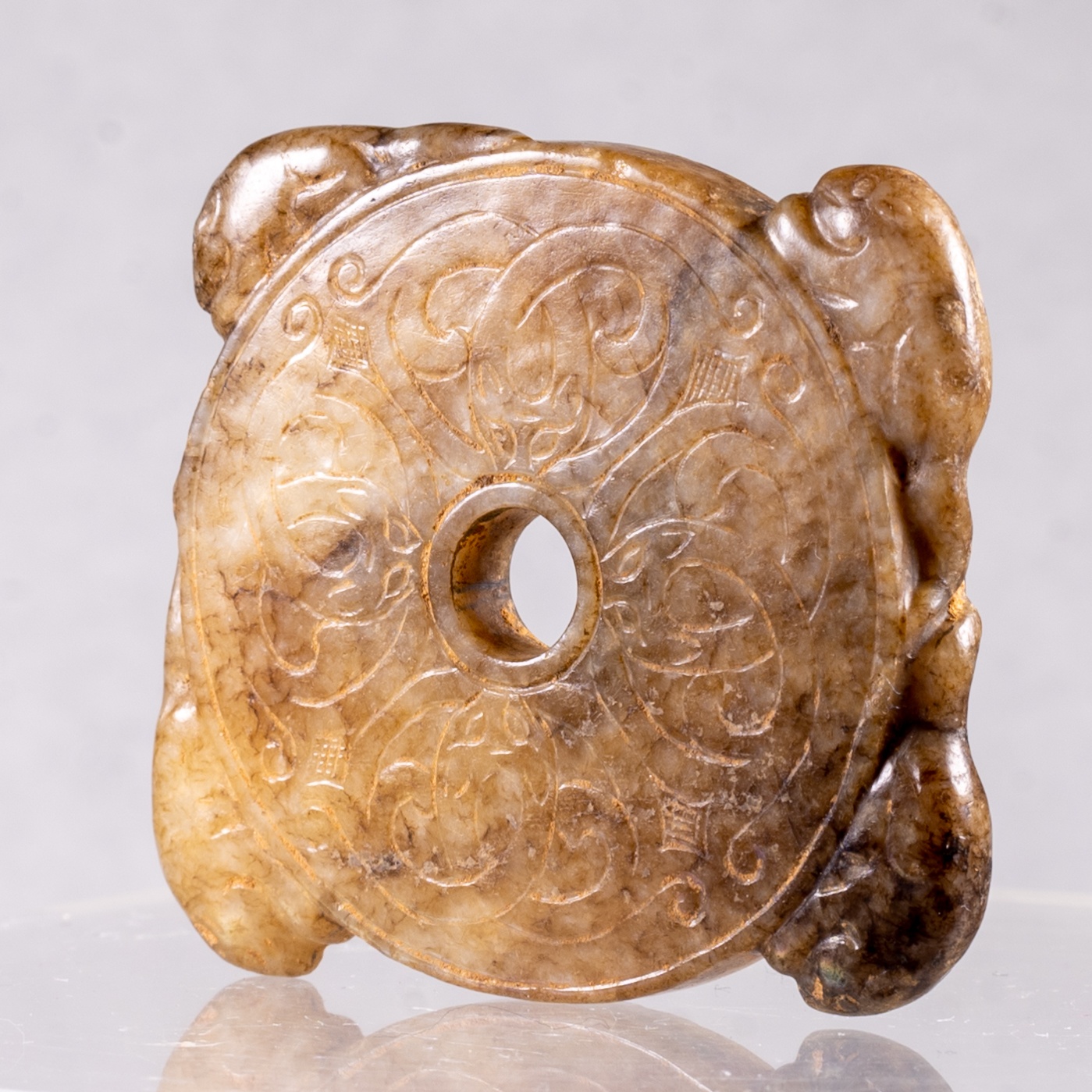
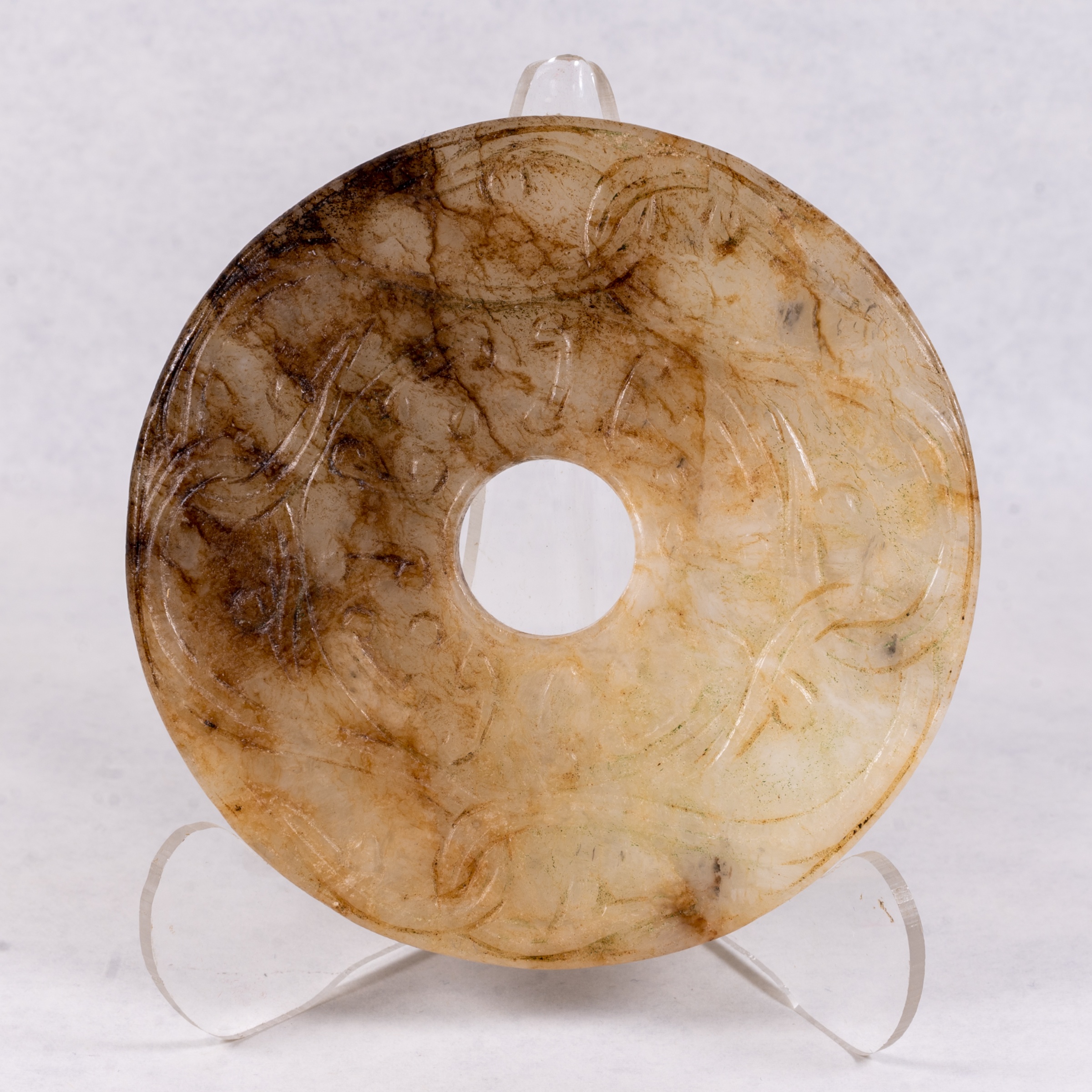
Archaic and archaistic jades. The oldest shapes in Chinese art are the ones nobody can fully explain: the bi, a flat disc with a hole; the cong, a square tube around a cylinder; the huang, an arc; and the pendants, blades and sword fittings of the Shang, Zhou and Han. By the Han dynasty the bi had acquired hornless chilong dragons clambering over its rim, and that image has been reworked for two thousand years since. The Song revived the archaic forms as a scholar's taste, the Ming carved them in abundance, and the Qianlong workshops made them the height of fashion, so most 'archaic' jades on the market are archaistic: honest antiques of a later date.
What to look for: calcified or 'chicken-bone' white patches and brown staining that follow the natural fissures of the stone, against staining that pools in recesses and stops at sharp lines; soft, slightly irregular carved grooves and conical drill holes from sand abrasion, against uniform modern scoring; and a design vocabulary that is spoken fluently rather than copied stiffly. What raises value: a secure early date, which usually needs a provenance or an excavation record; fine stone; crisp, confident carving. What lowers it: the word 'style' in the description, which is where most pieces honestly belong.
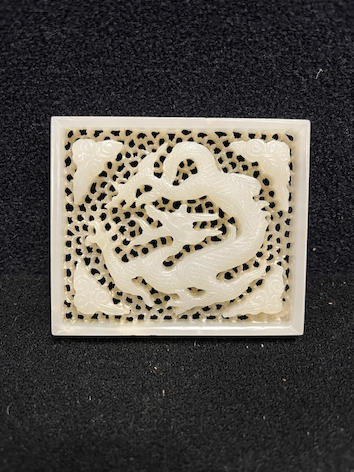
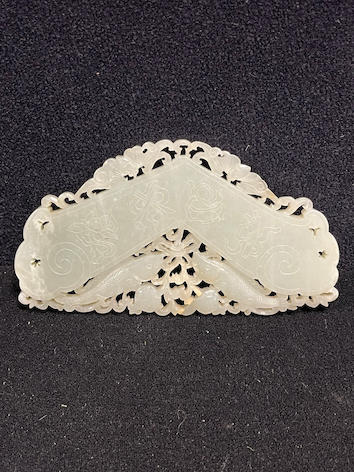
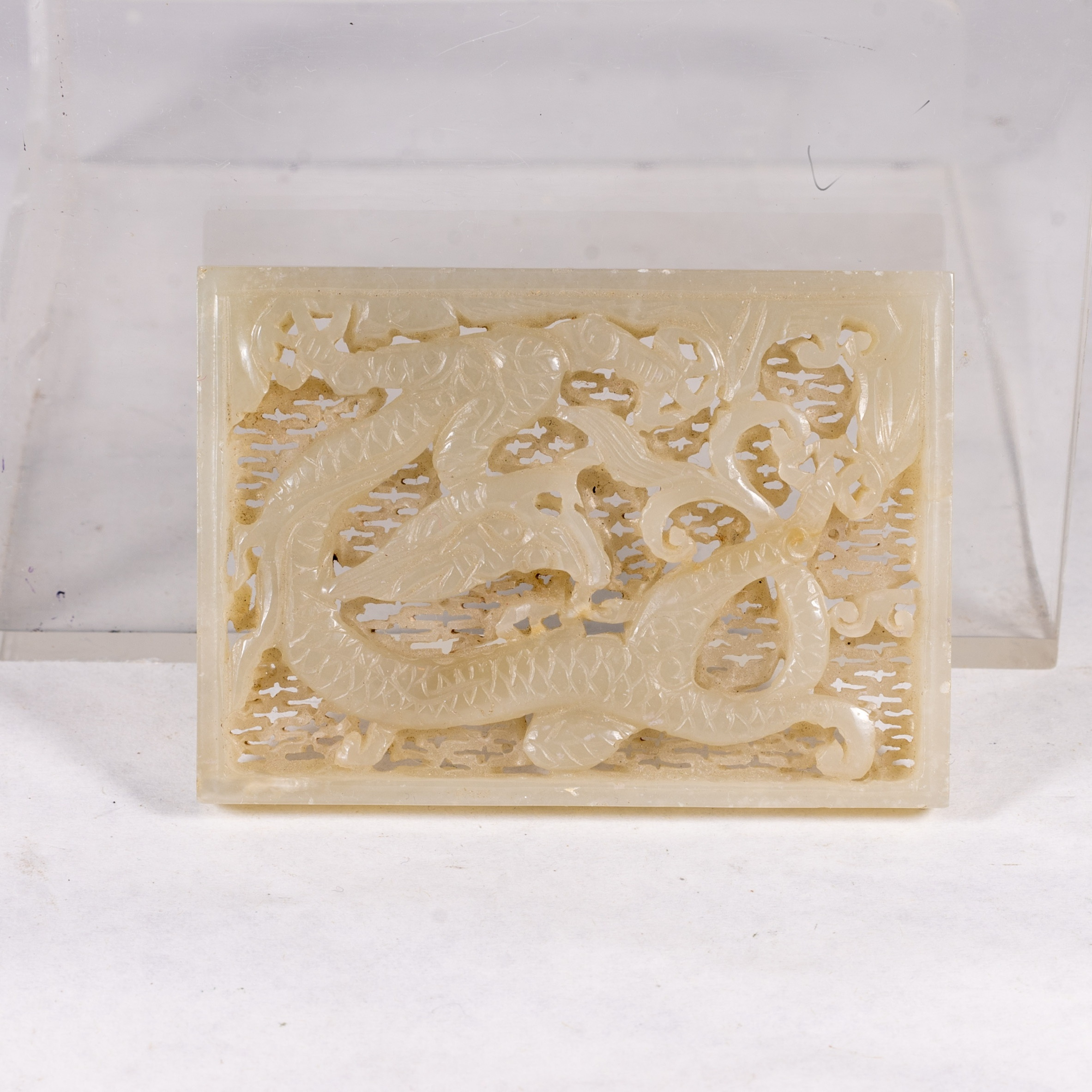
Belt plaques and ornaments of rank. Ming officials wore leather belts sewn with sets of up to twenty jade plaques, rectangular and peach-shaped, and the material and the motif, a five-clawed dragon, a four-clawed one, a crane or a lion, declared the wearer's grade. The sets were broken up centuries ago and single plaques survive in great numbers, which makes this the most studied and most faked form in Ming jade. The finest are carved in two or three layers of openwork, a dragon writhing through a pierced ground of clouds, with the back left plain and pierced for stitching.
What to look for: layered openwork with the under-layer genuinely cut away, not just incised; stitching holes on the reverse, often worn; an even white or pale celadon stone. What raises value: the whiteness and evenness of the stone above all, then the depth and fluency of the openwork, then a secure Ming date and a collection history. The same type ranges from a few thousand pounds for a competent plaque in mottled stone to several tens of thousands for a fine one, so the quality of the stone is the first thing to judge.
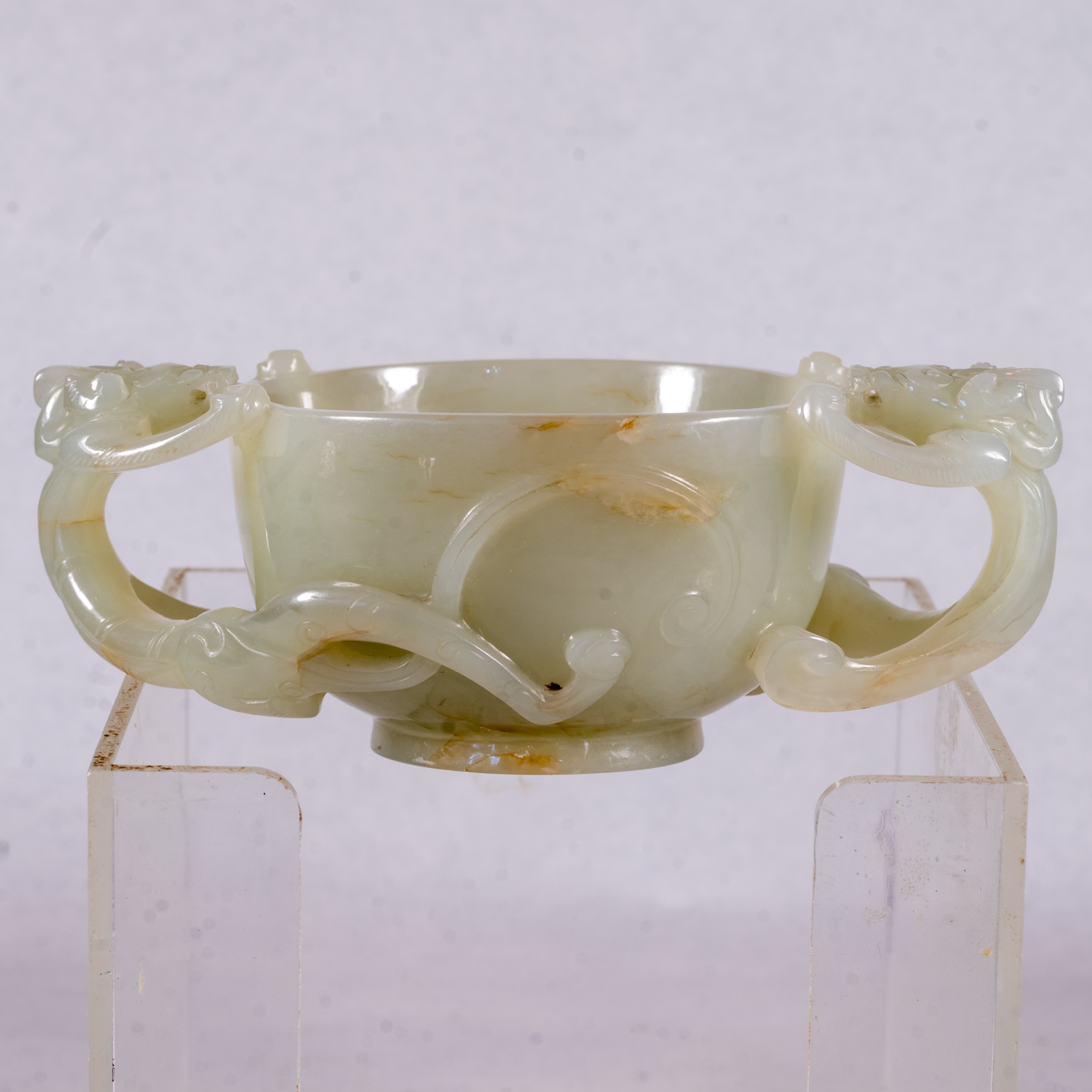
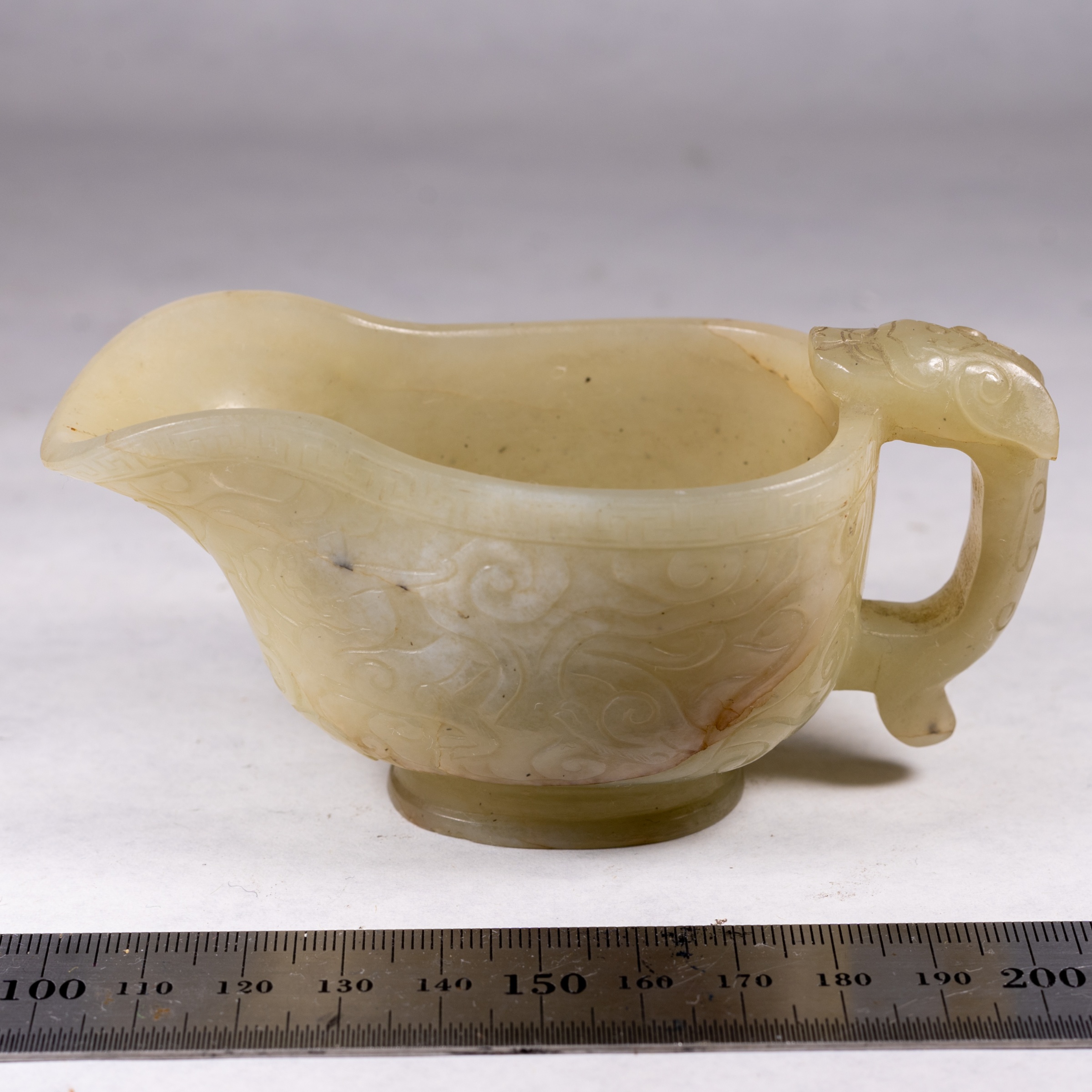
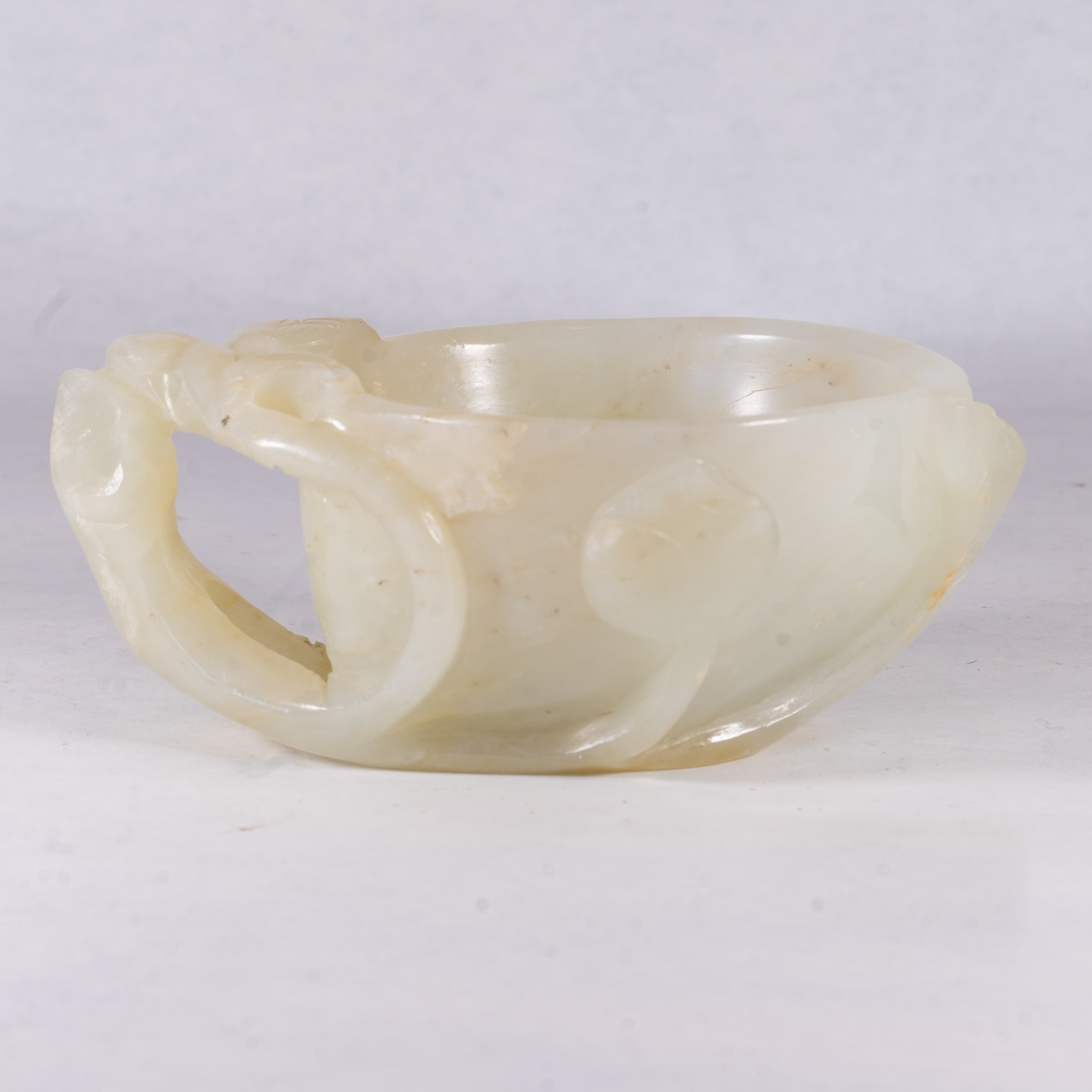
Cups, censers and archaistic vessels. From the late Ming onwards jade was hollowed into the shapes of ancient bronzes: libation cups with chilong handles, tripod censers with taotie masks and loose-ring handles, gu beaker vases, yi pouring vessels, hu vases with covers. They sat on a scholar's desk or an altar table and were never used; the point was the reference to antiquity, and the cost was the stone, since a cup is hollowed out of a boulder and most of the boulder ends up as dust.
What to look for: the thinness and evenness of the walls, which only a skilled workshop could achieve; handles and loose rings carved from the solid rather than attached; a cover that belongs to its vessel; and the inside, where hollowing marks and the honest colour of the stone show. What raises value: white or pale celadon stone with the russet skin used in the design, crispness of the archaic motifs, and an eighteenth-century date over a nineteenth. What lowers it: cracks, which in a hollowed vessel are usually structural; chips to handles; a replacement cover; and the heavy, thick-walled carving of later export work.
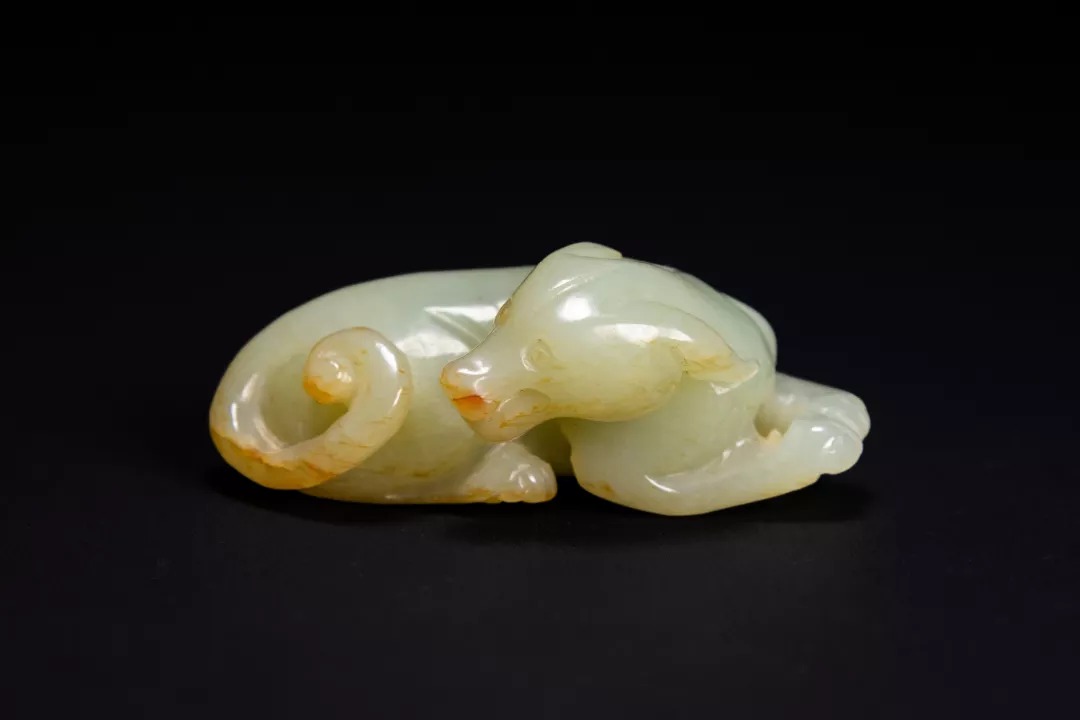
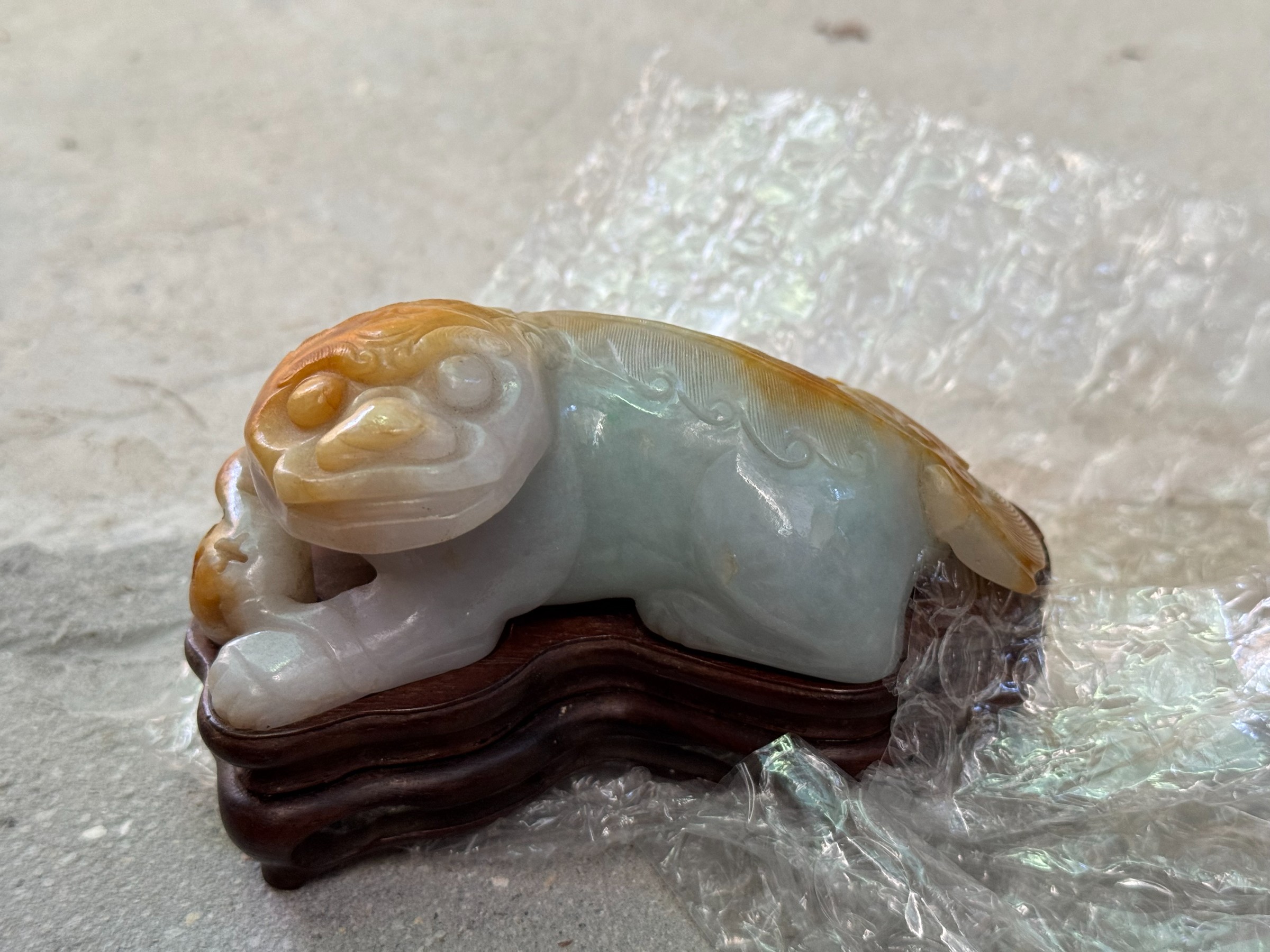
Figures and animals. Small carvings of recumbent horses, water buffalo, mythical beasts, boys with lotus leaves, maidens and immortals were made from the Song dynasty onwards as objects to be handled as much as looked at: compact, smooth, fitting the palm, often with the russet skin of the pebble left on to become a mane, a saddle-cloth or a leaf. The 'boy and lotus' is a wish for sons; the recumbent horse is a scholar's quiet companion; the bixie and qilin are guardians.
What to look for: the carver's use of the pebble, meaning a design that follows the shape and colour of the stone rather than fighting it; the softness of the modelling and the polish in the hollows that long handling leaves; and the underside, which on a good piece is finished as carefully as the top. What raises value: fine white stone, skin colour used with wit, an early Qing or Ming date, and a documented history. What lowers it: harsh modern tooling, a glassy uniform polish, dye standing in for skin, and the stiff, symmetrical modelling of twentieth-century export carvings.
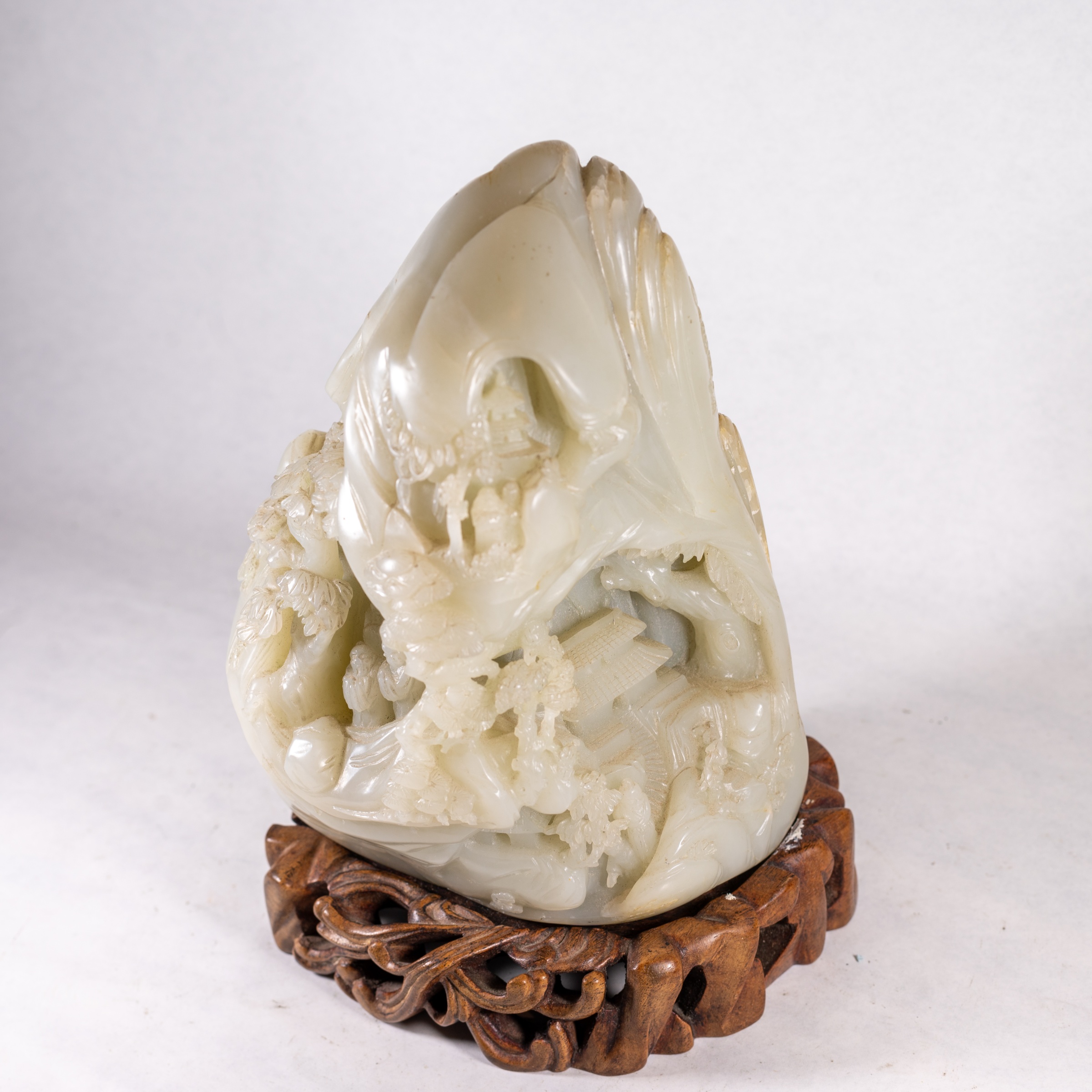
Mountains and boulders. The jade mountain, or shanzi, is a boulder carved in relief as a landscape: pines, pavilions, paths, sages climbing to a retreat, sometimes an imperial poem cut into a flat face. The Qianlong emperor's workshops made the largest, including a five-tonne boulder of Yu the Great taming the waters that took ten years, and the taste trickled down through the nineteenth century to boulders the size of a hand. They stand on carved hardwood stands made for them, and the stand is part of the object.
What to look for: a landscape that reads as a whole from every side, with the russet skin used as cliff or autumn foliage; depth of undercutting in the trees and figures; a stand that fits exactly. What raises value: size, the quality and whiteness of the stone, an eighteenth-century date, and any inscription that can be tied to a workshop or a collection. What lowers it: shallow, flat carving; a mottled or dull stone; a lost or replacement stand; and chips to the pavilions and pine needles, which are the first things to break.
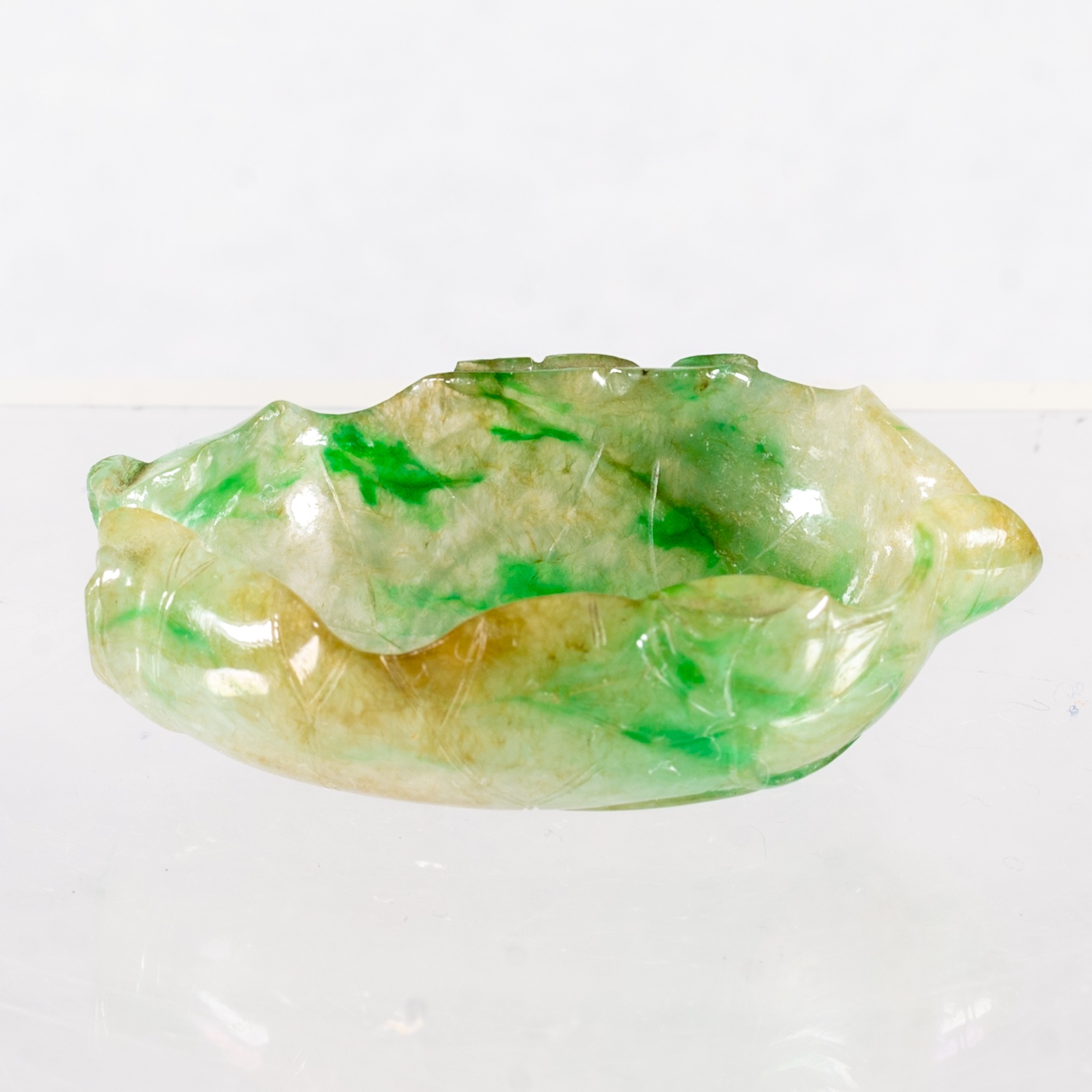
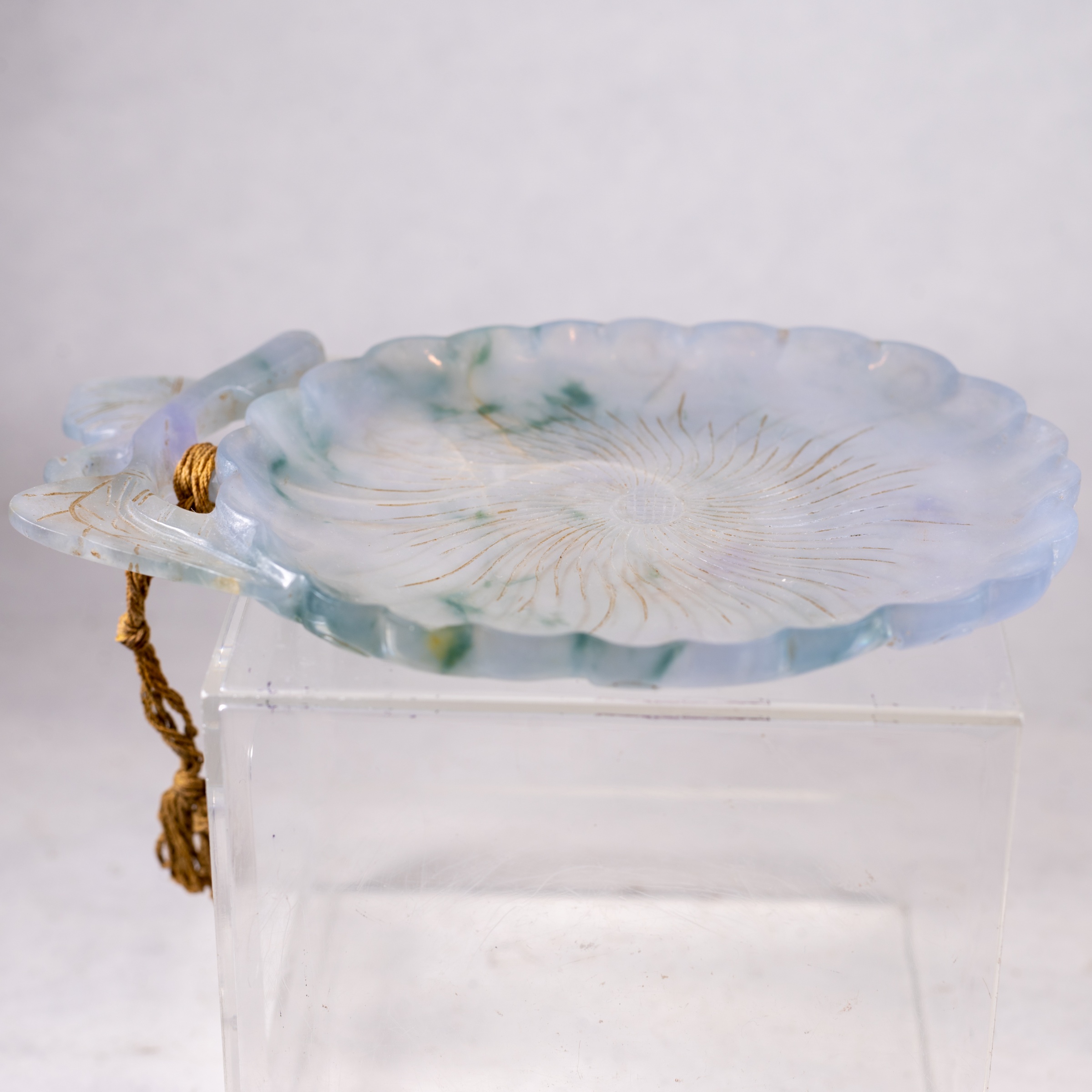
Scholar's objects. The desk of a Chinese scholar was furnished in jade: brush washers in the form of a lotus leaf or a flower, brush pots, water droppers, wrist rests, seals, paperweights, table screens, and the thin-walled bowls and dishes in imitation of the Mughal jades the Qianlong emperor collected from India. These are objects of taste rather than rank, and the best of them are the most refined jades of all.
What to look for: walls thin enough to pass light, a sign of the Mughal influence and of a confident workshop; naturalistic carving of veins, petals and curling leaf edges; and in jadeite, the mottling of lavender, white and apple green that the trade calls 'spring colours'. What raises value: thinness, translucency, an unflawed stone, and a form that sits squarely in the eighteenth- or nineteenth-century repertoire. What lowers it: thick clumsy walls, a stone chosen for colour but carved without finesse, and, in jadeite, any doubt about treatment.
Pendants, toggles and rebuses. Most jade that has come down in families is small and was worn: pendants hung from a belt or a sash, toggles that held a purse, archer's thumb rings, hair pins. Nearly every one is a pun. A fish on a chime reads as 'auspicious abundance' because the words sound alike; a bat and a peach are happiness and long life; a cicada is rebirth; a boy on a lotus leaf is a wish for sons; a double gourd is fertility. Reading the rebus is part of valuing the piece, because some are commoner than others and some were palace favourites.
What to look for: the quality and evenness of the stone, which on a small piece is everything; the suspension hole, which on an old pendant is worn smooth and often slightly oval; and openwork that is undercut rather than merely pierced. What raises value: white 'mutton-fat' stone, an eighteenth-century date, and a design that is both rare and refined. What lowers it: the generic quality of the thousands of modern pendants carved in the same subjects, which is why a photograph of the stone against the light and the holes close up matters more here than anywhere.
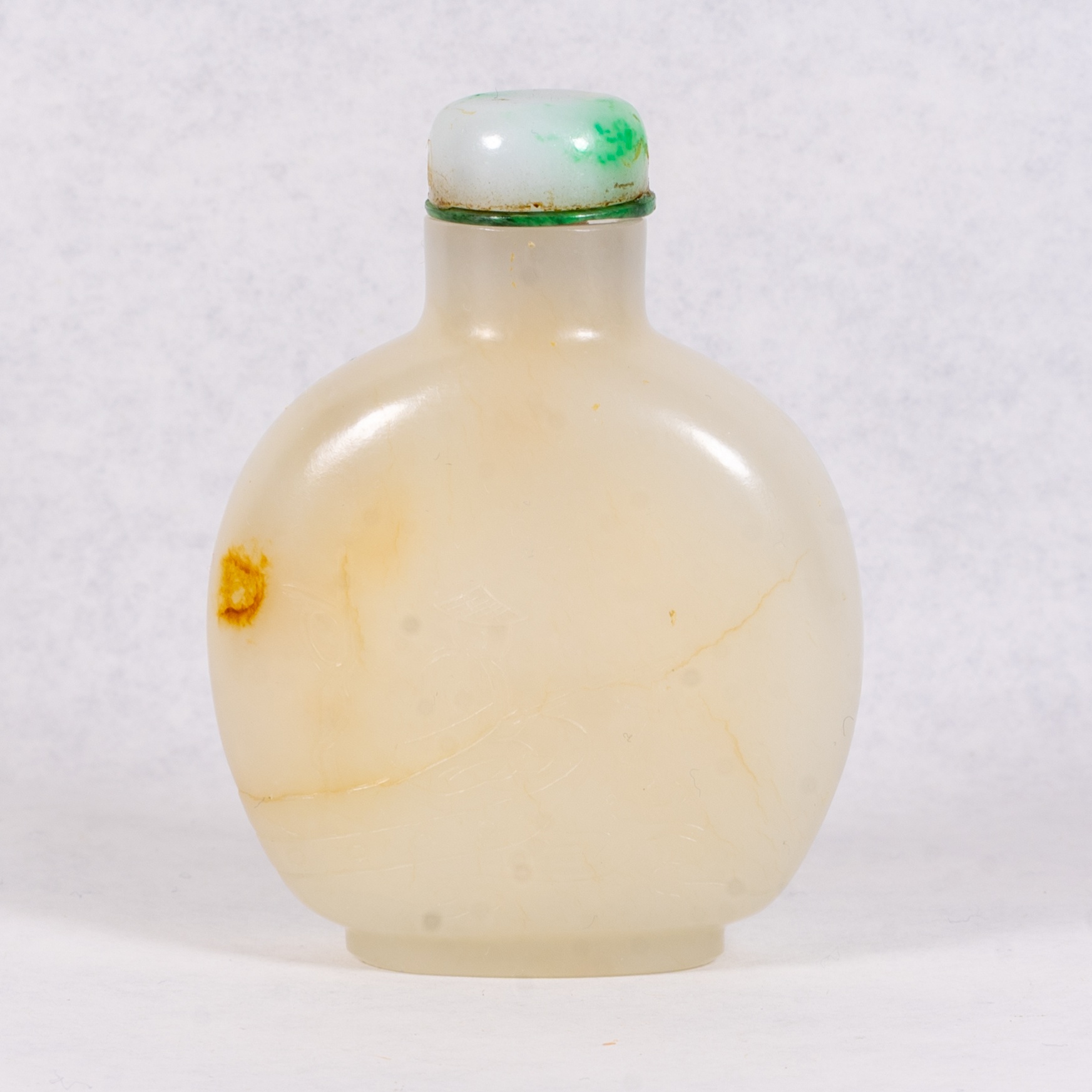
Snuff bottles. Tobacco reached China in the seventeenth century and snuff became a court habit under the Kangxi emperor; the bottle to carry it in became, over the next two hundred years, the most intensely collected small object in Chinese art. Jade bottles were hollowed from pebbles and small boulders, often leaving the russet skin as a landscape or a fisherman, and the finest, from the Suzhou workshops, carve a whole scene in low relief so that the skin becomes the picture.
What to look for: the hollowing, which on a good bottle is extensive and even, judged by holding it to the light and by weight; a well-fitting stopper, ideally the original, with its spoon; a foot ring; and the use of the skin. What raises value: a Suzhou-school scene, fine white or 'mutton-fat' stone, an eighteenth-century date, and completeness. What lowers it: a replaced or ill-fitting stopper, a chipped lip, a solid or barely hollowed body, which usually means a later decorative piece, and the plain pebble bottles made in quantity for the export trade.
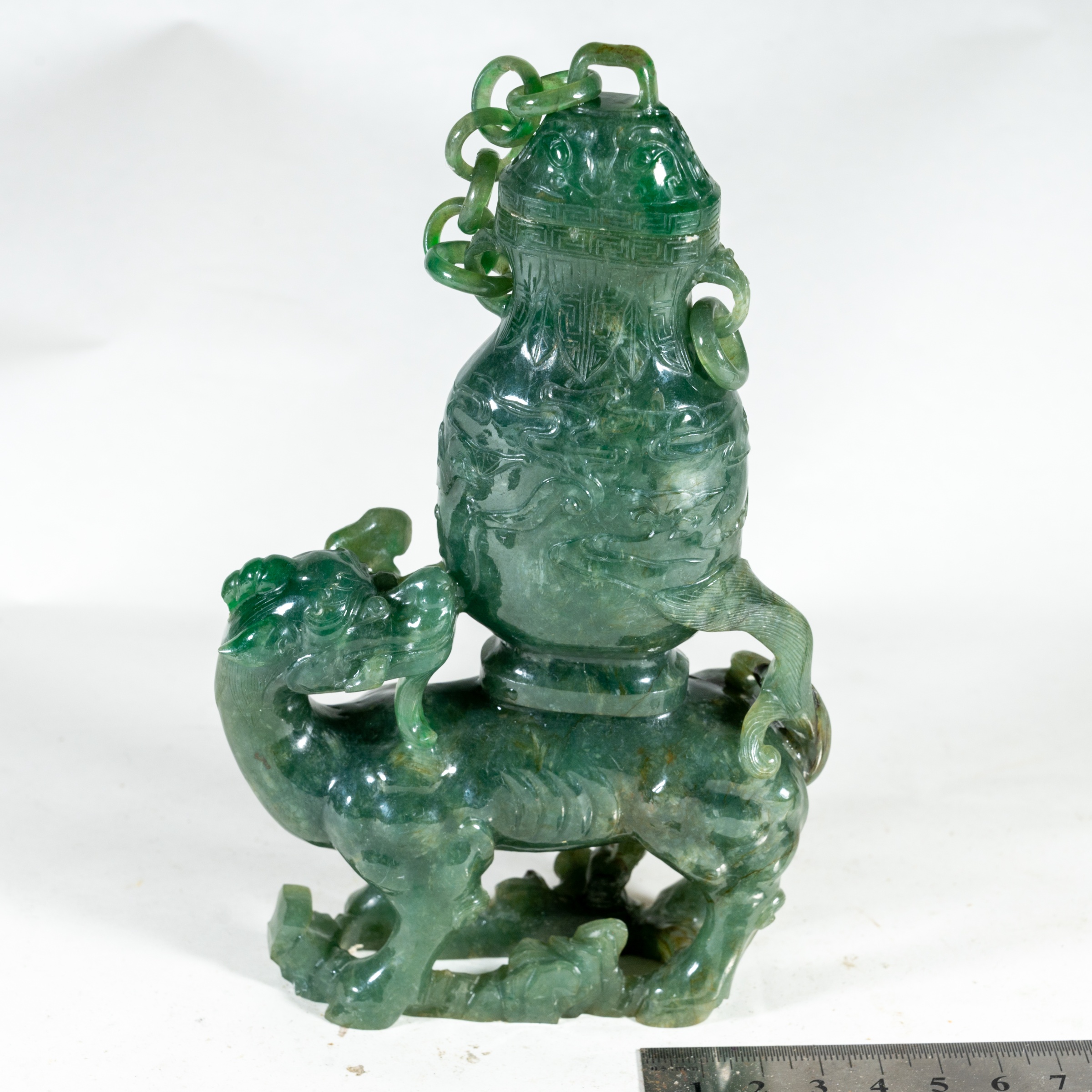
Jadeite, the other jade. Jadeite came to China from the mines of northern Burma in quantity only in the eighteenth century, so almost everything carved from it is late Qing or later, and that is no bar to value. Its colours are what the nephrite carver never had: emerald 'imperial' green, lavender, ice-white, and the mottled 'spring colours' of a single stone. Most of the money in jadeite is in jewellery, bangles, cabochons and bead necklaces, where the finest green with high translucency reaches prices that only diamonds otherwise command; the carvings, vases on beasts with chains of linked rings cut from the solid, washers and figures, are a separate and more modest market.
What to look for: colour and translucency first; then the glassy lustre and the fine granular texture under magnification that separate jadeite from nephrite and from dyed quartz; and then treatment, which cannot be seen. What raises value: natural, untreated 'Type A' stone confirmed by a laboratory report, even colour, and in carvings the technical feat of chains and loose rings. What lowers it, drastically: bleaching and polymer filling (Type B) and dye (Type C), which turn a fine-looking bangle into a costume piece. For any jadeite of value the certificate is the first thing a buyer asks for.
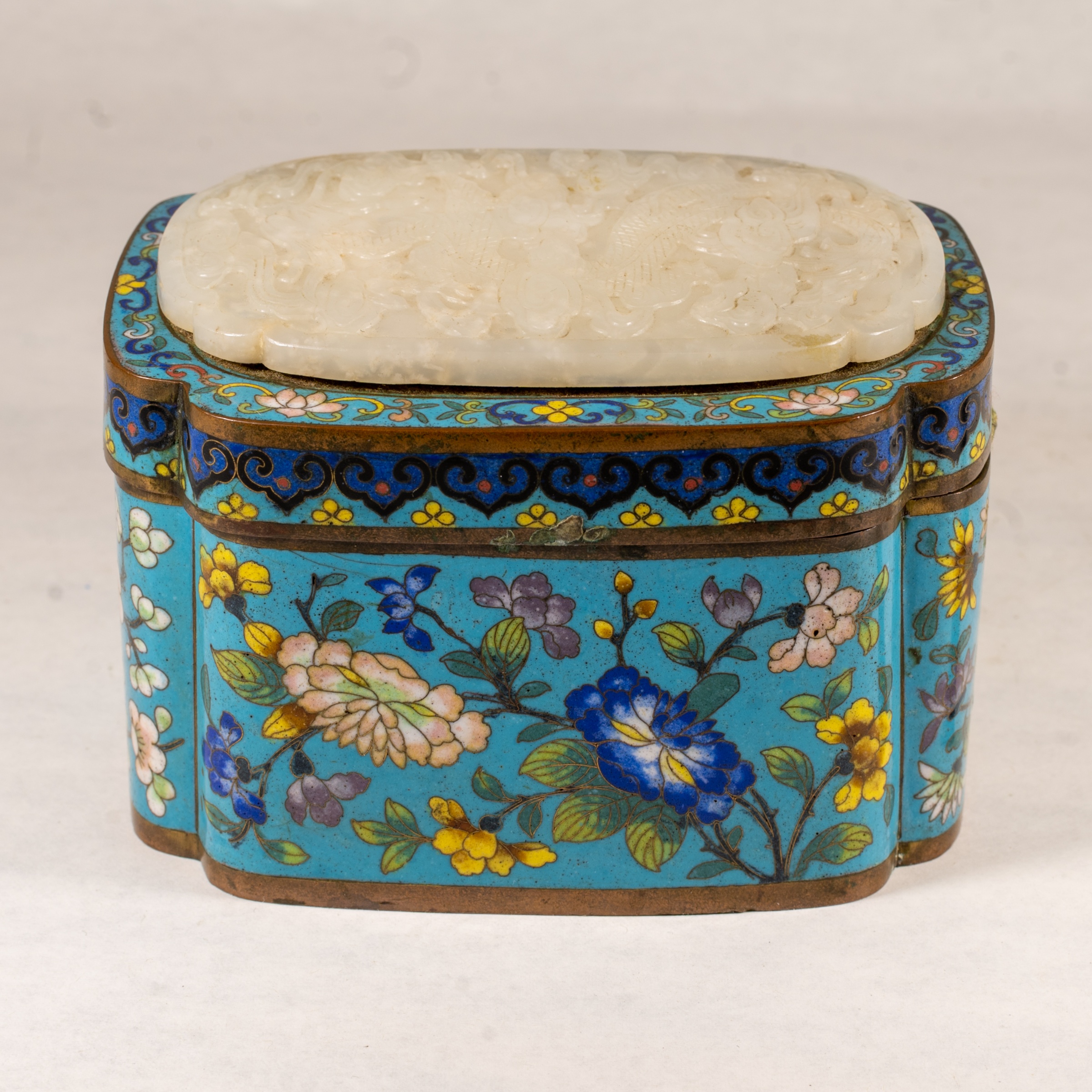
Jade set in other materials. From the eighteenth century, and in great numbers in the nineteenth, white jade plaques, often re-used from earlier belts and pendants, were set into the covers of cloisonné enamel boxes, gilt-bronze and tortoiseshell caskets, lacquer screens, hardwood brush pots and the tops of walking sticks. Chinese export silver was mounted with jadeite and other hardstones for the Western market. These are composite objects, and they are valued as the whole rather than as the jade.
What to look for: whether the plaque is older than its setting, which is common and adds interest; the condition of the enamel, gilding or lacquer around it, which usually decides the price; and whether the setting was made for the plaque or the plaque cut down to fit. What raises value: a fine plaque in a fine setting, both of the period, in good condition inside and out. What lowers it: pitted or restored enamel, worn gilding, a plaque that is loose or replaced, and the twentieth-century reproductions of the whole type that are made to this day.
Modern jades and reproductions. Carving in nephrite and jadeite never stopped, and a well-made modern pendant or vase in good stone is an honest object with a decorative market of its own; so are the greenstone carvings of New Zealand and the Canadian nephrite of the last century. The trouble begins with the industry that makes new jades look old. Pale stone is dyed brown to imitate the russet skin of a river pebble; it is heated and quenched so that a crackle network takes the dye and imitates the calcified surface of a burial jade; it is etched in acid to soften the tooling; and it is carved with a diamond burr in the shapes of Han discs, Liangzhu cong and Qing animals.
What to look for: colour that sits in cracks and recesses rather than in the body of the stone; a uniform crackle across the whole surface, which a real burial never produces; uniform parallel tool scoring and perfectly cylindrical drill holes; a glassy, even modern polish; and a 'soapy' or 'sugary' surface from acid or heat. What raises value in a modern piece: genuine nephrite or jadeite, good colour, and carving of real quality sold as what it is. What destroys it: the antique price it was bought at.
Comparisons: the same form, different dates and prices
The fastest way to learn jade is to put pieces of the same form side by side. The four comparisons below do that with objects from the examples on this page: two belt plaques, bi discs across four thousand years, hollowed vessels from the late Ming to the Republic, and jadeite from a chained vase to a decorative beast. In every case the shape is the same and the price is not, and the right-hand column says what separates them. Every piece is in the examples below with its full report.
| Piece | Attribution | What separates it | Estimate |
|---|---|---|---|
| White jade 'dragon' belt plaque | Ming dynasty | An even, unctuous white stone of the 'mutton-fat' grade; a five-clawed dragon in two layers of fluent openwork over a pierced cloud ground; excellent condition. Stone quality is the first thing a specialist judges on a plaque, and this is the top of it | £25,000 – £40,000 |
| Reticulated pale celadon-white jade 'dragon' belt plaque | Yuan to early Ming dynasty | A well-carved dragon in pierced openwork with ruyi clouds and period tool marks, but in a greyer, less even celadon-white stone and with a less certain date. Same form, same subject, lesser stone: the gap is the material | £4,000 – £6,000 |
| Piece | Attribution | What separates it | Estimate |
|---|---|---|---|
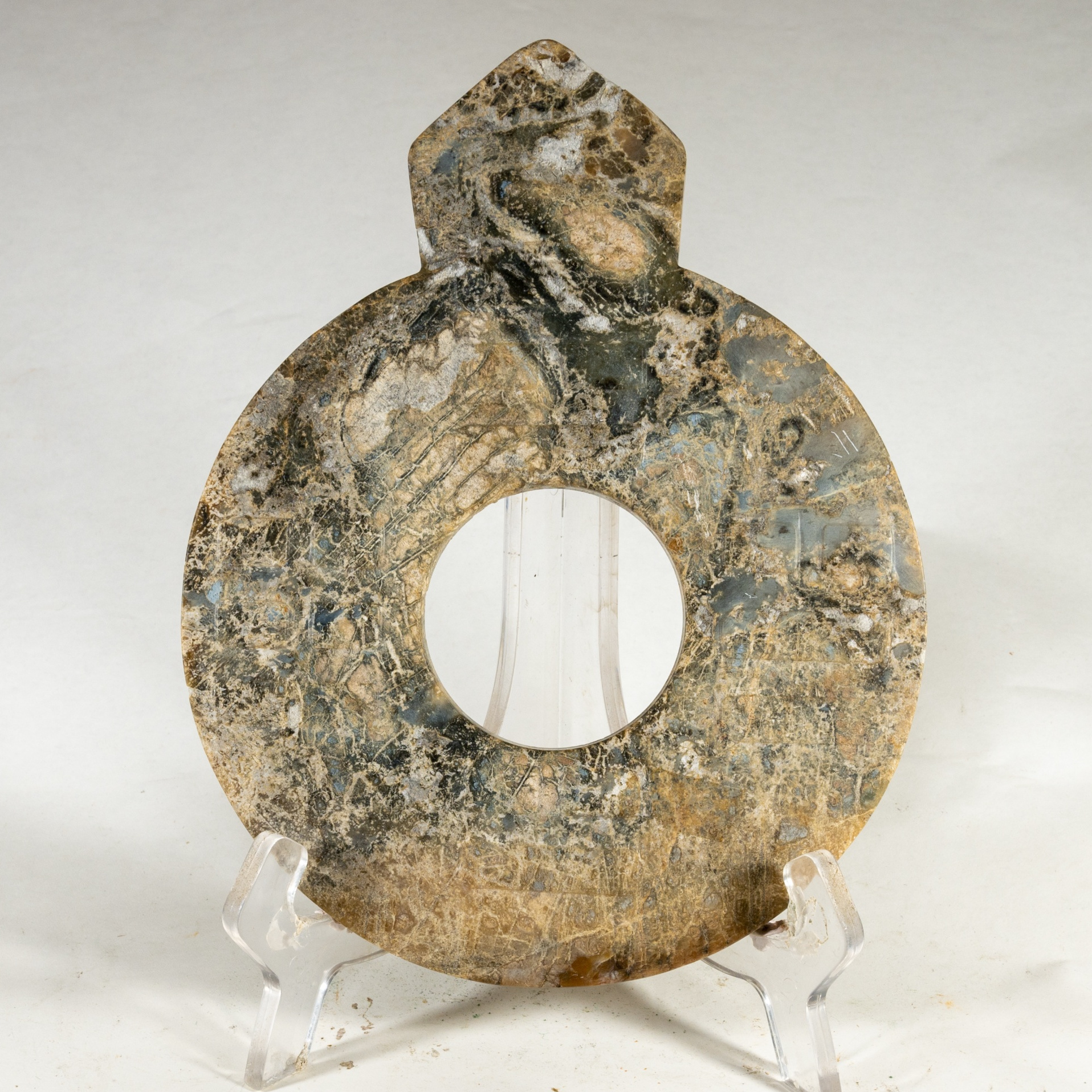
| Crested 'gui-bi' disc with three associated rings | Attributed to the Neolithic, Liangzhu or Qijia culture; a Ming parallel exists for the shape | Heavy calcification and burial colour across the whole surface; the crested form is known in archaic contexts but also in a Ming example, so the attribution rests on style and needs provenance to be secure | $10,000 – $15,000 |
| White jade bi with chilong dragons | Qing dynasty, 18th–19th century | Fine even white nephrite; archaistic dragons carved in confident high relief with hand-abraded tool marks and a soft handling patina | £3,000 – £5,000 |
| Large incised bi in the Western Han style | 20th century | Dramatic dark staining on both faces that reads as burial but is uniform and artificial; a glossy modern polish; carving that copies Han motifs stiffly | $400 – $600 |
| Han-style bi with four chilong | Assessed as a modern decorative reproduction | Artificial ageing, mottled beige stone, incised scrollwork with uniform tooling | $100 – $300 |
| Piece | Attribution | What separates it | Estimate |
|---|---|---|---|
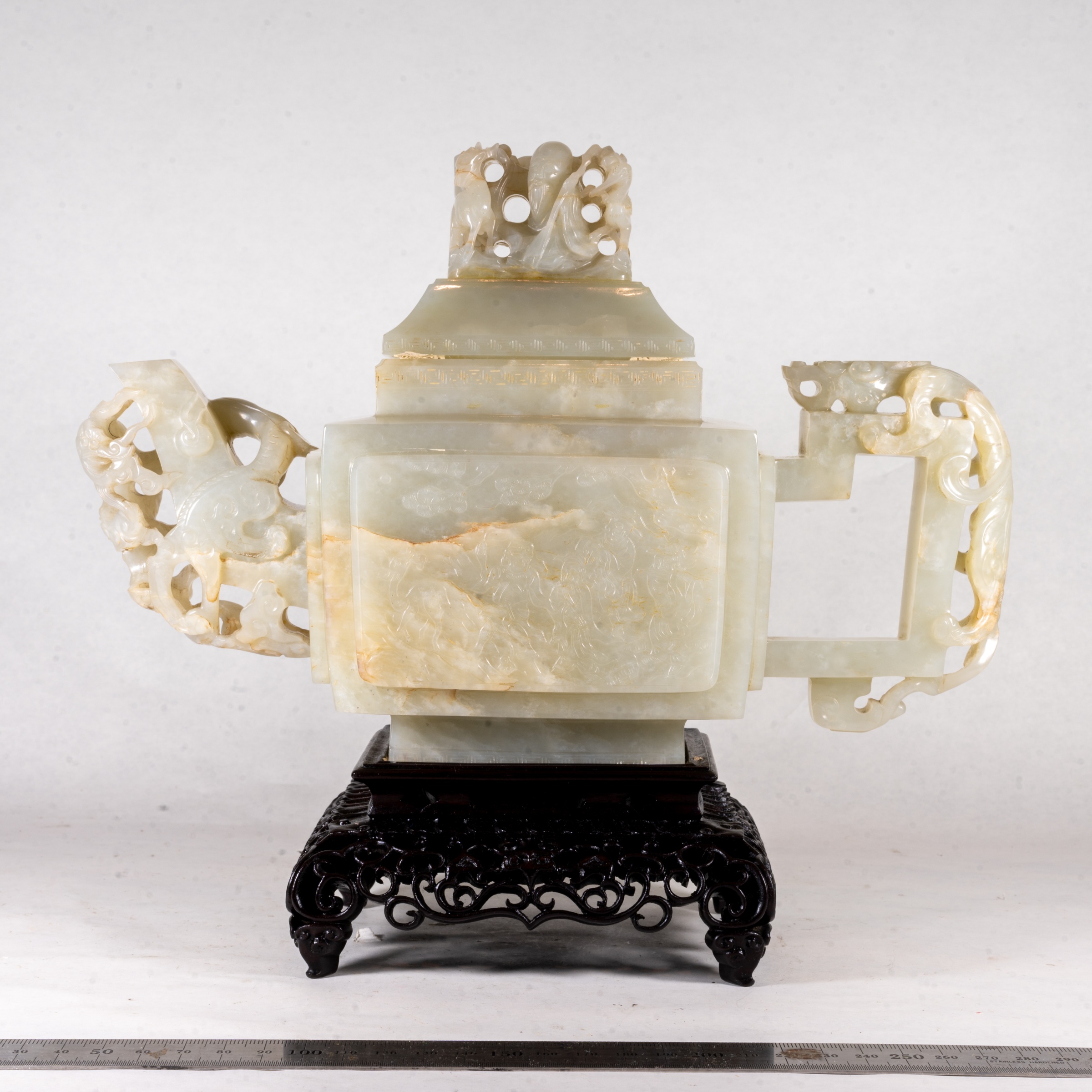
| Large 'Eight Immortals' rectangular teapot and cover | Probably late Ming | Scale, fully reticulated chilong spout and handle, relief panels of figures, and a previous sale at a major London Asian-art auction; the figure depends entirely on the Ming attribution holding | $50,000 – $70,000 |
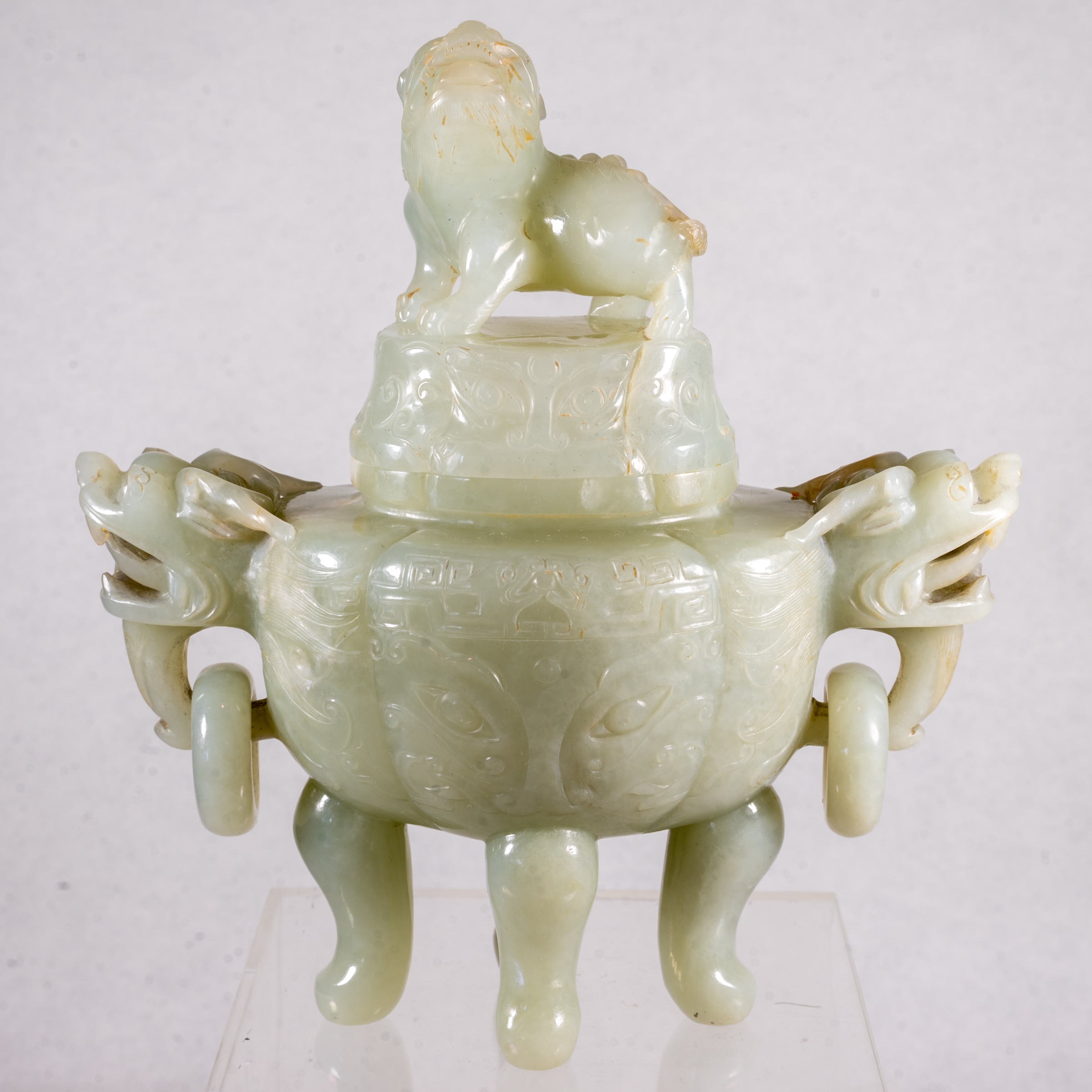
| Archaistic tripod censer and cover with loose rings | Late Qing to Republic | Classic taotie form carved from one block with dragon-head handles and free-moving rings; good stone, later date | $8,000 – $12,000 |
| Chilong cup, pale celadon | Late Ming to early Qing, 17th century | Deeply undercut pierced handles, thin walls, period tool wear in the recesses, excellent original condition | £7,000 – £12,000 |
| Archaistic pouring vessel, yi | Late Ming to early Qing | A rarer bronze-derived form; russet fissures penetrating the stone naturally | £4,000 – £7,000 |
| Archaistic gu beaker vase | Late Qing to Republic | A common form carved competently in good celadon stone, a century or two later than the cups above | £2,500 – £4,500 |
| Single-handled chilong cup | Qianlong period, 18th century | The right date and a fine white stone, but a structural crack through the body | £2,500 – £4,000 |
| Octagonal two-handled cup, mottled grey and white | 17th century | Rare octagonal form in excellent condition, but a greyer, less valued stone | £2,000 – £3,000 |
| Piece | Attribution | What separates it | Estimate |
|---|---|---|---|
| Vase and cover in zun form on a bixie, with a carved chain | 20th century | Deep even spinach-green stone and the technical feat of a chain, cover and vase cut from one piece; the figure assumes natural, untreated stone | $8,000 – $12,000 |
| Lotus-leaf brush washer | Late Qing to Republic | Naturalistic carving in mottled green and white jadeite; a classic scholar's form | $2,000 – $4,000 |
| Floriform dish in 'spring colours' jadeite | Late Qing to Republic | Lavender, white and apple-green zoning in a thin-walled Mughal-influenced form | $1,000 – $1,500 |
| Tri-colour mythical beast | Likely a modern reproduction | Jadeite-style stone whose colour zoning and glossy finish point to decorative manufacture | $200 – $400 |
Reference: types and what they typically run
| Type | Period | Typical price range |
|---|---|---|
| Neolithic bi, cong and pendants (Liangzhu, Hongshan), with provenance | c. 3500 – 2000 BCE | $5,000 – $500,000+ |
| Shang and Zhou pendants, blades and plaques | c. 1600 – 256 BCE | $2,000 – $200,000+ |
| Han bi discs, chilong pendants, sword fittings | 206 BCE – 220 CE | $3,000 – $300,000+ |
| Song to Ming archaistic cups, vessels and animals | 960 – 1644 | $2,000 – $100,000+ |
| Ming openwork dragon belt plaques | 1368 – 1644 | $2,000 – $60,000+ |
| Qianlong-period white jade, palace-workshop quality | 1736 – 1795 | $10,000 – $1,000,000+ |
| Qing white jade pendants, toggles, plaques | 1644 – 1911 | $300 – $20,000 |
| Qing libation cups, censers and vases | 1644 – 1911 | $1,500 – $50,000+ |
| Jade mountains (shanzi) and large boulder carvings | 1736 – 1911 | $10,000 – $500,000+ |
| Spinach-green and Mughal-style thin-walled jade | 1750 – 1900 | $2,000 – $100,000+ |
| Jade and hardstone snuff bottles | 1750 – 1920 | $300 – $50,000+ |
| Cloisonné, gilt-bronze and lacquer objects inset with jade | 1800 – 1920 | $500 – $5,000 |
| Late Qing and Republic jadeite carvings (washers, vases, figures) | 1880 – 1950 | $500 – $20,000 |
| Natural 'Type A' jadeite jewellery, imperial green and lavender | 1900 – present | $2,000 – $1,000,000+ |
| Treated 'Type B / C' jadeite jewellery | 1980 – present | $20 – $500 |
| New Zealand pounamu and other nephrite carvings | 1900 – present | $100 – $5,000 |
| Modern Hetian-style nephrite pendants and carvings | 1980 – present | $50 – $1,000 |
| Modern archaistic reproductions, stained and 'antiqued' | 1980 – present | $20 – $300 |
| Serpentine, bowenite, quartzite and glass sold as jade | any | $10 – $300 |
Practical things to think about
Jade is the most durable thing on this site and the easiest to damage with good intentions, because what the market pays for is the surface, and the surface is the one part a well-meaning owner is tempted to improve.
Do not re-polish. The soft patina of two centuries of handling, the slightly irregular tool marks in the recesses and even the dull patches are the evidence that dates the piece and the thing a specialist looks for first. A jade that has been buffed to a modern shine has lost its history and, usually, half its value. Do not try to clean off a brown skin or a dark inclusion: on a genuine piece it is the stone's own colour and the carver chose to keep it. Warm water and a soft brush are the only cleaning a jade ever needs. Never use bleach, acids, ultrasonic cleaners or heat; treated jadeite in particular can cloud or crack.
Handle it as though it were glass. Nephrite is tougher than steel in the sense that it resists breaking, which is why it could be made into axes, but jadeite is brittle and both chip at thin openwork edges. Reticulated plaques, chain-linked covers and the pine needles on a mountain are the parts that break. Store jades separately, wrapped, because jade scratches almost everything else and a jadeite bangle will scratch a nephrite cup.
Keep the stand. The carved hardwood stands that came with Qing jades were often made for the piece, are frequently of the period, and are part of the value; a jade with its original stand sells better than the same jade without. Keep every label, auction ticket and collection number too, especially anything stuck to the base: in Chinese art a traceable previous sale or a known collection is worth real money, and it travels with the paperwork, not with the stone.
For jadeite jewellery, get the certificate before you sell, not after. The laboratories in Hong Kong and the major gemmological institutes test for bleaching, polymer and dye, and a 'Type A' report is the difference between a piece a saleroom will take and one it will not. For insurance, schedule anything over a few thousand individually, with photographs against a scale and through the light.
Upload photographs of your jade, every side in daylight, the base, the skin and the light through it, and we'll send back a documented valuation with the comparable sales we used: lot, price and venue, drawn from Christie's, Sotheby's and Bonhams in Hong Kong, London and New York, the specialist Asian-art sales, and the dealers who handle most of this market. The report says what the stone is, which period and quality it is consistent with, how confident that is, what condition and provenance are doing to the figure, and which physical tests remain before a sale. We don't buy and we don't take consignment. Your first valuation is on us.
Reviewed by The Findthevalueof research team. Last reviewed 7 Oct 2026.
Common questions
How can I tell whether my jade is real?
- Start with what 'real' means: nephrite and jadeite are both jade, and most of what is sold under the name is neither. Real jade feels cold and dense, heavier than it looks, and warms slowly in the hand. It has a waxy (nephrite) or glassy (jadeite) lustre, not the soapy feel of serpentine or the granular sparkle of quartzite, and it will not be scratched by a steel blade, though please do not test that on a carved surface. Glass shows bubbles and a shell-shaped chip. Held against the light, nephrite shows a fibrous, felted structure and jadeite a fine granular one; dyed stones show colour concentrated in cracks. None of this is conclusive. A refractive-index or specific-gravity test takes a jeweller minutes and settles the question, and until it has been done the honest description is 'hardstone'.
What is the difference between nephrite and jadeite?
- Different minerals that share a name. Nephrite is a calcium-magnesium silicate, an interlocked mass of amphibole fibres that makes it the toughest common stone on earth; it is the jade of Chinese history, from Khotan and later from British Columbia, Siberia and New Zealand, in white, celadon, spinach green, grey and black, with a waxy lustre. Jadeite is a sodium-aluminium silicate, a pyroxene, harder but more brittle, more translucent, from Burma, and it is the jade of emerald-green bangles and lavender pendants. It reached China in quantity only in the eighteenth century, so a jadeite carving is rarely earlier than the late Qing. The two are valued on different scales: nephrite on period, carving and provenance, jadeite on colour, translucency and whether it has been treated.
Which colours of jade are the most valuable?
- In nephrite, an even, unflawed white with a warm, greasy lustre, the 'mutton-fat' of the connoisseurs, has been the most prized colour for a thousand years, followed by pale celadon, yellow, which is rare, and the deep spinach green favoured for Mughal-style vessels. Grey, mottled and dark stones are the least valued, unless a carver has used the mottling with wit. A natural russet skin, used in the design, adds rather than subtracts. In jadeite the order is different: a vivid, even 'imperial' green with high translucency first, then fine lavender and ice-white, then the mottled 'spring colours'. In both stones evenness matters as much as hue: a small flawless piece outprices a large blotchy one.
Is 'archaistic' the same as 'archaic'?
- No, and the difference can be a hundredfold. 'Archaic' means from antiquity: Neolithic, Shang, Zhou, Han. 'Archaistic' means made in the ancient manner at a later date, and the Chinese have done that deliberately and respectfully since the Song dynasty a thousand years ago. A Ming scholar's bi disc with clambering chilong is an archaistic antique; a Qianlong workshop cup copying a Shang bronze is an archaistic masterpiece; a 1990s export disc stained to look excavated is an archaistic reproduction. Each is a different price, and a reputable description says which century it believes the manner was adopted in, with 'possibly' where the evidence runs out. A genuine archaic date usually needs a provenance or an excavation record behind it.
What do 'Hetian' and 'mutton-fat' mean?
- Hetian is the modern name of Khotan, the oasis on the southern Silk Road whose rivers supplied China's nephrite for three thousand years, so 'Hetian jade' properly means river nephrite from that region, prized for its even texture and the russet skin on the pebbles. 'Mutton-fat' (yangzhi) is the top grade of it: an opaque, unctuous, slightly warm white with no grey or green cast and no flaws. Both terms now appear on every online listing for any pale stone, so treat them as a claim to be tested rather than a description, and expect a genuine example to be small, expensive and accompanied by some history.
What is Type A, Type B and Type C jadeite?
- The treatment grades the jadeite trade adopted after the 1980s, when Hong Kong workshops began bleaching poor stone in acid and filling it with polymer resin to make it look like fine green jade. Type A is natural, untreated jadeite, possibly with a traditional wax polish. Type B has been bleached and impregnated with resin, which clouds and yellows over the years. Type C has been dyed, and B+C both. The differences are invisible to the eye and dramatic in price, so a laboratory report from a recognised gemmological institute is now expected for any jadeite of value, and any valuation of untested jadeite is conditional on the stone being Type A.
Why do two similar jade carvings have such different prices?
- Because the market for Chinese jade is the most stratified of any collecting field. Take two Ming openwork belt plaques of the same size and subject: one in even white stone with three layers of fluent undercutting and a traceable history will fetch ten times the other, in mottled stone with simpler carving and no past. Add venue, and the gap widens again: the same piece sold at a major Hong Kong or London Asian-art sale, catalogued by a specialist and seen by the mainland buyers, against a generalist country auction where it is 'a jade plaque'. Quality of stone, quality of carving, confidence of the attribution, provenance and the room it is sold in: a valuation has to say where your piece sits on each of those, and why.
Can a jade be dated from photographs?
- Partly, and an honest report says which part. Style, form, the vocabulary of decoration and the way a russet skin has been used all place a piece in a period of taste. Close photographs of tool marks and drill holes separate hand-abraded work from modern rotary tools, and a soft handling patina from a modern polish. What photographs cannot do is prove the stone's identity, detect treatment in jadeite, or always distinguish a fine Qing archaistic piece from the Ming or Han original it imitates. A good valuation gives a range where two dates remain possible, states its confidence, and lists the checks that need the stone in hand.
Does the brown colour on my jade add value or mean damage?
- It depends on whether the stone grew it or someone applied it. Khotan river pebbles have a natural russet rind, and from the Song dynasty onwards carvers prized it, planning the design so that the brown became a horse's mane, a leaf, a dragon or a lychee. That 'clever colour' carving (qiaose) is a mark of quality and adds to the price. Brown that sits in cracks, pools in the recesses, stops at a sharp line or covers a stone uniformly is stain, usually driven in with heat, and it is the commonest sign of a reproduction. Genuine burial alteration, the chalky 'chicken-bone' white and the earthy brown of a jade that has been in a tomb, follows the natural fissures of the stone rather than the whole surface.
Do I need a certificate to sell jade?
- For jadeite jewellery, yes in practice: the major salerooms will not catalogue an untested bangle or cabochon as natural, and buyers pay accordingly. For nephrite carvings there is no laboratory test for age, so what stands in for a certificate is history: a previous auction appearance, a collection label, a dealer's invoice, a museum loan, an old photograph. A nineteenth-century collection number stuck to the base can be worth more than the stand it is stuck to. Keep every piece of paper, and photograph anything on the base before it falls off.
What does the hardwood stand tell you?
- Often a great deal. Qing jades were supplied with carved hardwood stands made to fit, in zitan, huanghuali or hongmu, and a stand that fits a piece exactly, with wear in the right places, is evidence that the two have been together a long time. A fine stand is also valuable in itself. A stand that does not quite fit, or that is of modern soft wood with a glossy finish, tells you the piece has been re-mounted, which is not damning but removes one line of evidence. Never throw a stand away, however broken; and if a jade arrives without one, do not have a new one made before it is valued.
Where is the best place to sell jade?
- By tier. Fine Qing and earlier jades, and good jadeite, do best in the dedicated Chinese works of art sales at Christie's, Sotheby's and Bonhams in Hong Kong, London and New York, which cluster around Asian Art in London in November and Asia Week New York in March, and draw the mainland buyers who set the prices. Below that, the Asian-art departments of the specialist regional houses and the specialist dealers reach the right buyers at lower cost. Modern and reproduction jades sell on online marketplaces for what they are. What goes wrong is the reverse: a genuine Ming plaque in a generalist sale catalogued as 'a jade plaque', or a stained pebble on a marketplace catalogued as Han.
Are modern 'antique-style' jades worth anything?
- Yes, as what they are. A well-carved modern nephrite pendant is a decorative object with an honest market in the tens to low hundreds of pounds, a large modern archaistic vase in good stone can fetch more, and the greenstone of New Zealand and the nephrite of British Columbia have collectors of their own. What a modern piece is not worth is the antique price it was sold at, and the point of a valuation is to find that out before paying for a stand, a case or an auction consignment that will not cover its commission.
What photographs should I send?
- Every side in daylight with the piece off its stand, the base, the skin and any brown areas close up, any damage or re-polished patches, and one shot with the light coming through the stone. Put a ruler or a coin beside it and tell us the weight. Photograph the stand separately, and any label, ticket, certificate or collection number. If it is jadeite jewellery, say whether it has ever been tested. The more of the stone we can see, the shorter the list of checks that remain.
Worked examples in this category
- A Rare and Large Pale Celadon Jade 'Eight Immortals' Rectangular Teapot and Cover, probably Late Ming Dynasty
- A Chinese White Jade 'Dragon' Belt Plaque, Ming Dynasty
- A Chinese Carved Pale Celadon and Russet Jade 'Penglai' Mountain Boulder (Shanzi), Qing Dynasty, 19th Century
- An Important Chinese Archaic Calcified Jade Crested 'Gui-Bi' Disc, Attributed to the Neolithic Period, Liangzhu or Qijia Culture, circa 3300-2000 BC, with Three Associated Jade Rings
- A Fine Chinese Archaistic Pale Celadon Jade 'Chilong' Cup, Late Ming to Early Qing Dynasty, 17th Century
- Chinese Pale Celadon Nephrite Jade Archaistic Tripod Censer and Cover, Late Qing Dynasty to Republic Period
- Chinese Carved Jadeite Ornamental Vase and Cover (Zun) on a Mythical Beast (Bixie) Stand, 20th Century
- A Chinese Archaistic Pale Celadon Jade Pouring Vessel, Yi, Late Ming to Early Qing Dynasty, 17th/18th Century
- A Rare Carved and Reticulated Pale Celadon-White Jade 'Dragon' Belt Plaque, Yuan to Early Ming Dynasty, 14th-16th Century
- A Chinese Carved White Jade 'Chilong' Bi Disc, Qing Dynasty, 18th/19th Century
- A Chinese Pale Celadon and Russet Jade Carving of a Recumbent Beast
- A Chinese Archaistic Celadon Jade Gu-Form Beaker Vase (Fanggu), Late Qing Dynasty to Republic Period
- A Chinese Spinach-Green Jade 'Mughal-Style' Incense Tool Vase
- A Chinese Carved Pale Celadon Nephrite Jade Covered Vase, 19th/20th Century
- A Chinese Mottled Grey and White Nephrite Jade Archaistic Octagonal Two-Handled Cup, 17th Century
- A Chinese Carved Jadeite 'Lotus Leaf' Brush Washer (Bixi), Late Qing Dynasty to Republic Period, 19th-Early 20th Century
- A Chinese White Jade Single-Handled 'Chilong' Cup, Qing Dynasty, Qianlong Period (1736-1795)
- A Chinese Quatrefoil Cloisonné Enamel and Carved White Jade Inset Box and Cover, Late Qing Dynasty, 19th Century
- A Finely Carved White Jade 'Boy and Lotus' Pendant, Qing Dynasty, 18th Century
- A Finely Carved Pale Celadon and White Nephrite Jade 'Buddha's Hand' Citron Group, Qing Dynasty, 18th/19th Century
- A Carved 'Chun Dai Cai' Jadeite Floriform Dish
- A Carved Pale Green and Russet Jade 'Fisherman' Snuff Bottle
- A Chinese Pale Celadon Jade Figure of a Maiden Seated on a Garden Stool, Late Qing Dynasty to Republic Period, 19th/Early 20th Century
- A Fine Carved White Jade 'Fish' Chime Pendant, 'Ji Qing You Yu', Qing Dynasty, 18th/19th Century
- A Large Chinese Archaistic Incised Jade Bi Disc, in the Western Han Style, 20th Century
- Chinese Tri-Color Jadeite-Style Carving of a Mythical Beast
- Chinese Archaistic Jade 'Chilong' Bi Disc, Han-Style